🔗 Affiliate Disclosure: As an Amazon Associate, Tech Rig Review earns from qualifying purchases. Links on this page may be affiliate links — at no extra cost to you.
Want more screen space for work, coding, or design but only have one video port on your laptop? A simple HDMI splitter usually just mirrors the same image. It does not give you two independent extended displays.
This guide shows practical ways to connect two monitors to a laptop without a splitter. We focus on USB-C docking stations, DisplayLink adapters, and native multi-port options that deliver true extended desktops. Recommendations come from current Amazon listings and patterns in verified buyer feedback. No invented hands-on claims.
You will learn how to check your laptop ports, choose the right dock or adapter, set up the displays in Windows or macOS, and avoid common pitfalls. Pair the setup with a good monitor stand for better ergonomics — see our guide to the best Amazon monitor stands for dual-arm options that free up desk space.
Table of Contents
Why a Splitter Is Not the Right Tool
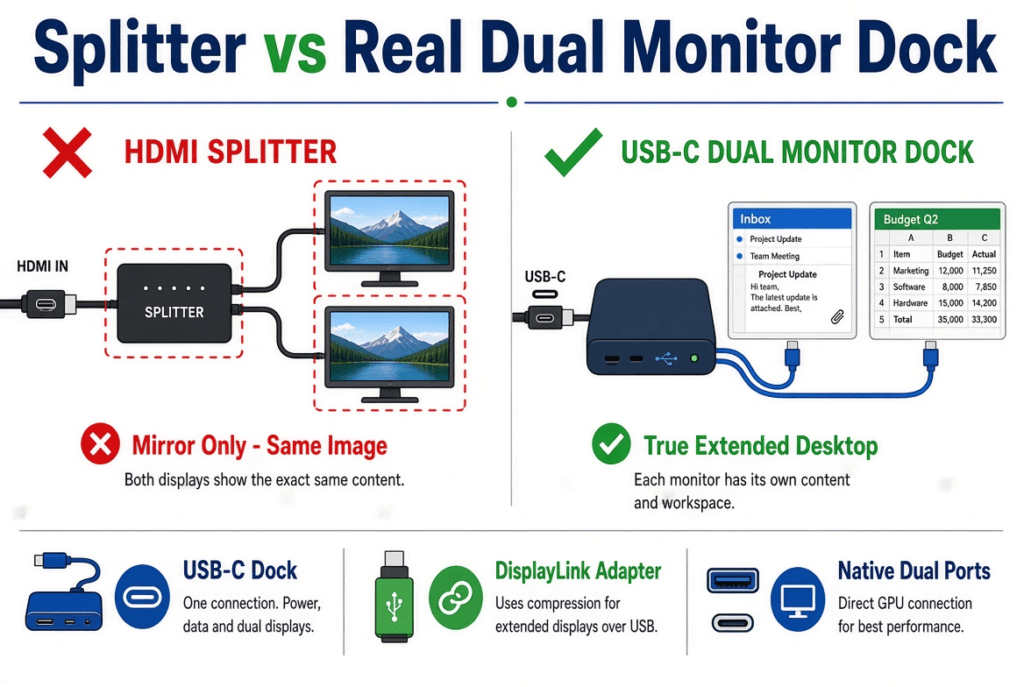
An HDMI splitter takes one signal and duplicates it. Both monitors show the exact same content. For productivity, you need an extended desktop so you can put different windows on each screen.
True dual-monitor support requires either:
- A laptop with two native video outputs (HDMI + USB-C/Thunderbolt, or dual USB-C).
- A USB-C or Thunderbolt docking station that supports dual independent displays.
- A DisplayLink-powered dock or adapter that creates virtual graphics over USB.
Most modern laptops rely on a single USB-C or Thunderbolt port for video. A proper dual-monitor dock turns that one port into two video outputs plus extra ports for charging, Ethernet, and peripherals.
Step-by-Step: How to Connect Two Monitors Without a Splitter
1. Check Your Laptop Ports and Capabilities
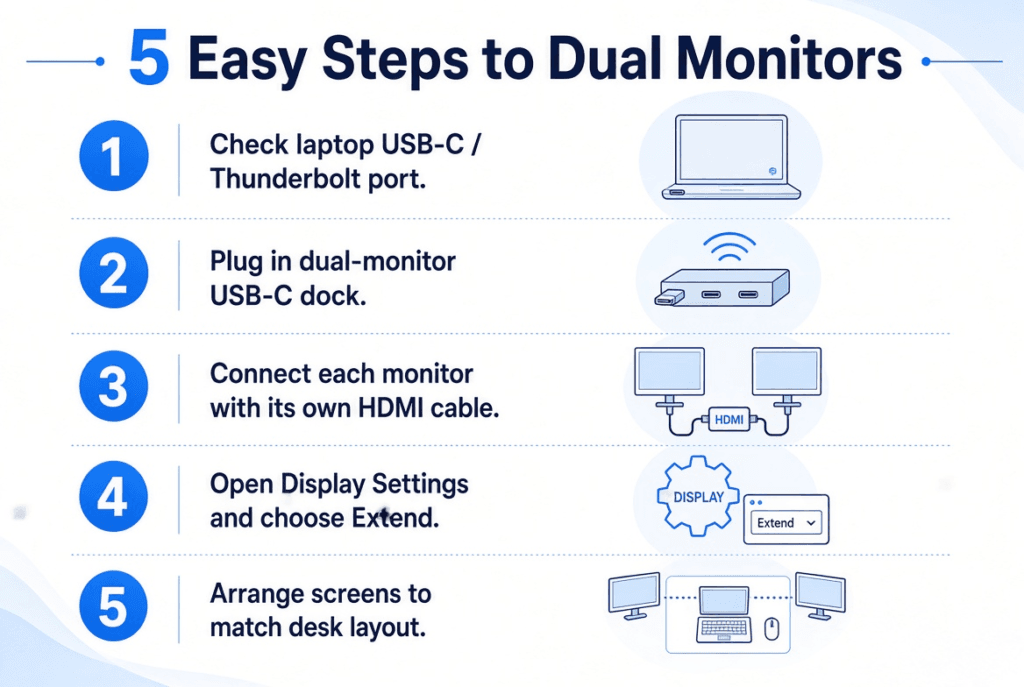
Look for USB-C, Thunderbolt 3/4, or USB4 ports. Confirm the port supports DisplayPort Alt Mode or Thunderbolt (check your laptop manual or manufacturer site). Windows laptops generally handle dual extended displays more flexibly than some Mac models with limited external display support on Apple silicon.
2. Choose the Right Method
- USB-C dual-HDMI dock — simplest for most Windows users.
- DisplayLink dock — works even on systems with limited native video bandwidth and supports Mac extended displays in many cases.
- Native dual ports — if your laptop already has HDMI + USB-C, use two direct cables.
3. Connect the Hardware
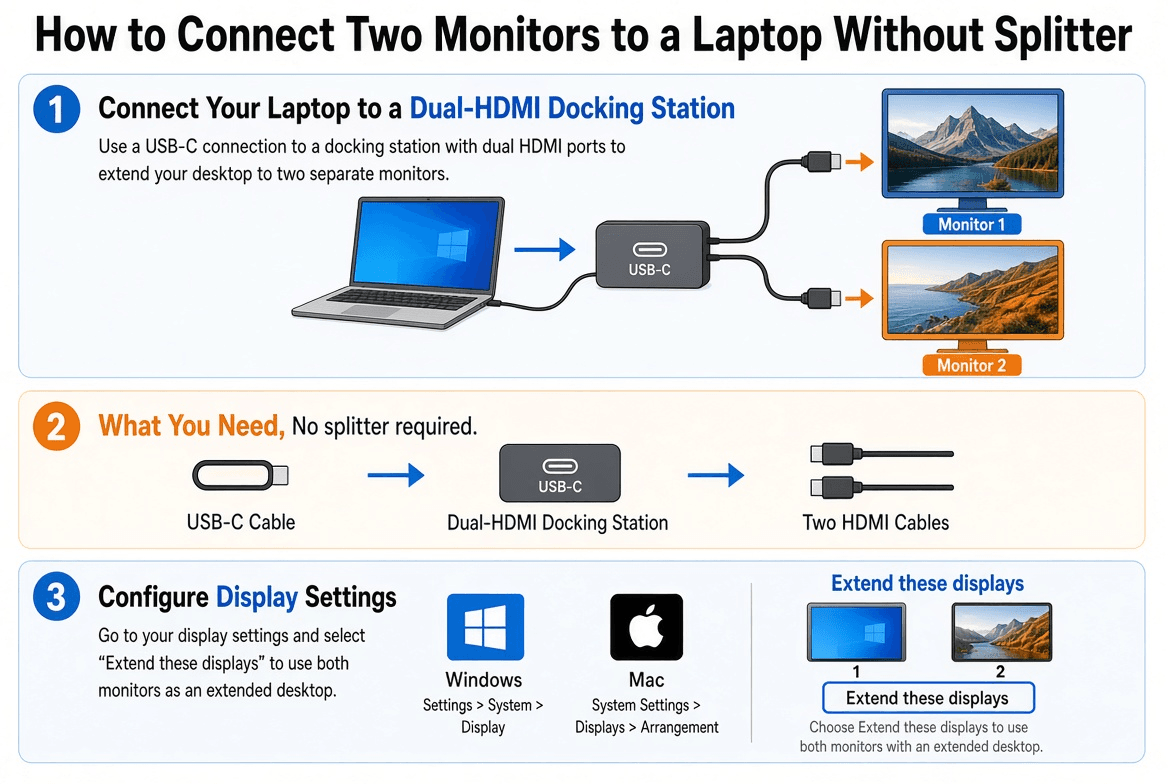
Plug the dock into your laptop’s USB-C/Thunderbolt port. Connect each monitor to a separate video output on the dock (HDMI or DisplayPort). Attach power to the dock if it supports pass-through charging. Connect keyboard, mouse, and Ethernet if needed.
4. Configure the Displays
Windows: Right-click desktop → Display settings → Multiple displays → Extend these displays. Drag the monitor icons to match their physical position.
macOS: System Settings → Displays → Arrangement. Drag screens into place. Note that some USB-C hubs only mirror on Mac; DisplayLink docks often allow true extension after driver install.
5. Fine-Tune and Test
Set resolution and refresh rate for each monitor. Test moving windows between screens. Update graphics drivers if needed.
Recommended Amazon Products for Dual-Monitor Laptop Setups
Only currently available products with verified ASINs appear below. Always double-check the live Amazon page for the latest stock and compatibility notes.
Anker Laptop Docking Station Dual Monitor, 8-in-1 USB-C Hub
This popular dual-HDMI dock expands one USB-C port into two HDMI outputs, Ethernet, USB-A ports, SD/TF card readers, and up to 85W power delivery pass-through. Buyer feedback patterns highlight reliable dual-monitor use on Windows laptops and solid build quality for the price. On many systems it supports dual 4K at 30Hz or single 4K at 60Hz.
Ideal for Windows users who want a compact, plug-and-play solution. Link: Anker 8-in-1 Dual Monitor USB-C Dock
Plugable USB-C / USB 3.0 Dual 4K DisplayLink Docking Stations
Plugable’s DisplayLink-based docks create independent displays over USB. They work with Windows, many Mac models (after driver install), and ChromeOS. Multiple models offer dual HDMI or mixed HDMI/DisplayPort outputs, Ethernet, extra USB ports, and sometimes charging. Buyers frequently note good extended-desktop performance for productivity tasks.
Choose these when native dual-video support is limited or you need broader OS compatibility. Search current Plugable dual-monitor DisplayLink docks on Amazon for the latest ASIN that matches your needs (examples include long-running models such as those in the UD-6950 series).
Baseus Dual-HDMI USB-C Docking Stations
Baseus offers 9-in-1 and 10-in-1 docks with dual HDMI ports, power delivery, Ethernet, and high-speed USB ports. Many support dual 4K at 60Hz on compatible hosts. Feedback patterns show solid everyday performance for home-office dual-monitor setups.
A strong mid-range option when you want more ports and higher refresh-rate potential. Check current Baseus dual-monitor docking station listings for available ASINs.
For laptop positioning while using dual monitors, a quality stand helps — see our best Amazon laptop stands guide.
Buyer’s Guide: Choosing the Right Dual-Monitor Solution
Match the dock to your laptop’s video capabilities. Windows machines with DisplayPort Alt Mode usually work well with dual-HDMI USB-C hubs. Mac users on Apple silicon often need DisplayLink technology for true dual extended displays beyond the native limit.
Prioritize power delivery if you want single-cable charging. Check maximum resolution and refresh rate (4K@30Hz vs 4K@60Hz). Look for Gigabit Ethernet if you need reliable wired networking. Read recent buyer comments for real-world notes on heat, driver requirements, and Mac compatibility.
Budget docks under $50 handle basic dual 1080p or 4K@30Hz well. Mid-range and Thunderbolt options deliver higher bandwidth and more ports.
Common Issues and Fixes
Monitors not detected: Reseat cables, try “Detect” in display settings, update drivers.
Only one monitor works: Confirm the dock supports dual independent outputs (not just a splitter).
Mac shows mirrored screens: Switch to a DisplayLink dock or check Apple’s external display limits for your model.
Low refresh rate: Use shorter, high-quality cables and ensure the host port supports the required bandwidth.
External resources for deeper technical guidance include Microsoft’s official multiple-monitor setup instructions, Apple’s support pages on connecting external displays, and DisplayLink’s configuration guides for their technology.
FAQ
Can I use a regular HDMI splitter for two independent monitors?
No. Splitters only mirror the same image. You need a dock or adapter that supports extended mode.
Do USB-C dual-HDMI docks work on Mac?
Many work for video, but Apple silicon Macs often mirror both external displays. DisplayLink docks are more reliable for true extended desktops on Mac.
What is DisplayLink and do I need drivers?
DisplayLink creates virtual graphics over USB. Windows usually installs drivers automatically; macOS often requires a manual download from DisplayLink.
Will the dock charge my laptop?
Many support USB-C Power Delivery pass-through (typically 60–100W). Confirm your laptop’s power needs and that you supply a compatible charger to the dock.
Can I run dual 4K at 60Hz?
It depends on the dock, cables, and laptop bandwidth. Some budget dual-HDMI docks top out at 4K@30Hz for dual use. Higher-end or DisplayLink models handle 4K@60Hz more reliably.
What if my laptop has only USB-A ports?
Use a DisplayLink USB 3.0 dual-monitor dock that accepts USB-A (or comes with an adapter).
Do I need Thunderbolt for dual monitors?
No. Many USB-C docks with DisplayPort Alt Mode or DisplayLink work without full Thunderbolt. Thunderbolt docks offer higher bandwidth and more future-proofing.
How do I arrange the monitors in software?
In Windows Display settings or macOS Displays, drag the numbered screen icons to match their physical left-right or above-below positions.
Conclusion
Connecting two monitors to a laptop without a splitter is straightforward once you choose the right hardware. A dual-HDMI USB-C dock such as the Anker 8-in-1 gives most Windows users independent extended displays from a single port. DisplayLink docks from Plugable expand compatibility, especially for Mac users who need true dual extended screens. Baseus options add more ports and higher refresh-rate potential.
Check your laptop’s USB-C capabilities, pick a currently available dock that matches your resolution and OS needs, connect the monitors, and set the displays to Extend mode. The result is a cleaner, more productive dual-monitor workspace without mirrored images or extra clutter.
As an Amazon Associate I earn from qualifying purchases.

MD.HASAN is an experienced SEO expert and amazon products review writer passionate about helping people find right products on amzon for buy without confusion. With 4 years of hands-on experience in content strategy and search engine optimization, he specializes in writing SEO-friendly blog posts that rank, engage, and convert.