🔗 Affiliate Disclosure: As an Amazon Associate, Tech Rig Review earns from qualifying purchases. Links on this page may be affiliate links — at no extra cost to you.
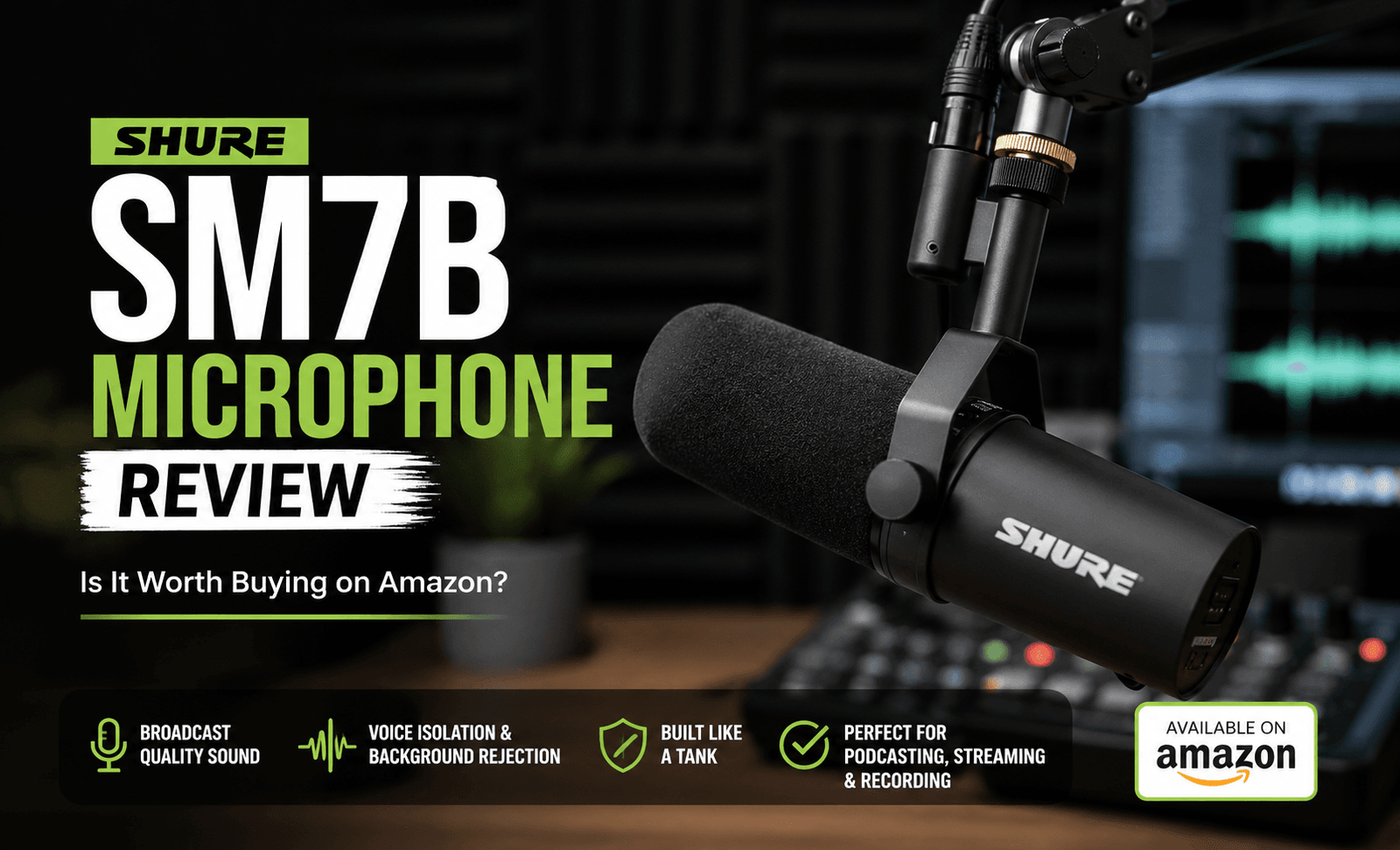
Shure SM7B microphone review for 2026. Learn about sound, specs, gain needs, podcasting, streaming, setup, pros, cons, and whether it is worth buying on Amazon.
Quick Answer
The Shure SM7B remains one of the most recognizable studio microphones for speech, podcasting, broadcasting, streaming, and vocal recording. It’s a dynamic cardioid microphone with an XLR connection — not a USB microphone, so you can’t plug it directly into a computer. You need an audio interface or another suitable XLR device between the microphone and your computer; Amazon’s current product information confirms the SM7B doesn’t communicate digitally on its own.
Its biggest strength is a controlled, smooth vocal sound. The cardioid pattern reduces sound from the sides and rear, and Shure adds bass rolloff and presence-boost controls plus internal air-suspension shock isolation and electromagnetic shielding.
The important catch: the SM7B needs a strong enough microphone preamp. Shure says many entry-level and mid-tier preamps may not provide enough gain, and recommends an inline boost amplifier or stronger preamp when the interface can’t provide more than about 60 dB of gain.
Is it worth buying? Yes — if you want a serious XLR microphone for a permanent podcast, streaming, voice-over, broadcast, or recording setup, and you already have (or are willing to buy) the right audio interface. If you want simple USB plug-and-play recording, this isn’t the easiest microphone to start with.
Check Price and Availability on Amazon →
Research note: This is a research-based review, not a claim of hands-on testing. It compares information from the current Amazon listing, Shure’s official product documentation and user guide, technical specifications, and general buyer-feedback patterns — not personal ownership. The useful question here is: what can a buyer reasonably expect from the SM7B based on verified specifications, manufacturer documentation, and current marketplace information? The current Amazon listing is associated with ASIN B0002E4Z8M.
Table of Contents

At a Glance
| Feature | Shure SM7B |
|---|---|
| Microphone type | Dynamic |
| Polar pattern | Cardioid |
| Connection | XLR |
| Frequency response | 50 Hz–20 kHz |
| Output impedance | 150 ohms |
| Sensitivity | -59 dBV/Pa |
| Main uses | Speech, vocals, podcasting, streaming, broadcast |
| Built-in USB | No |
| Built-in preamp | No |
| Phantom power required by mic | No |
| Mount included | Integrated yoke mount |
| Close-talk windscreen | Included |
| Best for | Serious voice and recording setups |
| Amazon ASIN | B0002E4Z8M |
What Is the Shure SM7B?
A professional dynamic vocal microphone designed around speech and vocal recording, used for radio, television, narration, studio recording, broadcasting, podcasting, and other voice-focused work. Shure describes its frequency response as smooth, flat, and wide-range.
Unlike many modern creator microphones, the SM7B doesn’t try to do everything inside the microphone — no USB port, no built-in digital interface, no software requirement, and no built-in preamp. It’s designed as an analog XLR microphone, which makes it attractive for a traditional recording chain:
Your voice → SM7B → XLR cable → audio interface/preamp → computer → recording software
That’s more equipment than a USB microphone requires, but it gives you a more traditional studio workflow.
Sound Quality
The SM7B has a dynamic moving-coil design and a cardioid polar pattern, with a frequency response of 50 Hz to 20 kHz. But the spec alone doesn’t tell you what your voice will sound like — a microphone’s usefulness comes from how it behaves with a specific source.
The SM7B is especially associated with close-up speech and vocals. Shure’s guide recommends speaking directly into it from roughly 1 to 6 inches away, noting that moving closer increases perceived bass response while moving farther away reduces that effect. Microphone position is extremely important here — a beginner might expect it to sound perfect from any distance, but distance, angle, room, voice, interface gain, and recording chain all affect the final result.
The Cardioid Pattern
Cardioid means the microphone primarily picks up sound from the front while rejecting more from the rear and sides — useful for a desk setup with a computer fan behind the mic, a noisy monitor, or unwanted sound from behind the speaker. But cardioid doesn’t mean soundproof: an extremely noisy room won’t be magically fixed, and room acoustics, microphone technique, and mouth-to-mic distance still matter.
Use Cases
Podcasting
One of the clearest use cases. The dynamic design and cardioid pattern suit a close-talk speaking setup well, and Shure specifically lists radio announcing, television talk shows, narration, and speech among the microphone’s applications. A typical setup: mount on a boom arm or stand, position close to the speaker, connect via XLR to a suitable interface, set enough preamp gain, monitor with headphones, adjust the rear switches if needed, and record.
Buying an SM7B doesn’t automatically create professional audio, though — if the room is echoey, you’ll still hear reflections; if the interface lacks gain, your level may be too low; if the mic is too far away, you lose the close, focused quality many buyers want. It gives you a strong foundation, not an automatic result.
YouTube and Streaming
A logical option for desk-based creators — YouTubers, podcasters, Twitch streamers, voice-over artists, online educators, commentary channels, interview hosts, radio-style broadcasters, video essayists, and vocal recording. Its integrated yoke mount works well with a boom arm. That said, if your goal is simply “connect a microphone to my computer and start recording,” a USB microphone is much easier — the SM7B suits someone building an audio setup, not someone who wants the fewest possible components.
Voice-Over
Another strong application — the close-talk design and adjustable frequency response give some control over the recorded voice’s character. Positioning matters greatly: start close enough to benefit from the focused vocal sound, then experiment, since moving slightly closer adds low-end warmth and moving away reduces it. This is one reason the SM7B rewards users who spend time learning microphone technique.
Streaming (frequency and casual use)
The SM7B being popular among professional creators doesn’t mean every streamer needs one. If you stream casually once a week, a less complicated microphone may be a better choice. If you stream frequently and want a serious XLR setup you’ll keep for years, it becomes much easier to justify — think of it as infrastructure rather than a simple computer accessory.
Gaming
Gaming itself doesn’t require an SM7B — the reason to use it is voice quality. If you make gaming videos, livestreams, commentary, or podcasts, it can be useful because those depend heavily on spoken audio. If you only need voice chat with friends, it’s probably more microphone than you need.
Music
Shure lists instrumental and vocal studio recording among the SM7B’s applications, and the dynamic design works well for certain loud sources and close-miked vocals. But microphone choice in music depends heavily on the singer, instrument, room, arrangement, and desired tone — it’s not a universal replacement for every condenser or dynamic microphone, just a tool with a particular character and workflow.
Frequency Response and Rear Switches
The official spec lists 50 Hz to 20 kHz. Two people using the same microphone can get very different results because voices, rooms, distances, interfaces, and positioning all vary. Shure’s bass-rolloff and presence-boost controls let you shape the response before the signal even reaches your recording software.
Bass Rolloff — Reduces low-frequency response, useful if your voice sounds overly heavy or low-frequency room noise (HVAC, traffic) is a problem.
Presence Boost — Increases midrange emphasis, which can make some voices sound more forward and clear. Not a universal “better” setting — different voices need different treatment, so listen to your own recording and choose accordingly.
Does the SM7B Need Phantom Power?
The microphone itself does not require phantom power — Shure’s documentation states the SM7B doesn’t need it and isn’t affected by it. That doesn’t mean every device in your chain is phantom-power-free, though: an external inline preamp, for example, may need it to operate. The microphone and the equipment used with it are not the same thing — always check the requirements of your specific interface, preamp, or inline booster.
The Biggest SM7B Problem: Gain
If there’s one issue to understand before buying, it’s gain. The microphone has relatively low output — Shure gives it a sensitivity rating of -59 dBV/Pa — and explicitly says many entry-level and mid-tier preamps may not provide enough gain for it. Official guidance recommends an inline boost amplifier or stronger preamp if your preamp doesn’t provide more than 60 dB of gain.
This is why some buyers have a disappointing first experience: an expensive microphone connected to an inexpensive interface, gain turned up, recording still quieter than expected — and the microphone gets blamed when the real issue is the gain structure.
Do You Need a Cloudlifter?
Not necessarily. You need enough clean gain, not automatically one specific brand of inline preamp. Some interfaces provide enough gain by themselves; some setups benefit from an inline booster; some modern interfaces and preamps are designed with higher-gain dynamic microphones in mind. The right question is: does my interface provide enough clean gain for the SM7B? Check Shure’s own documentation and your interface’s actual specifications — don’t buy a booster just because someone online says every SM7B needs one.
Build Quality and What’s in the Box
Shure describes the construction as rugged, designed to protect the microphone cartridge, with a dark gray aluminum and steel case. It’s also fairly heavy — Shure’s user guide lists roughly 0.764 kg, while another official spec document lists about 851.6 g net weight with cable (the difference reflects how the weight is specified). This matters for choosing a boom arm — a cheap arm that barely supports a lightweight mic may not be ideal here.
In the box:
- SM7B microphone
- Standard windscreen
- A7WS close-talk windscreen
- Switch cover plate
- Stand adapter
Note: The microphone stand is not included — Amazon’s product information confirms this explicitly, so plan your mounting separately.
Windscreen
The standard windscreen suits general voice and instrumental use; the larger A7WS is for close-talk applications, helping podcasters and voice-over artists who position the mic very close to their mouth. Shure says the larger windscreen helps reduce plosives (“P” and “B” bursts) and wind noise — but good positioning and angle still matter; don’t rely on the windscreen alone.
Internal Shock Isolation
The SM7B uses an internal air-suspension system that Shure says reduces mechanical noise transmission — useful if your hand bumps the desk or your boom arm shifts slightly. It’s one less problem to worry about, though it doesn’t mean you can hit the desk without consequences.
Electromagnetic Shielding
Shure says the SM7B is designed to reject electromagnetic hum from computer monitors and other electrical equipment — useful in a modern desk setup surrounded by computers, monitors, USB gear, power supplies, LED lighting, and audio interfaces. It’s an added layer of protection, not a replacement for good cable management.
Pros and Cons
Pros
- Excellent for speech and vocal recording
- Dynamic design suits close-talk applications
- Cardioid pattern rejects off-axis sound
- XLR connection works with traditional studio equipment
- Bass-rolloff and presence-boost controls
- Internal shock isolation, electromagnetic shielding
- Includes standard and close-talk windscreens
- Rugged construction, no battery or software required
- Long-established professional design
Cons
- Requires an XLR audio interface or suitable preamp
- Can need substantial clean gain
- More complicated than a USB microphone
- Microphone stand or boom arm not included
- Heavy compared with many basic desktop microphones
- Higher total setup cost once interface and mounting are included
- Not the simplest choice for a first-time creator
- Good results still depend on room acoustics and technique
Buyer Sentiment
Buyer sentiment is strongly positive overall, with a large body of customer feedback on the Amazon listing. The most useful way to read microphone feedback is to look for recurring themes rather than one individual review — for the SM7B, the key buyer questions usually concern vocal quality, setup, gain requirements, mounting, and whether the microphone fits the buyer’s recording chain. That last point matters: a microphone can get excellent feedback and still be the wrong purchase for someone who wants a simple USB setup.
When reading reviews, look for comments on voice clarity, background noise, required gain, interface compatibility, mounting, build quality, windscreen performance, and long-term ownership — and separate genuine product issues from setup problems. “Microphone is too quiet,” for instance, often actually means the buyer’s interface doesn’t provide enough clean gain.
Is the SM7B Good for a Home Studio?
Yes, but your room matters. The directional pattern and close-talk design help you focus on the speaker’s voice, but they don’t remove room reflections — hard walls, a bare desk, and glass surfaces can all create unwanted sound. You don’t need a professional studio, though; simple changes help:
- Record away from bare walls
- Use soft furnishings
- Avoid the middle of a highly reflective room
- Keep your mouth at a consistent distance
- Experiment with microphone angle
- Monitor with headphones
- Reduce computer fan noise where practical
That’s often more useful than buying another piece of expensive gear.
Is It Too Much for Beginners?
Depends on the beginner. If you’re serious about podcasting and already understand XLR recording, it makes sense. If you’re completely new to microphones and just want better Zoom calls, it’s probably overkill. Ask yourself:
- Do I understand XLR? If not, learn the basics first.
- Does my interface provide enough gain? Check the specifications.
- Am I building a permanent recording setup? If yes, the SM7B becomes much more attractive.
SM7B vs. USB Microphone
The biggest difference is workflow. A USB microphone has a digital audio interface built in:
Microphone → USB → computer
The SM7B doesn’t:
SM7B → XLR → interface/preamp → computer
USB is simpler; XLR is more modular, letting you replace the microphone, interface, preamp, and cables independently — one reason serious creators may prefer it. But simplicity has value too — if you don’t need a modular setup, a good USB microphone may be more practical.
SM7B vs. Shure SM7dB
The SM7dB is an important alternative within Shure’s own lineup. The biggest difference is a built-in active preamp — Shure says it provides up to +28 dB of gain, designed to deliver the classic SM7B sound without an external inline preamplifier. It requires 48V phantom power when the preamp is engaged, but can run without it in bypass mode.
The SM7dB is worth considering if you want the SM7 family sound with more built-in gain flexibility. The classic SM7B remains attractive if you already have a suitable interface and want the simpler, passive microphone design.
How to Set Up the Shure SM7B
- Mount the microphone using the integrated mount with a compatible stand or boom arm (not included).
- Connect the XLR cable from the microphone to your audio interface or preamp.
- Check the gain — start moderate, speak at your normal volume, and increase until you have a healthy level without noise or clipping.
- Position the microphone close — Shure recommends roughly 1 to 6 inches for close speech applications.
- Test the rear switches — start flat, then compare bass rolloff and presence boost if your voice needs adjustment.
- Record a longer test sample, not just a five-second check — speak naturally, move slightly, listen back, and adjust position and gain as needed.
How Far Should You Be From It?
There’s no single ideal distance — Shure’s guide gives a broad close-talk range of roughly 1 to 6 inches. Closer placement generally increases proximity effect for a warmer, fuller sound, but getting extremely close can make plosives more noticeable. Start close enough to capture a focused voice while keeping the windscreen between you and the capsule, then make small adjustments — your voice is the final test, not an exact number.
Does It Need a Pop Filter?
The included windscreen (plus the larger A7WS) is enough for most users, so an additional pop filter isn’t automatically necessary. Good technique matters more — avoid speaking directly into the mic from an extremely close distance if your voice creates strong plosives, and try adjusting the angle.
Can You Use It Without an Audio Interface?
Not with a normal computer directly. The SM7B is an analog XLR microphone — Amazon’s product information explicitly states it doesn’t communicate digitally and requires an audio interface to connect to a computer, tablet, or phone. This is one of the biggest differences from USB microphones.

- NATURAL VOCALS: Engineered with a dynamic cartridge and wide-range frequency response, the Shure SM7B captures warm, bal…
- FOCUSED AUDIO: A precise cardioid pickup pattern works with air suspension shock isolation to minimize background noise,…
- BROADCAST-READY CLARITY: Built-in pop filtering and a detachable windscreen reduce plosives, breath, and wind noise, del…
Who Should Buy the Shure SM7B?
- Podcasters, especially those building a permanent desk setup
- Streamers who want a serious XLR workflow
- Voice-over artists, thanks to the close-talk design and controlled presentation
- Broadcasters, given the microphone’s history and design fit
- YouTubers, especially commentary, educational, documentary, and voice-heavy channels
- Musicians, for vocals and certain instruments
- Serious home-studio users building a modular recording chain
Who Should Not Buy It?
Consider something else if you want USB plug-and-play, don’t own an audio interface, don’t want to learn about microphone gain, mainly need a mic for occasional video calls, have a very small total setup budget, need a portable wireless microphone, record mainly with an iPhone while moving around, or don’t want a mic arm or stand on your desk.
Buying Checklist
- [ ] Confirm the exact model — the listing should say Shure SM7B
- [ ] Check the ASIN — B0002E4Z8M for the product researched here
- [ ] Check current seller and availability (listings can change)
- [ ] Check your interface provides suitable gain
- [ ] Check your XLR cable
- [ ] Plan your mounting (stand not included)
- [ ] Consider your room — a great microphone can’t fully fix a poor recording environment
- [ ] Think about your use case — do you need a professional XLR microphone, or would a USB microphone solve the problem more simply?
Frequently Asked Questions
Is the Shure SM7B worth buying on Amazon?
For the right user, yes — a professional dynamic XLR microphone for speech, vocals, broadcasting, podcasting, streaming, and recording. The main issue is that it requires an appropriate audio interface or preamp rather than connecting directly to a computer.
Is the Shure SM7B good for podcasting?
Yes — one of its strongest use cases. Shure specifically lists speech, radio announcing, television talk shows, and narration among its applications.
Does the Shure SM7B need phantom power?
The microphone itself doesn’t require it, though some external preamps or inline boosters used with it may.
Does the SM7B need a Cloudlifter?
Not automatically — the important requirement is enough clean gain. Shure recommends an inline boost amplifier or stronger preamp when the available preamp doesn’t provide more than about 60 dB of gain.
Can I plug the SM7B directly into my laptop?
No — it’s an analog XLR microphone. You need an appropriate audio interface or compatible device to convert the signal for computer recording.
Is the SM7B good for YouTube?
Yes, especially for voice-heavy channels — commentary, tutorials, podcasts, streaming, and narration where voice quality matters.
Does the SM7B come with a stand?
No — Amazon’s product information states the microphone doesn’t include a stand.
Does the SM7B include a windscreen?
Yes — both a standard windscreen and the A7WS close-talk windscreen are supplied.
Is the SM7B good for a noisy room?
It helps with some unwanted off-axis sound via its cardioid pattern, but it’s not a noise-cancellation microphone — room acoustics, distance, positioning, and background noise still matter.
What is the SM7B’s frequency response?
Shure specifies 50 Hz to 20 kHz.
Final Verdict
The Shure SM7B is still a strong microphone for serious speech and vocal recording in 2026. Its biggest strengths aren’t flashy software features — it’s a proven dynamic microphone design, cardioid pickup, a smooth wide-range response, adjustable bass and presence controls, internal shock isolation, electromagnetic shielding, and a traditional XLR connection.
The biggest weakness is equally clear: the SM7B is not plug-and-play. You need an appropriate audio interface or preamp, a stand or boom arm, and a working understanding of gain. That makes it a better fit for a serious creator than for someone who simply wants a microphone for occasional calls.
If you’re building a podcast, streaming station, voice-over desk, home studio, or professional content setup, the SM7B is worth considering. If your priority is simplicity, look at a USB microphone instead. The right microphone isn’t the one with the biggest reputation — it’s the one that fits your recording chain. For buyers who want the classic Shure dynamic XLR approach and are prepared for the extra setup, the SM7B remains a very compelling choice.
Check the Current Shure SM7B Listing on Amazon →
Related TechRigReview Guides
- 10 Best Amazon Wireless Microphones Under $90 — if your real goal is portable or wireless recording rather than a permanent XLR studio setup.
Useful Official Sources
Amazon Associates Disclosure: As an Amazon Associate I earn from qualifying purchases.

MD.HASAN is an experienced SEO expert and amazon products review writer passionate about helping people find right products on amzon for buy without confusion. With 4 years of hands-on experience in content strategy and search engine optimization, he specializes in writing SEO-friendly blog posts that rank, engage, and convert.