🔗 Affiliate Disclosure: As an Amazon Associate, Tech Rig Review earns from qualifying purchases. Links on this page may be affiliate links — at no extra cost to you.
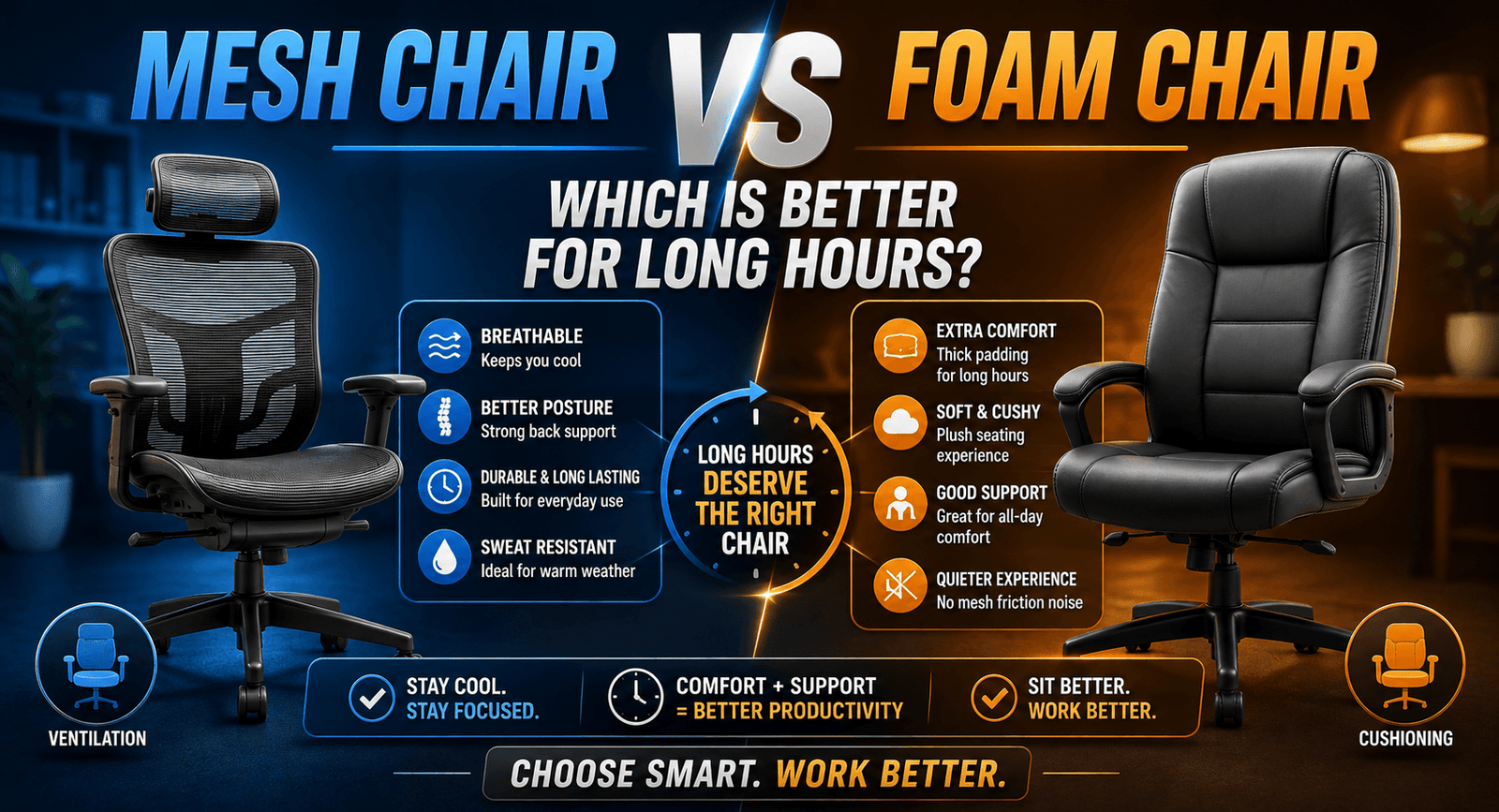
Mesh chair or foam chair — which is better for long hours? This 2026 guide compares breathability, back support, and durability with real Amazon picks to help you decide.
You have been sitting for four hours. Your back is starting to ache. Your shirt is slightly damp. And you’re shifting in your seat every few minutes because you just can’t get comfortable anymore.
Sound familiar? The chair you sit in during long work sessions matters more than most people realize. And when it comes to office chairs, the most common debate is still this: should you buy a mesh chair or a foam (padded/cushioned) chair?
Both types have real fans. Both have real drawbacks. And most comparison articles skip the actual ergonomics in favor of just listing products. This guide does things differently.
Here, you’ll get a research-backed breakdown of how mesh and foam chairs actually perform during 6-to-8-hour workdays — covering breathability, back support, pressure distribution, durability, and who each type genuinely suits. Then you’ll find four real Amazon picks (verified and currently available) that represent each category well, across different budgets and use cases.
Whether you’re setting up a home office, replacing an old chair that’s destroyed your posture, or choosing between two options in your cart right now — this article is written to help you make a decision you won’t regret in six months.
Table of Contents
What’s Actually Inside a Mesh Chair vs a Foam Chair?
Before getting into performance, it helps to understand what these chairs are actually made of.
A mesh chair uses a flexible, tensioned fabric — usually a woven polymer — stretched across a rigid frame to form the backrest, and sometimes the seat. The mesh acts like a suspension system. It flexes slightly under your body weight and distributes pressure across a larger surface area rather than concentrating it in a few spots.
A foam chair (also called a padded, cushioned, or executive chair) uses layers of foam — often high-density foam, memory foam, or a combination of both — compressed into a shaped seat pan and backrest. The foam is typically wrapped in fabric, bonded leather, or genuine leather. The cushioning absorbs body weight through compression rather than suspension.
The material choice affects five key things: heat, support feel, posture over time, durability, and body type compatibility. We’ll go through each one.
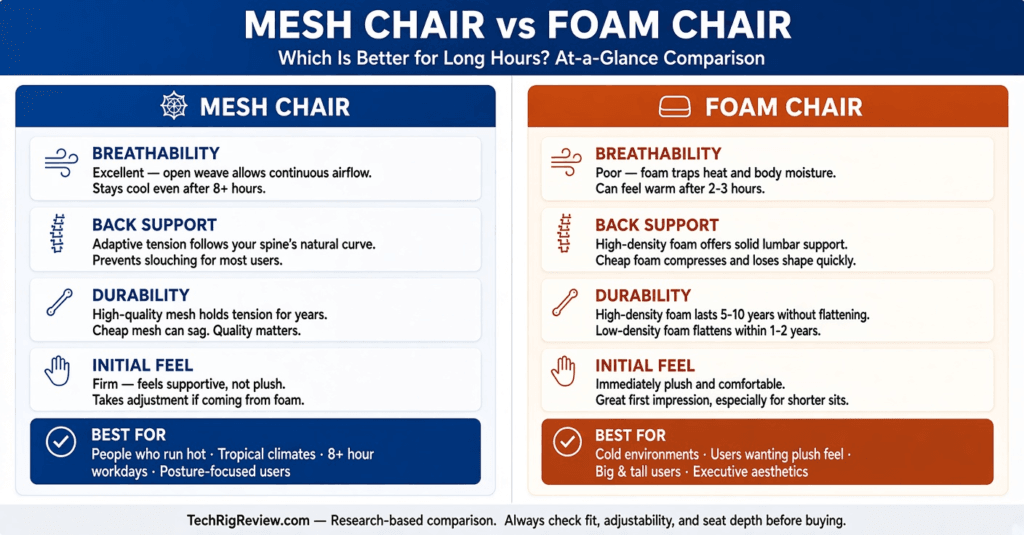
Breathability: The Real Difference After Hour 4
This is where mesh chairs have a genuine, documented advantage — not just a marketing claim.
When you sit in a foam or leather chair for several hours, your body heat has nowhere to go. The foam insulates, the leather surface traps moisture, and the air between your back and the chair simply gets warmer. Research published in MDPI (2025) confirms that users experience significant differences in thermal sensation depending on chair material during extended sitting.
That heat buildup is not just uncomfortable. According to ergonomics research cited by EU-OSHA on prolonged static sitting, elevated temperatures cause subtle increases in muscle tension as the body tries to regulate core temperature. You start fidgeting. You shift your weight more often. You unconsciously change your posture to try to cool down — and those micro-adjustments away from a neutral spine position are exactly what cause lower back fatigue and pain over long days.
Mesh’s open weave solves this directly. Air circulates continuously through and around the backrest. Most high-quality mesh chairs also have a waterfall-style seat edge that reduces pressure on the back of the thighs (where blood vessels and nerves run close to the surface), further reducing the discomfort that comes from sitting for hours at a time.
Foam chairs in air-conditioned offices narrow this gap significantly. If your home office is consistently cool, the thermal disadvantage of foam is much less of a factor. In a heated room, a tropical climate, or anywhere you naturally run warm, mesh is the stronger choice for full-day comfort.
Back Support: Who Actually Wins?
This one is more nuanced than most articles admit. The short answer is: both can provide excellent back support — but through different mechanisms, and with different failure modes.
How Mesh Supports Your Back
Well-tensioned mesh follows the contour of your spine as you move and shift throughout the day. The flexibility allows it to push back against your lumbar region, encouraging the natural S-curve of the spine. Premium mesh chairs add independently adjustable lumbar support on top of this, letting you dial in the position to your exact height and sitting preference.
The key word is “well-tensioned.” A cheap mesh chair uses lower-quality polymer that sags under weight within months. The mesh goes slack, and instead of supporting your lumbar curve, it lets your lower back fall into a rounded posture. This is why mesh chairs at the very low end of the market often get terrible reviews for back support — the material fails, not the concept.
How Foam Supports Your Back
High-density foam distributes your body weight across the seat pan through compression. When properly shaped and dense enough, foam provides firm, consistent support that doesn’t shift during the day. Memory foam adds a body-contouring layer that molds to your specific sitting position, which is particularly effective for distributing pressure evenly across the sit-bones (ischial tuberosities).
The failure mode for foam is compression over time. Low-density foam takes a permanent set — meaning it develops a depression in the shape of your body — and stops supporting you correctly, usually within one to two years of daily use. High-quality foam, like what Serta and La-Z-Boy use in their upper-tier chairs, resists this much longer.
What the Research Suggests
A study tracked in the Journal of Rehabilitation Research and Development measured healthy adults during prolonged sitting and found that subjects shifted posture naturally about 7.8 times per hour, and each shift raised local tissue oxygenation by roughly 2.2%. The practical takeaway: neither mesh nor foam eliminates the need to move. What matters is how well the chair supports you when you do sit still and how easily it accommodates natural movement.
A UC Berkeley ergonomics researcher studying mesh vs foam chairs made an important point worth quoting from the Secretlab study: “People are often drawn to mesh chairs, but our findings suggest that foam seats shouldn’t categorically be underestimated as a seat material suitable for long bouts of sitting.” Foam — when the density and shape are right — can absolutely support full-day sitting without causing the back pain it’s often blamed for.
Posture Over an 8-Hour Day: The Timeline
Here’s what ergonomics research suggests actually happens over the course of a full workday in each chair type:
Hours 1-2: Both types feel comfortable for most users. Foam’s initial plushness is satisfying. Mesh feels firm but supportive.
Hours 3-4: Heat starts accumulating in foam seating. Users on foam chairs begin shifting more frequently. Mesh users typically stay more still because they’re not fighting discomfort from temperature.
Hours 5-6: Postural drift starts in both chair types, but is often worse in foam where heat-related restlessness has been building. Lumbar support quality becomes the dominant factor at this point — the adjustable lumbar on a quality mesh chair gives most users a clear advantage.
Hours 7-8: Foam chairs that use high-density foam with good lumbar positioning can still support users well at this point. Cheaper foam chairs often leave users with noticeable lower back fatigue. Quality mesh chairs tend to maintain their support properties consistently at this stage.
The takeaway: For 8-hour-plus workdays, mesh chairs have a statistical advantage primarily because of breathability and adjustability. But the quality of the chair matters far more than the material category. A well-built foam chair will always outperform a cheap mesh chair.
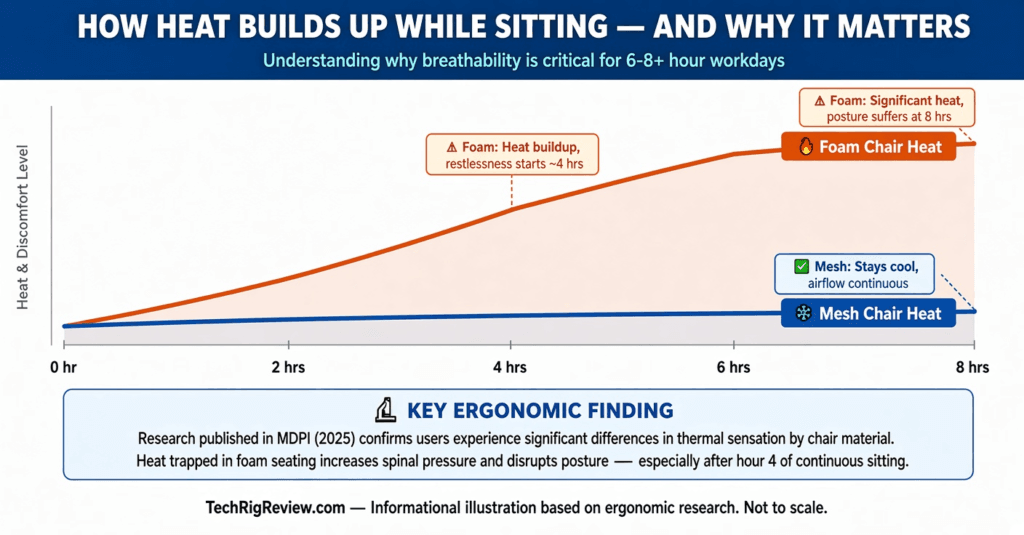
This chart illustrates how heat discomfort accumulates over a typical 8-hour workday. Foam chairs trap heat; mesh allows continuous airflow. The gap becomes most pronounced after the 4-hour mark.
Durability: Which Type Lasts Longer?
Mesh chairs — when made with quality materials — can outlast most foam equivalents because the mesh itself doesn’t compress or flatten. The risk for mesh is tension loss in the fabric over years of use, but quality woven polymers from reputable manufacturers hold their tension well under normal daily loads.
Foam chairs with high-density foam are extremely durable. The problem is density. Look for foam rated at 1.8 lb per cubic foot or higher. Low-density foam (under 1.5 lb/cubic foot) will flatten within one to three years. Memory foam on top of a high-density base gives the best of both worlds: initial softness and long-term structure.
Leather and bonded leather surfaces on foam chairs are the real durability concern. Genuine leather is extremely long-lasting but expensive. Bonded leather (a mix of leather scraps and polyurethane) looks good initially but tends to crack and peel after two to five years, especially at high-use points like the seat edge and armrests.
Bottom line on durability: A premium mesh chair and a premium foam chair are similarly durable. At budget price points, mesh chairs tend to hold up slightly better simply because there’s less material to fail.
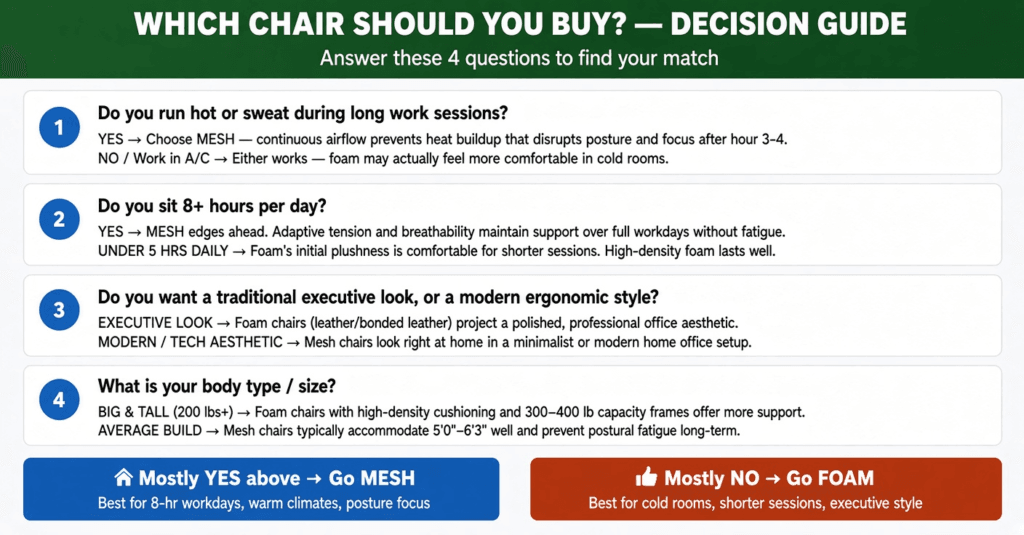
Who Should Buy a Mesh Chair?
Buy a mesh chair if most of the following describe you:
- You sit for 6 to 8+ hours per day at a desk
- You run warm or work in a room without consistent air conditioning
- You prioritize posture support and are willing to spend a few minutes adjusting lumbar and headrest settings
- You prefer a modern, minimalist aesthetic in your workspace
- You have an average-to-lean build and want a chair that accommodates natural movement
- You are concerned about long-term back health and want a chair that discourages slouching
Who Should Buy a Foam Chair?
Buy a foam chair if most of the following describe you:
- You sit for 4-6 hours per day or work intermittently throughout the day
- You work in an air-conditioned room and don’t run particularly warm
- You want an executive or traditional office aesthetic — leather and bonded leather chairs project a polished, professional look
- You are big and tall and need a wider seat, higher weight capacity, and substantial cushioning to feel supported
- You prefer immediate cushioning and find mesh chairs feel too firm right away
- You will be entertaining clients or colleagues and want a chair that visually matches a premium office environment
<!– IMAGE 3: Insert which-chair-decision-guide.svg here –>
The Best Mesh Chairs on Amazon Right Now
Both chairs below are currently sold on Amazon, have verified ASINs, and have been researched from their current Amazon listings.
1. GABRYLLY Ergonomic Mesh Office Chair — Best Mid-Budget Mesh Chair
Amazon Link: GABRYLLY Ergonomic Mesh Chair (B07Y8BXBX8)
The GABRYLLY high-back mesh chair consistently appears among the top-selling mesh office chairs in its category on Amazon — and the reasons are straightforward. It is BIFMA and SGS certified, which means it has been tested to meet real industry safety and ergonomic standards, not just passed an internal factory check.
What Makes It Stand Out for Long Hours
The GABRYLLY uses breathable mesh on the full backrest, which addresses the heat-buildup problem described above. The high-back design extends support into the upper back, and the adjustable headrest provides neck support during reclined breaks — something that makes a real difference on a 7-to-8-hour day when your neck muscles start to tire.
The 90-to-120° tilt lock range lets you recline slightly during less intensive tasks like reading or taking calls, which reduces lumbar pressure and gives your intervertebral discs a chance to decompress. The flip-up armrests are a practical feature for compact desks — you can fold them out of the way when you need to pull the chair closer.
The wide seat cushion paired with the mesh backrest means you’re getting the padded seat comfort that foam chairs offer for your sit-bones while still maintaining the airflow benefits of mesh on your back — a reasonable compromise for users who find pure mesh seats too firm.
Specs at a Glance
- Backrest: Breathable mesh, high-back
- Seat: Wide foam-cushioned seat
- Armrests: Flip-up, adjustable
- Tilt: 90–120° with lock
- Headrest: Adjustable height
- Certifications: BIFMA, SGS
- Weight capacity: 250 lbs
Best For: Remote workers and students working 6-8 hour days who want a quality mesh chair without an enterprise price tag. Particularly well-suited for users who want the breathability benefits of mesh with a padded seat rather than a full-mesh seat pan.
👉 Check current price on Amazon
2. GABRYLLY Big and Tall Mesh Chair with 3D Armrests — Best for Heavier Users
Amazon Link: GABRYLLY Big and Tall Mesh Chair (B0DC6NYGMW)
For users who need a mesh chair that genuinely handles more weight and a bigger frame, this GABRYLLY model addresses the gap that many standard mesh chairs leave. Its 350 lb rated capacity, double-back lumbar support design, and 3D armrests with 215° rotation range put it in a different class from standard ergonomic mesh chairs.
What Makes It Stand Out
The double-back design means the lumbar support wraps more comprehensively around the lower spine, which matters significantly for larger users where a single lumbar pad often misses its target position. The BIFMA certification confirms the chair has been tested under the real loads it will face in daily use.
The 3D armrest system — adjustable up/down, front/back, and with a 215° rotation range — is genuinely more adaptable than the 2D armrests found on most chairs in this price range. Proper armrest positioning reduces shoulder and neck tension during keyboard and mouse work, which is one of the leading causes of upper-body fatigue in desk workers who spend long hours typing.
The mesh backrest combined with a soft seat cushion (not a full mesh seat) follows the same hybrid logic as the previous pick — keeping the back cool while maintaining seat comfort for heavier users who might find a full mesh seat less comfortable.
Specs at a Glance
- Backrest: Double-back full mesh
- Seat: Soft cushioned seat pan
- Armrests: 3D, 215° rotation
- Tilt: 90–120° lock
- Headrest: 3D adjustable
- Certifications: BIFMA
- Weight capacity: 350 lbs
Best For: Big and tall users (5’9″ to 6’4″, 200–350 lbs) who need a mesh chair with genuine structural support rather than just a label. Also suitable for anyone who has had neck or shoulder tension from poorly positioned armrests and wants a wider range of arm adjustment.
👉 Check current price on Amazon
The Best Foam Chairs on Amazon Right Now
3. Serta Bryce Executive Office Chair — Best Mid-Range Foam Chair
Amazon Link: Serta Bryce Executive Chair (B00EUU5G82)
Serta is best known for mattresses, and that same foam expertise carries into their office chair line. The Bryce is a good example of what separates a quality foam chair from the cheap padded chairs that flood the market. It uses Serta’s layered high-density non-toxic foam with pocket coils built into the seat cushion — a mattress-inspired construction that adds spring-back support beneath the foam to prevent the permanent compression that ruins cheap foam chairs within a year or two.
What Makes It Stand Out
The perforated leather backrest on the Bryce makes a genuine effort to address foam’s breathability weakness. By punching airflow holes through the bonded leather, Serta allows at least some air circulation through the backrest — not equivalent to mesh, but meaningfully better than solid leather or solid bonded leather.
The AIR Lumbar Technology in this model is a patented system that adjusts as you move rather than requiring you to manually reposition a lumbar pad. For users who forget to adjust lumbar settings (most people), this adaptive design maintains contact with your lower back even when you shift forward to type or recline to think. That continuous lumbar contact is one of the most important factors in preventing the lower back fatigue that foam chairs are commonly blamed for.
The 275 lb weight capacity and mid-back design make this a comfortable choice for users up to about 6’1″. A well-padded headrest takes pressure off the neck during lean-back moments.
Specs at a Glance
- Seat: Layered memory foam + pocket coils
- Backrest: Perforated bonded leather, contoured
- Lumbar: Patented AIR Technology (adaptive)
- Tilt: Adjustable tilt tension + tilt lock
- Headrest: Padded, included
- Certifications: Serta quality foam (non-toxic, non-recycled)
- Weight capacity: 275 lbs
Best For: Remote workers and home office users who prefer the feel of a traditional executive chair but want better-than-average foam quality. Particularly good for users in air-conditioned rooms who want lumbar support that works passively without requiring manual adjustment throughout the day.
👉 Check current price on Amazon
4. La-Z-Boy Delano Big and Tall Executive Chair — Best Premium Foam Chair
Amazon Link: La-Z-Boy Delano Big and Tall Chair (B074MSBTZP)
If the foam chair category had a flagship representative for long-hour sitting, the La-Z-Boy Delano would be a strong candidate. This is a properly engineered executive chair from a brand with a 90-year history in seating comfort — and the Delano’s ComfortCore memory foam construction reflects that lineage.
What Makes It Stand Out
The ComfortCore seat construction layers high-density foam base with a memory foam topper. The base provides the structural support that prevents the sagging that ruins cheaper foam chairs within a year. The memory foam layer conforms to your specific body shape and distributes pressure across the sit-bones rather than concentrating it on a narrow contact area. For users who sit for long sessions and find hard or firm seats uncomfortable, this combination is notably better than single-density foam.
The plush body pillow lumbar support in the backrest is positioned to target the lower back specifically, and the high-back design (the Delano has an extended 28+ inch backrest) supports the full spine from lumbar to upper back. For big and tall users (up to 350 lbs), the wide seat and sturdy heavy-duty base with Mahogany real wood arms and 360° dual-wheel casters provide the structural confidence that smaller executive chairs often lack.
The bonded leather upholstery is the one honest trade-off: bonded leather is not as durable as genuine leather over the long term, and in high-traffic seating areas it can begin to crack and peel after 3-5 years. La-Z-Boy’s construction quality extends the lifespan beyond cheaper bonded leather products, but it is worth knowing what you’re buying.
Specs at a Glance
- Seat: ComfortCore memory foam layered system
- Backrest: Body pillow lumbar, high-back (28.5″)
- Arms: Real wood Mahogany, padded
- Base: Heavy-duty 360° swivel metal base
- Upholstery: Bonded leather
- Adjustments: Height, tilt tension, tilt lock
- Weight capacity: 350 lbs
Best For: Big and tall users and anyone who wants the best possible foam chair experience for an executive home office. Also ideal for users who frequently take video calls or meet with clients and want a chair that projects professionalism and premium aesthetics without compromise.
👉 Check current price on Amazon
Quick Comparison: All 4 Chairs at a Glance
| GABRYLLY Standard | GABRYLLY Big & Tall | Serta Bryce | La-Z-Boy Delano | |
|---|---|---|---|---|
| Type | Mesh | Mesh | Foam | Foam |
| Best for | Daily 6–8 hr workers | Big & tall mesh users | Mid-range foam buyers | Premium foam / B&T |
| Weight limit | 250 lbs | 350 lbs | 275 lbs | 350 lbs |
| Lumbar | Adjustable pad | Double-back | AIR adaptive | Body pillow |
| Armrests | Flip-up 2D | 3D 215° rotation | Padded fixed | Padded wood |
| Breathability | ⭐⭐⭐⭐⭐ | ⭐⭐⭐⭐⭐ | ⭐⭐⭐ | ⭐⭐ |
| Initial comfort | ⭐⭐⭐ | ⭐⭐⭐ | ⭐⭐⭐⭐ | ⭐⭐⭐⭐⭐ |
Ratings are relative within this comparison group, not absolute scores.
Common Mistakes People Make When Buying Either Type
Mistake 1: Buying based on how the chair feels for the first five minutes.
Initial comfort is a poor predictor of all-day comfort. Foam often feels great immediately because it’s soft. Mesh can feel surprisingly firm at first. Test or return policies matter here — look for chairs with at least a 30-day return window.
Mistake 2: Ignoring seat depth.
Seat depth is one of the most overlooked adjustments. If the seat is too long for your legs, the front edge presses into the backs of your knees, restricting circulation — no chair material can fix that problem. Most ergonomic mesh chairs offer seat depth adjustment; many foam chairs do not. Measure your seated thigh length before buying.
Mistake 3: Assuming the chair will fix back pain on its own.
Back pain from sitting is rarely just about the chair material. Lumbar support position, seat height relative to your desk, armrest height and angle, and monitor position all contribute. A cheap mesh chair in a properly set-up workstation will usually outperform an expensive foam chair in a poorly configured one.
Mistake 4: Confusing adjustability with ergonomics.
More adjustment points do not automatically mean better ergonomics. What matters is whether the key adjustments — seat height, lumbar height and depth, armrest height — cover the range you actually need for your body dimensions.
Mistake 5: Not accounting for the room temperature.
If you work in a warm room or a tropical climate, breathability should be a top priority. Buying a foam chair because it’s cheaper and then sitting in it through humid summers is a predictable recipe for discomfort.
Frequently Asked Questions
Is a mesh chair or foam chair better for back pain?
Neither material category automatically prevents or causes back pain. Back pain from sitting is primarily a function of lumbar support quality, seat depth fit, chair height, and how often you change position. That said, research suggests mesh chairs — through their breathability benefit — reduce the fidgeting and postural drift that accompany heat buildup in foam chairs, which can indirectly reduce fatigue-related back discomfort over long days.
Do mesh chairs wear out faster than foam chairs?
Quality mesh chairs do not wear out faster than quality foam chairs. In some ways they last longer because the mesh doesn’t compress the way foam does. The failure mode for cheap mesh is tension loss (the mesh goes saggy); the failure mode for cheap foam is compression (it flattens). Both happen within 1–3 years in low-quality products. Premium versions of either type easily last 5–10 years.
Are foam chairs better for big and tall people?
Foam chairs with high weight capacity and wide seats can be very good for larger users who want cushioned support. Mesh chairs with reinforced frames — like the GABRYLLY Big and Tall model above — are also fully capable of supporting larger body types. The key is checking weight capacity, seat width, and back height rather than assuming material type determines big-and-tall suitability.
Can you make a mesh chair feel more comfortable if it’s too firm?
Yes. A seat cushion placed on top of the mesh seat pan adds padding without eliminating airflow. Many mesh chair users who find the seat too firm use a thin gel or memory foam seat pad that still allows air circulation from the mesh backrest. This is a common and practical adjustment.
How important is BIFMA certification for office chairs?
BIFMA (Business and Institutional Furniture Manufacturers Association) certification indicates the chair has been tested to industry safety standards for things like structural integrity, stability, and durability under real use conditions. It’s a meaningful signal of quality, especially for chairs claiming high weight capacities. Both GABRYLLY chairs listed above carry BIFMA certification.
What lumbar support setting is correct for my chair?
Position the lumbar pad so it sits at your belt line — roughly the curve of your lower back just above your hips. It should contact your lower back when you sit fully back in the chair without you having to lean back into it. If you’re leaning forward to reach your desk, the lumbar pad will lose contact; this is usually a sign you need to move your desk or monitor closer rather than change the lumbar setting.
Is it worth spending more on a chair if I work from home?
For anyone working 6 or more hours per day from home, yes — the chair is almost certainly the most used piece of furniture in the house. Spending $300–$600 on a quality chair that supports your posture for 5+ years is a better investment per-hour than most other desk accessories. Cheap chairs that fail within a year often end up costing more over time.
Do foam chairs cause more sweating?
In warmer rooms or climates, yes. Foam and leather upholstery create a sealed surface against your back that traps heat and moisture. This is not a concern in a consistently cool environment, but in rooms above 68–70°F, most users sitting in foam chairs will notice thermal discomfort — especially in the upper 4 hours of a sitting session.
Conclusion
Here’s the honest bottom line: for most people who sit for 6 to 8 hours per day, a quality mesh chair is the better long-term choice. The breathability advantage is real, the adaptive support quality is excellent in reputable brands, and the airflow benefit specifically helps maintain posture during the hours when fatigue sets in.
But foam chairs are not a bad choice — particularly for users who work in cool environments, prefer the plushness of cushioned seating, need a big-and-tall option with substantial weight capacity, or want the professional aesthetic of an executive leather chair. The key is buying quality foam (high-density, with a good lumbar system) rather than cheap foam that will flatten within a year.
The GABRYLLY High-Back Mesh Chair is the best starting point for most daily desk workers. The La-Z-Boy Delano is the go-to for premium foam. Both are currently available on Amazon with verified listings.
Whatever you choose — prioritize adjustability, verify that the seat depth fits your body, and set up the lumbar support correctly before deciding the chair isn’t working. The material matters, but the fit and setup matter more.
External Resources
- EU-OSHA — Prolonged Static Sitting and Musculoskeletal Disorders — authoritative reference on prolonged sitting risk factors
- BIFMA — Business and Institutional Furniture Manufacturers Association — the certification body whose standards both GABRYLLY chairs meet
- OSHA Ergonomics — Computer Workstation Checklist — free official checklist for setting up your chair and workstation correctly
As an Amazon Associate, I earn from qualifying purchases.

MD.HASAN is an experienced SEO expert and amazon products review writer passionate about helping people find right products on amzon for buy without confusion. With 4 years of hands-on experience in content strategy and search engine optimization, he specializes in writing SEO-friendly blog posts that rank, engage, and convert.