🔗 Affiliate Disclosure: As an Amazon Associate, Tech Rig Review earns from qualifying purchases. Links on this page may be affiliate links — at no extra cost to you.
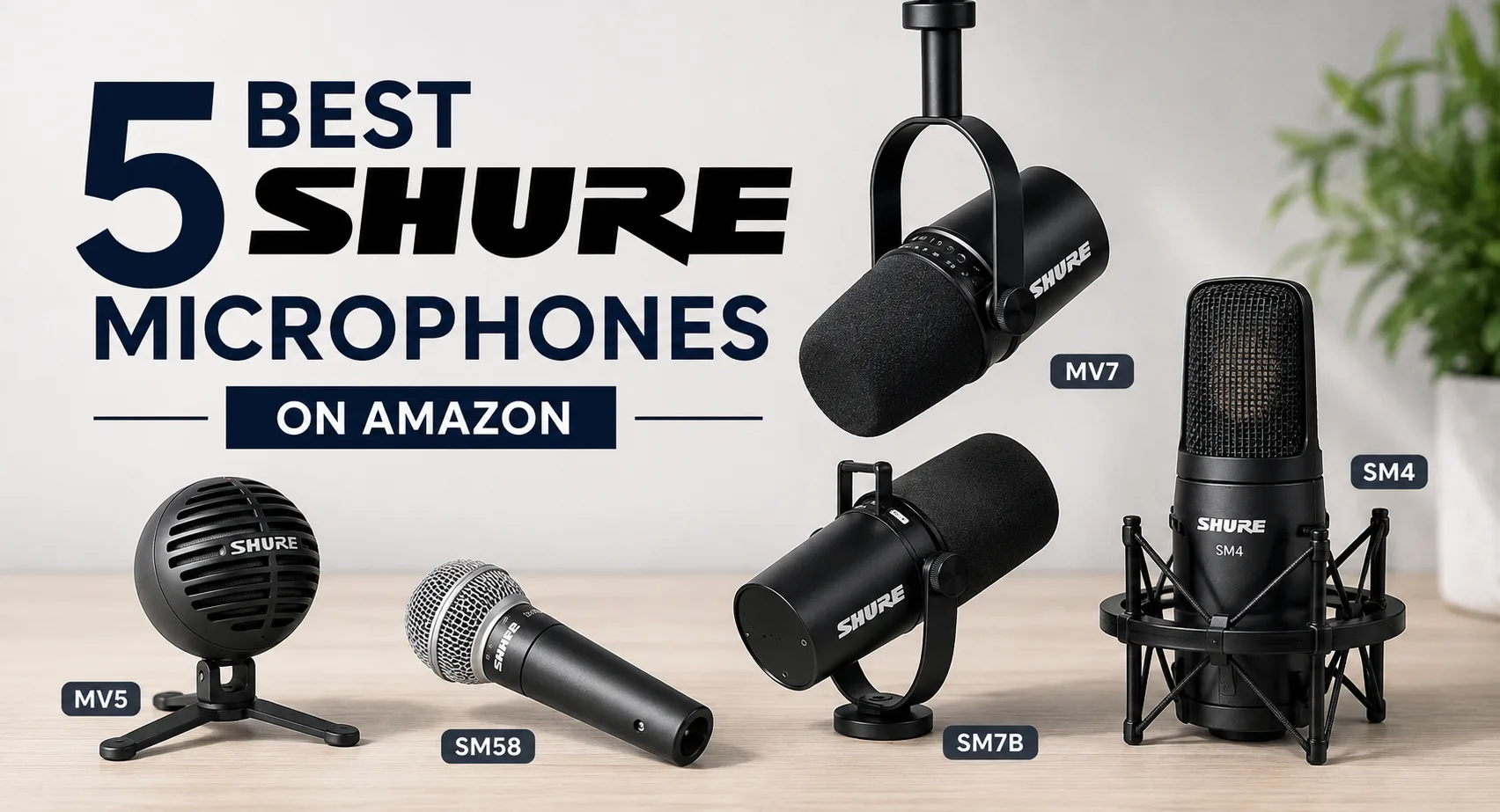
Discover the 5 best Shure microphones on Amazon in 2026, from the SM58 and SM57 to the SM7B, SM7dB, and MV7+.
If you want a microphone that can last for years, Shure is one of the first brands worth considering — the company makes microphones for singers, musicians, podcasters, streamers, broadcasters, and home studios. But choosing the right Shure microphone isn’t as simple as picking the most expensive model.
The SM58 is famous for vocals and live performances. The SM57 is a classic choice for instruments and recording. The SM7B is built around professional voice recording, broadcasting, podcasting, and studio work. The newer SM7dB adds a built-in preamp to make the SM7B-style workflow easier. And the MV7+ combines USB-C and XLR connectivity with digital processing aimed at modern creators.
For this guide, I compared these models by intended use, pickup pattern, connectivity, design, manufacturer specifications, and the type of buyer each one serves.
Building a home recording setup? See Amazon Microphones for Computer and Amazon Wireless Microphones — both help if you’re deciding between a traditional XLR microphone and a wireless setup.
Research note: This article is based on product research, manufacturer specifications, current Amazon product listings, and buyer-feedback patterns. I did not personally purchase or hands-on test these microphones. Amazon availability can change by location and seller, so check the live Amazon page before buying.
Table of Contents


Quick Comparison
| Product | Best For | Key Feature | Buyer Sentiment |
|---|---|---|---|
| Shure SM58 | Live vocals and speech | Cardioid dynamic design + built-in pop/wind filter | Consistently popular among vocal users |
| Shure SM57 | Instruments and studio recording | Focused cardioid pickup, rugged construction | Widely regarded as a dependable recording classic |
| Shure SM7B | Podcasting and professional voice | Smooth wide-range response + internal shock isolation | Strong long-term reputation among voice creators |
| Shure SM7dB | Voice recording with simpler gain setup | Built-in switchable preamp | Popular for SM7B-style sound without a separate gain booster |
| Shure MV7+ | Podcasting, streaming, hybrid setups | USB-C + XLR, DSP, Auto Level | Strong choice for modern content creators |
Amazon availability: These are active listings researched for this article. Sellers, offers, and delivery availability can vary by location — always check the live product page before purchasing.
1. Shure SM58
Best for: Live Vocals
The SM58 is probably the safest choice if your main goal is singing or speaking into a handheld microphone. It’s a dynamic vocal microphone designed for live performance, sound reinforcement, and studio recording — a cardioid dynamic mic with a vocal-focused frequency response, a pneumatic shock-mount system, and a built-in spherical wind and pop filter.
You don’t need a complicated setup: hold it, aim it toward the singer or speaker, connect the XLR cable, and send the signal to a mixer or audio interface. It’s not a USB microphone, has no software controls, and doesn’t try to be everything at once — that simplicity is one of its biggest strengths.
The cardioid pickup pattern focuses on sound from the front while reducing sound from the rear, useful on stage since the microphone doesn’t need to capture the entire room. Shure lists a frequency response of 50 Hz–15 kHz, tailored for vocals with a brightened midrange and bass rolloff. The internal pneumatic shock mount reduces handling noise, and the built-in spherical wind/pop filter controls breath and wind noise without needing a separate external pop filter for normal vocal use. The steel mesh grille suits frequent transport and handling.
Key specs: Dynamic vocal microphone · cardioid pattern · XLR · 50 Hz–15 kHz · built-in spherical wind/pop filter · internal pneumatic shock mount · rugged handheld design
| ✅ Pros | ❌ Cons |
|---|---|
| Excellent for live singing | Not a USB microphone |
| Strong option for public speaking | Requires an XLR cable and suitable input |
| Cardioid pattern reduces unwanted sound | Not the best choice for onboard digital controls |
| Built-in pop and wind filter | Less suited to desk-based podcasting than the MV7+ or SM7B |
| Durable, simple XLR workflow |
What buyers say: feedback tends to focus on reliability, vocal clarity, and durability — buyers wanting a straightforward stage microphone often value the simple design more than extra features. A microphone doesn’t become better simply because it has more controls; for live vocals, a focused dynamic microphone can be exactly what you need.
Who should buy it: singers, live performers, public speakers, church speakers, karaoke users, band members, and anyone who wants a durable handheld microphone to buy once and use for years.
Who should skip it: if you want to plug directly into a laptop via USB-C, look at the MV7+ instead. For a broadcast-style desk microphone for close voice recording, the SM7B or SM7dB makes more sense.
🔗 Check Price and Availability on Amazon
2. Shure SM57
Best for: Instruments
One of the most useful microphones here if you record instruments. Shure positions the SM57 for drums, percussion, guitar amplifiers, bass amplifiers, saxophones, trumpets, and other instruments — it can also handle vocals. The main difference from the SM58 isn’t simply “instruments vs. singers”; their designs overlap more than many beginners realize.
The SM57 has a contoured frequency response and a uniform cardioid pickup pattern, isolating the main source while reducing background noise — especially useful when placing the mic close to a specific sound source. It’s built to handle loud sources, making it useful around guitar cabinets, snare drums, and brass instruments that create high sound pressure. Shure lists a frequency response of 40 Hz–15 kHz, plus an internal pneumatic shock-mount system to reduce handling noise. It’s a traditional XLR dynamic microphone — a natural fit for mixers, interfaces, studio preamps, and live sound systems.
Key specs: Dynamic instrument microphone · cardioid pattern · XLR · 40 Hz–15 kHz · pneumatic shock-mount system · rugged construction · no USB
| ✅ Pros | ❌ Cons |
|---|---|
| Excellent for guitar amplifiers | Not designed primarily as a plug-and-play computer mic |
| Very useful for snare drums | Requires XLR equipment |
| Good for brass and other instruments | No modern USB/DSP controls |
| Cardioid pattern helps control bleed | Vocal users may prefer the SM58’s built-in vocal filter |
| Handles demanding sound sources, strong durability |
SM57 vs. SM58: The SM58 is optimized for handheld vocal use, with a spherical grille and built-in pop/wind filter practical for singers and speakers. The SM57 has a smaller grille and is particularly suited to close-miking instruments. If your main job is singing, start with the SM58. If your main job is recording instruments, start with the SM57.
Can the SM57 record vocals? Yes — Shure notes it can provide rich vocal pickup, but that doesn’t mean it should automatically replace an SM58 for every singer; the SM58 is simply more convenient for handheld vocal work.
Who should buy it: anyone recording guitar amps, bass amps, snare drums, percussion, brass, acoustic instruments, live instruments, or studio sources — also a strong first professional microphone for musicians.
🔗 Check Price and Availability on Amazon
3. Shure SM7B
Best for: Professional Voice Recording
If your main goal is podcasting, broadcasting, voice-over work, or professional vocal recording, the SM7B is the most famous microphone in this comparison — closely associated with podcast studios, radio-style recording, streaming, and professional voice work.
Important before ordering: the SM7B is an XLR dynamic microphone, not USB, and benefits from a strong microphone preamp — Shure notes it operates best with preamps providing around 60 dB of gain, depending on the interface. The microphone itself is only part of the system.
The SM7B uses a smooth, flat, wide-range frequency response designed for music and speech, different from the more vocal-tailored character of the SM58. It’s built for close voice recording, with an internal air-suspension shock isolation system to reduce mechanical noise and built-in pop filtering for breath sounds and plosives. Its cardioid pattern focuses on the front while reducing sound from other directions — helpful in home studios where the room isn’t perfectly treated. It also includes physical controls for bass rolloff and midrange presence.
Key specs: Dynamic vocal microphone · cardioid pattern · XLR · wide-range response for music and speech · internal air-suspension shock isolation · built-in pop filtering · bass rolloff and midrange presence controls · yoke mounting · designed for close voice applications
| ✅ Pros | ❌ Cons |
|---|---|
| Excellent for podcasting and broadcasting | Requires XLR equipment |
| Excellent for voice-over work | Can need substantial preamp gain |
| Smooth vocal character, strong background rejection | Usually more complicated to set up than USB mics |
| Internal shock isolation, built-in pop protection | A boom arm or suitable stand is normally needed |
| Long-established professional reputation | Not the simplest first microphone for casual users |
Does it need an audio interface? For a traditional setup, yes — you need an audio interface, mixer, or suitable microphone input with enough clean gain. Check your interface before buying; if it doesn’t provide enough gain, you may need an inline booster.
For podcasting: the cardioid pattern and close-talk design make it a natural fit for spoken voice, with shock isolation and pop filtering helping reduce mechanical and plosive noise. Still, technique matters — even an expensive microphone can’t fully fix poor placement, so speak consistently toward the front and keep a stable working distance.
For streaming: popular here too, but consider desk space — the SM7B is larger than many compact USB microphones, and a boom arm is often more practical than a small desktop stand.
SM7B vs. SM7dB: the big difference is gain management. The SM7dB adds a built-in preamp with selectable gain, simplifying the setup. If you already have a strong interface and enjoy managing your own signal chain, the SM7B remains a great choice; if you want more built-in gain flexibility, the SM7dB may be easier.
Who should buy it: podcasters, broadcasters, voice-over artists, streamers, recording professionals, and serious home-studio vocal creators.
🔗 Check Price and Availability on Amazon
4. Shure SM7dB
Best for: Built-In Preamp / Easier Gain Management
An interesting choice because it solves one of the biggest setup questions surrounding the SM7B: gain. Shure describes the SM7dB as a dynamic vocal microphone with a built-in preamp providing up to +28 dB of low-noise, flat, transparent gain, with selectable +18 dB or +28 dB boosts and a bypass switch. In simple terms — more gain flexibility built into the microphone itself, making the overall setup easier.
The SM7dB follows the same general design as the SM7B, aimed at creators who want the familiar SM7-style form factor with less dependence on a high-gain microphone preamp — especially interesting for home studio users whose interface works well with many microphones but struggles to provide enough gain for the SM7B. A bypass option lets you deactivate the internal preamp and use the microphone closer to the traditional SM7B signal path, adding flexibility.
Key specs: Dynamic vocal microphone · cardioid pattern · XLR · built-in preamp · selectable +18 dB or +28 dB gain boost · preamp bypass · wide-range vocal response · professional studio-style construction
| ✅ Pros | ❌ Cons |
|---|---|
| Built-in preamp, easier to pair with more interfaces | Still requires an XLR connection |
| Familiar SM7-style design | More complex than a basic dynamic microphone |
| Selectable gain, preamp can be bypassed | Built-in electronics need appropriate power from the audio chain |
| Good for podcasting and voice-over work | More expensive than basic Shure dynamic models |
| Professional XLR workflow | May be unnecessary if your interface already has plenty of gain |
Why the built-in preamp matters: imagine a basic audio interface — plug in the SM7B, turn gain almost all the way up, and hear more noise than you want. The SM7dB’s built-in gain reduces pressure on the interface’s mic preamp. That doesn’t mean every interface needs it — if yours already provides enough clean gain, the SM7B works perfectly well. But for a simpler signal chain, the SM7dB is attractive.
SM7dB vs. SM7B: the SM7B is the classic model; the SM7dB adds a preamp. The SM7dB makes sense for newer creators who want the SM7 design without figuring out external gain solutions. The SM7B makes more sense if you already have a capable interface and prefer the traditional signal chain.
For podcasting and streaming: yes to both — its intended use fits spoken voice well, and it’s particularly appealing for creators who want an XLR microphone rather than USB-only. If you’re building your first streaming setup from zero, a USB/XLR microphone like the MV7+ can be easier; if you already own an XLR interface, the SM7dB becomes much more attractive.
Who should buy it: podcasters, streamers, broadcasters, voice-over creators, home studios, users with modest-gain interfaces, and anyone who wants simpler XLR gain management.
🔗 Check Price and Availability on Amazon
5. Shure MV7+
Best for: Modern Content Creators
Probably the most flexible microphone in this comparison, because it supports both USB-C and XLR. Connect it directly to a computer or compatible mobile device through USB-C, or use an XLR connection with a traditional audio interface. Shure also adds digital processing: Voice Isolation Technology, Auto Level Mode, a digital pop filter, real-time denoiser, compressor, limiter, EQ controls, reverb options, and a headphone output — a very different approach from the SM58 and SM57.
Built for podcasters, streamers, YouTubers, voice creators, musicians, online educators, and home-office users. The USB-C connection makes it much easier to start with than an XLR-only microphone — no separate audio interface needed to begin recording. At the same time, the XLR output gives you an upgrade path: start with USB, later add an audio interface and move to an XLR workflow. That flexibility is one of the MV7+’s biggest advantages.
Key specs: Dynamic microphone · cardioid pattern · USB-C and XLR · 50 Hz–16 kHz · 3.5mm headphone output · Auto Level Mode · Digital Popper Stopper · real-time denoiser, compressor, limiter · EQ/tone controls, reverb options · touch-to-mute LED panel · metal housing · compatible with Shure MOTIV software/apps
| ✅ Pros | ❌ Cons |
|---|---|
| USB-C and XLR connectivity | More complicated than a basic dynamic microphone |
| Excellent for podcasting and streaming | USB features depend on software/device compatibility |
| Built-in digital processing, Auto Level Mode | Not the same traditional workflow as an SM58 |
| Digital pop filtering, real-time denoiser | Digital processing may be unnecessary for some users |
| Headphone monitoring, touch mute, flexible upgrade path | Larger than many small USB microphones |
Why USB-C matters: with an SM58, SM57, SM7B, or SM7dB, you’re dealing with an XLR workflow. With the MV7+, connect directly via USB-C — put the microphone on a stand or boom arm, connect the cable, select the microphone on your computer, and start recording. Less hardware to buy.
Why XLR still matters: it gives the MV7+ a longer life in your setup. Start as a beginner with USB; later upgrade your interface and keep the same microphone — a major advantage over replacing your mic entirely when your setup becomes more advanced.
For podcasting: one of its best uses — Shure specifically says the MV7+ uses its highly directional cardioid pattern together with digital processing to isolate the voice and reduce unwanted background sound, useful in a home office without a professionally treated room.
For streaming: the touch panel provides mute control and can function as an audio meter, the headphone output allows real-time monitoring, USB simplifies computer use, and XLR provides a path toward a more advanced setup.
MV7+ vs. SM7B: a much closer comparison than SM58 vs. SM7B. The SM7B is a traditional professional XLR microphone; the MV7+ is a modern hybrid. If you already own a high-quality interface and want a traditional analog signal path, the SM7B may be more attractive. If you want USB now and XLR later, the MV7+ is more practical.
Who should buy it: new podcasters, YouTubers, streamers, online teachers, home-office users, musicians, anyone who wants USB and XLR together, and people recording in untreated rooms.
🔗 Check Price and Availability on Amazon
How to Choose the Right Shure Microphone
Stop asking “Which microphone is best?” and start asking “Which microphone is best for what I do?” There’s no single winner for every person.
1. Start with your main use.
| Use case | Recommended model |
|---|---|
| Singing | SM58 — vocal-focused response, cardioid pattern, built-in pop/wind filter |
| Instruments | SM57 — guitar amps, drums, percussion, brass |
| Podcasting | SM7B (classic), SM7dB (built-in preamp), or MV7+ (most flexible, USB-C) |
| Streaming | MV7+ is easiest; SM7B/SM7dB make sense if you already have a professional XLR setup |
2. Decide between USB and XLR. USB is easier — connect directly to a compatible computer or device with less equipment, ideal for beginners (the MV7+ is the USB-C choice here). XLR is more flexible for professional audio setups — connecting to an interface, mixer, or professional equipment — but the SM58, SM57, SM7B, and SM7dB all require more equipment to get running.
3. Think about your room. A condenser microphone captures a lot of room sound; dynamic microphones are often a better fit for spoken voice in noisy or untreated rooms — one reason Shure’s dynamic range works well for podcasting, streaming, and live use. The MV7+ goes further with digital voice isolation and denoising. No microphone fully eliminates a bad room, though — closing windows, turning off noisy fans, moving away from hard reflective walls, adding soft furnishings, recording closer to the mic, using a boom arm, and keeping mic position consistent all help.
4. Consider microphone gain. This matters most with the SM7B — Shure notes it benefits from substantial preamp gain, and even an excellent microphone can disappoint if the interface can’t provide enough clean gain. If you don’t want to worry about this, the SM7dB gives you built-in preamp gain, or the MV7+ sidesteps the issue with a direct USB connection.
5. Do you need software? For a traditional, simple microphone, the SM58 or SM57. For software control — gain, EQ, compression, limiting, denoising — the MV7+’s MOTIV software is much more interesting. The SM7B takes the opposite approach: physical controls, with more processing left to the rest of your signal chain. Neither is automatically better — it depends on how much control you want.
6. Do you move the microphone often? Singing on stage → you likely hold the SM58. Recording an instrument → the SM57 may stay mounted near the source. Podcasting → the SM7B, SM7dB, and MV7+ are more likely on a boom arm. A microphone perfect for a desk may be inconvenient on stage, and vice versa.
7. Consider your upgrade path. A first-time XLR purchase also requires an XLR cable, audio interface, stand or boom arm, and headphones — the total setup gets larger fast. A USB microphone is simpler to start. The MV7+ has an unusual advantage here: it can start as USB and later work through XLR, so you don’t necessarily need to replace the microphone when you upgrade the rest of your equipment.
Shure SM58 vs. SM57
Often compared because they’re both classic Shure dynamic microphones. The easiest way to separate them is by intended use: choose the SM58 for vocals, the SM57 for instruments. The SM58 has a vocal-focused response and built-in spherical pop/wind protection; the SM57’s response and design suit instruments, amplifiers, drums, and percussion. There’s overlap — the SM57 can record vocals, and the SM58 can be used in other situations — but if you’re buying one microphone for a clear primary purpose, this distinction is the useful shortcut.
Shure SM7B vs. SM7dB
Simpler still. The SM7B is the traditional model; the SM7dB adds a built-in preamp with selectable +18 dB or +28 dB gain and a bypass option. If your interface already has strong gain, the SM7B may be enough. If you want easier gain management, consider the SM7dB.
Shure SM7B vs. MV7+
These target similar users but have different workflows.
Choose the SM7B if: you already have an XLR interface, want the classic SM7 design, prefer a traditional analog signal path, are comfortable managing preamp gain, and want a professional studio microphone.
Choose the MV7+ if: you want USB-C, want XLR too, want built-in DSP and software control, want Auto Level Mode and headphone monitoring, and are building a modern creator setup.
For a beginner, the MV7+ is generally easier to integrate. For an experienced audio user with the right interface, the SM7B remains highly compelling.
Is a Shure Microphone Worth Buying?
For the right buyer, yes — the important thing is not to buy a Shure simply because the logo is famous, but to choose the model that matches your job:
- The SM58 is worth considering if you sing or speak live.
- The SM57 is worth considering if you record instruments.
- The SM7B is worth considering if you want a professional voice microphone and already understand XLR recording.
- The SM7dB is worth considering if you want SM7-style voice recording with built-in gain assistance.
- The MV7+ is worth considering if you want a modern USB/XLR setup with digital controls.
How We Researched These Microphones
This is a research-based buying guide — I did not purchase these microphones for hands-on testing. The comparison is based on current Amazon product listings, Amazon product-page information, manufacturer specifications, Shure’s official product documentation, intended-use information, design differences between models, general buyer-feedback patterns, and connectivity/workflow comparisons.
Specifically: Shure’s official SM58 information confirms its vocal-focused response, cardioid pickup pattern, shock-mount system, and built-in spherical wind/pop filter. The SM57 documentation confirms its instrument-focused design, cardioid pattern, handling-noise reduction, and 40 Hz–15 kHz frequency response. For the SM7B, Shure documents the wide-range response, cardioid pattern, internal air suspension, and pop filtering. For the MV7+, Shure documents USB-C/XLR connectivity, voice isolation, Auto Level Mode, and onboard DSP. For the SM7dB, Shure documents the built-in preamp and selectable gain boost. This approach is more honest than pretending to have personally tested products that weren’t purchased.
Related TechRigReview Guides
If you’re building a complete home-office or creator audio setup:
- 10 Best Amazon Microphones for Computer — useful if your main goal is computer recording, calls, podcasting, or streaming
- 10 Best Amazon Wireless Microphones — useful if you need wireless audio for video, interviews, vlogging, or mobile recording
- 10 Best Amazon Vlogging Equipment for Beginners — useful if the microphone is only one part of your creator setup
FAQ
What is the best Shure microphone on Amazon?
No single best model for every user. For live vocals, the SM58. For instruments, the SM57. For professional voice recording, the SM7B. For easier gain management, the SM7dB. For USB-C plus XLR flexibility, the MV7+.
Is the Shure SM58 good for singing?
Yes — specifically designed for professional vocal use, live performance, and sound reinforcement, with a built-in spherical wind and pop filter. Its cardioid pattern helps reduce unwanted sound from behind the microphone, especially useful for live singing.
Is the Shure SM57 good for vocals?
Yes, though strongly associated with instruments — Shure notes it can provide rich vocal pickup. The SM58 is usually the more obvious choice for handheld vocal use since its grille and built-in filter are designed around vocals specifically.
Is the Shure SM7B good for podcasting?
Yes. Designed for speech and music, with internal air-suspension shock isolation and pop filtering suited to close voice recording. Remember it uses XLR and can require significant clean gain.
Does the Shure SM7B need an audio interface?
For a normal XLR setup, yes — you need a suitable XLR microphone input, and the interface or preamp needs to provide enough clean gain. An additional gain solution may be required if it doesn’t.
Is the SM7dB easier to use than the SM7B?
In terms of gain management, yes. It includes a built-in preamp with selectable +18 dB and +28 dB gain boosts, and can bypass the preamp — giving it more flexibility across different interfaces.
Is the Shure MV7+ USB or XLR?
Both. It has USB-C and XLR outputs, plus digital processing through Shure’s software and apps — a strong option for starting with USB and potentially moving to XLR later.
Which Shure microphone is best for a beginner?
For a singer wanting a simple live microphone, the SM58. For a beginner podcaster or streamer wanting computer connectivity, the MV7+ (USB-C support). For a beginner building a serious XLR studio, the SM7B or SM7dB — but the rest of the audio chain matters too.
Which Shure microphone is best for a home studio?
Depends what you record. Vocals/spoken voice → SM7B, SM7dB, or MV7+. Instruments → SM57. Live vocals in a studio or rehearsal environment → SM58 is also practical.
Are Shure microphones good for streaming?
Yes. The SM7B and SM7dB are popular for voice-focused streaming setups; the MV7+ is particularly convenient with USB-C + XLR, Auto Level Mode, digital pop filtering, and voice isolation.
Should I buy a Shure SM58 or a USB microphone?
If you primarily sing live, choose the SM58. If you want to record directly into a computer without an audio interface, a USB microphone is simpler. For both simplicity and an upgrade path, the MV7+ is worth considering.
Do Shure microphones need phantom power?
Depends on the model. Traditional dynamics like the SM58 and SM57 don’t need it, and the SM7B itself doesn’t require it either. The SM7dB’s built-in preamp requires appropriate power through the XLR setup — always follow Shure’s documentation for your exact model.
Final Verdict
The best Shure microphone depends on the job.
If you’re a singer or live performer, start with the Shure SM58 — simple, rugged, and designed around vocals.
If you’re a musician recording instruments, the Shure SM57 is the strongest choice here — focused cardioid pickup and instrument-oriented design that works in both live and studio environments.
If you’re a podcaster, broadcaster, or professional voice creator, the Shure SM7B remains an excellent option — just make sure your audio interface can provide the gain it needs.
If you like the SM7B concept but want easier gain management, look at the Shure SM7dB — its built-in preamp can simplify the signal chain.
For a modern content creator, the Shure MV7+ is arguably the most flexible choice — USB-C makes it easy to start, XLR gives you room to upgrade, and its digital processing suits home podcasting and streaming well.
Quick picks:
- Best for live vocals → Shure SM58
- Best for instruments → Shure SM57
- Best for professional voice → Shure SM7B
- Best for easier SM7-style gain → Shure SM7dB
- Best for USB + XLR creators → Shure MV7+
Before ordering, check the current Amazon listing, seller, delivery information, and included accessories — offers can change.
Amazon Associates Disclosure: As an Amazon Associate I earn from qualifying purchases.

MD.HASAN is an experienced SEO expert and amazon products review writer passionate about helping people find right products on amzon for buy without confusion. With 4 years of hands-on experience in content strategy and search engine optimization, he specializes in writing SEO-friendly blog posts that rank, engage, and convert.