🔗 Affiliate Disclosure: As an Amazon Associate, Tech Rig Review earns from qualifying purchases. Links on this page may be affiliate links — at no extra cost to you.
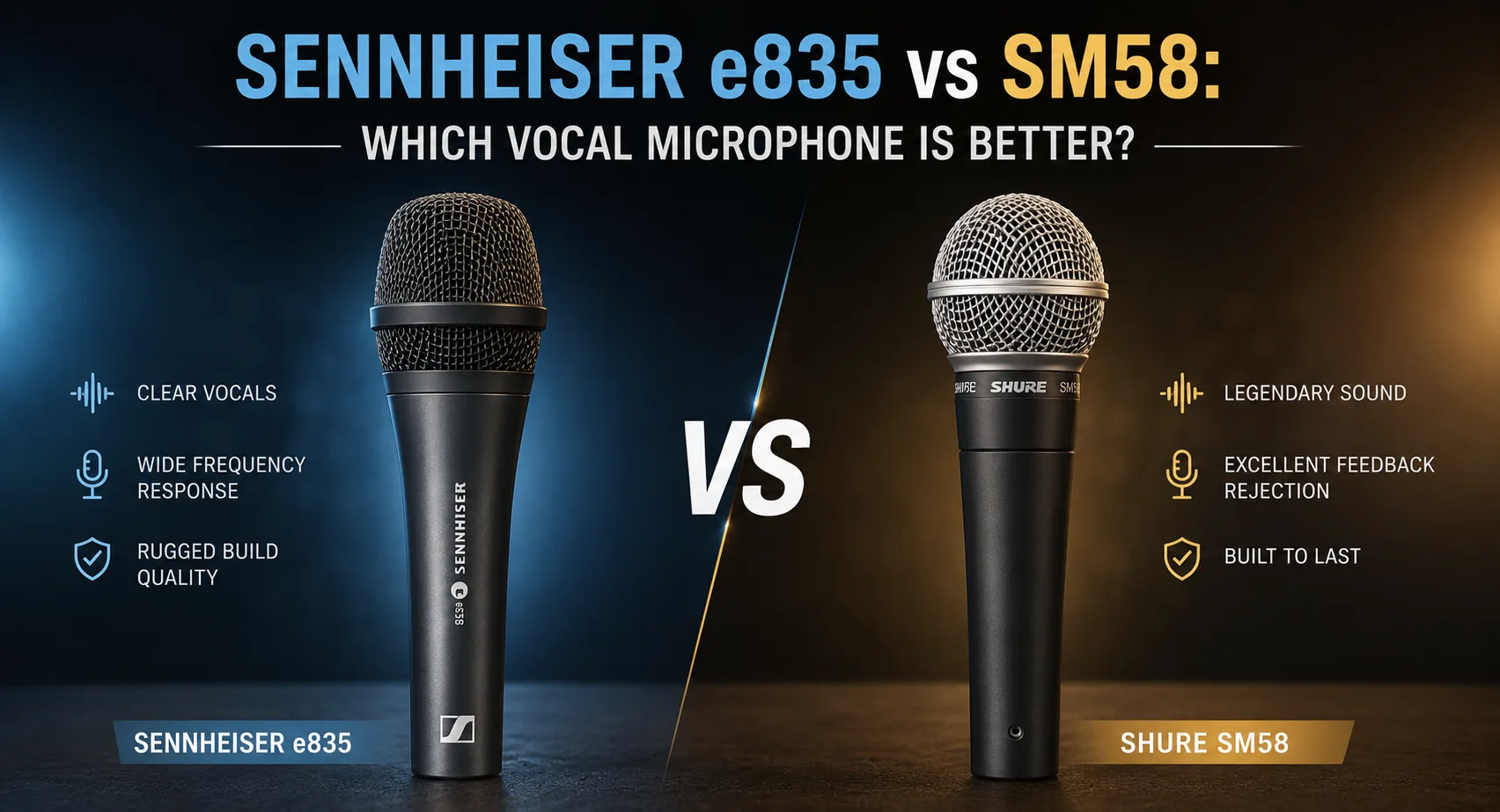
Sennheiser e835 vs Shure SM58: Compare sound, build, pickup pattern, specs, live vocals, recording, and value to find the right microphone for your setup.
Quick Answer
If you’re deciding between the Sennheiser e835 and Shure SM58, you’re already looking at two proven dynamic vocal microphones. Both are cardioid, both use XLR, both are built for demanding vocal work, and both are popular for live performance, speech, rehearsal, and recording. The difference is in how they shape the voice.
The Sennheiser e835 has a 40 Hz–16 kHz frequency response and is designed to give vocals a clear, present sound. Sennheiser also highlights its feedback rejection, handling-noise isolation, and rugged metal body.
The Shure SM58 has a 50 Hz–15 kHz response, a cardioid dynamic design, built-in spherical pop and wind protection, a pneumatic shock mount, and a steel mesh grille.
My research-based verdict: choose the Sennheiser e835 if you want a slightly wider published frequency range and a vocal sound that emphasizes clarity and presence. Choose the Shure SM58 if you want the classic, proven live-vocal design, strong handling-noise protection, and an enormous track record in live sound.
Research note: I did not buy or personally test either microphone. This comparison is based on manufacturer specifications, product documentation, Amazon listing information, and research into common buyer feedback patterns.
Table of Contents

Comparison Table
| Feature | Sennheiser e835 | Shure SM58 |
|---|---|---|
| Microphone type | Dynamic | Dynamic |
| Pickup pattern | Cardioid | Cardioid |
| Connection | 3-pin XLR | 3-pin XLR |
| Published frequency response | 40 Hz–16 kHz | 50 Hz–15 kHz |
| Weight | About 330 g | About 330 g |
| Main strength | Clear, present vocal reproduction | Proven live-vocal performance |
| Handling protection | Internal design for handling-noise isolation | Pneumatic shock mount |
| Pop protection | Grille design | Built-in spherical filter |
| Best for | Vocal clarity and stage use | Live vocals, speech, and reliability |
| Amazon ASIN | B00006I5R7 | B000CZ0R42 |
The Amazon product pages for these ASINs were resolving on Amazon.com during research. Because availability can change by seller, stock level, and delivery location, check the live listing before buying.
1. Sennheiser e835

- Cardioid pickup pattern: Provides good signal isolation and feedback rejection, enabling higher sound levels to be obtai…
- Balanced frequency response: Maintains signal quality when moving on and off axis during performance
- Gentle presence boost: Ensures vocal clarity and projection
Best For: Clear, Present Vocals
The Sennheiser e835 is a straightforward microphone built around one important job: capturing vocals clearly in real-world environments. It’s a dynamic cardioid microphone with a standard 3-pin XLR connection, designed for connection to a mixer, audio interface, PA system, or other compatible microphone input.
Sennheiser lists the e835 with a 40 Hz–16,000 Hz frequency response, a 350-ohm nominal impedance, and a sensitivity of 2.7 mV/Pa. It measures 180 mm long and 48 mm in diameter and weighs about 330 grams.
Those specifications only tell part of the story, though. The e835 is especially interesting for singers and presenters who want the voice to stay clear when other sounds are present — Sennheiser specifically describes it as having excellent feedback rejection and handling-noise isolation. That matters on stage, where a microphone has to deal with far more than the singer’s voice: monitors, speakers, instruments, audience noise, movement, cable noise, and room reflections. A good cardioid dynamic microphone helps focus the pickup toward the performer while reducing unwanted sound from other directions.
👉 Check the Sennheiser e835 on Amazon
Key Specs
- Type: Dynamic
- Pickup pattern: Cardioid
- Frequency response: 40 Hz–16 kHz
- Connection: 3-pin XLR
- Nominal impedance: 350 ohms
- Sensitivity: 2.7 mV/Pa
- Length: 180 mm / Diameter: 48 mm
- Weight: Approximately 330 g
- Construction: Rugged metal housing
What Makes It Different
The biggest difference isn’t just the number beside the frequency response — the e835 is voiced specifically as a vocal microphone. Sennheiser describes it as providing definition and detail while helping vocals maintain presence in a mix. That’s useful when singing with a full band: a vocal microphone doesn’t need to make the voice sound huge in isolation, it needs to help the voice remain understandable once guitars, drums, keyboards, and bass enter the mix. This is one reason dynamic cardioid microphones remain popular for live performance.
The e835 also has a practical advantage for performers who move the microphone during a performance — a singer may not keep the exact same distance or angle throughout a song, and a microphone that remains usable through small position changes is easier to work with.
Pros
- Clear and present vocal character
- Dynamic capsule works well for live vocal use
- Cardioid pickup helps reduce unwanted sound
- Rugged metal housing
- Excellent feedback rejection as a stated design feature
- Standard XLR connection
Cons
- Requires an XLR-compatible input — not a USB plug-and-play microphone
- 350-ohm impedance may matter in some long-cable or low-gain setups
- Doesn’t have the instantly recognizable SM58 form factor
Buyer Sentiment: Strong reputation among buyers looking for a serious stage vocal microphone, particularly where clarity and feedback control matter.
What Buyers Commonly Look For: Research around the e835 shows buyers often focus on clarity, isolation, and its ability to work well in less-than-perfect recording environments — a home office with computer fans, keyboards, air conditioning, or nearby traffic, for example, is easier to manage with a cardioid dynamic microphone than with a highly sensitive condenser. That doesn’t mean the e835 magically removes background noise; the singer should stay close enough to produce a strong direct signal, and the microphone should be aimed correctly. Shure’s own microphone guidance notes that directional microphones reject more sound from unwanted directions, and that placement can have a major impact on the final recording.
Who Should Buy It: Anyone who sings live regularly, performs in small or medium venues, needs a durable handheld microphone, wants clear vocal presence, or records vocals through a mixer or audio interface. If your goal is simply to plug a microphone directly into a laptop, this isn’t the right type — you’d need an audio interface or compatible XLR-to-USB solution.
2. Shure SM58

- LEGENDARY VOCAL CLARITY: A finely tuned frequency response with subtle midrange lift delivers warm, articulate vocals th…
- TRUSTED WORLDWIDE: The microphone of choice for artists and performers everywhere, from small venues to major stages, de…
- PRECISION CARDIOID PERFORMANCE: A uniform cardioid pickup pattern focuses tightly on your voice while minimizing backgro…
Best For: Proven Live Performance
The Shure SM58 is one of the most recognizable live vocal microphones ever made, and its design is simple: a cardioid dynamic vocal microphone with a standard professional XLR connection. Shure lists its frequency response as 50 Hz–15 kHz.
But its popularity isn’t based on specifications alone — the SM58 has been used for decades in live performance, sound reinforcement, speech, and recording. Shure’s 2026 announcement marking 60 years of the SM58 says the model remains in production and continues to be used for live performance. A microphone that’s stayed relevant for decades has had plenty of time to prove its basic design works.
The SM58 uses a uniform cardioid pickup pattern, which Shure says helps isolate the main sound source while reducing unwanted background noise. It also has a pneumatic shock-mount system designed to reduce handling noise, and the grille includes a built-in spherical wind and pop filter — useful for singers and speakers who hold the microphone in their hand.
👉 Check the Shure SM58-LC on Amazon
Key Specs
- Type: Dynamic
- Pickup pattern: Cardioid
- Frequency response: 50 Hz–15 kHz
- Connection: Three-pin professional XLR
- Weight: Approximately 330 g
- Housing: Die-cast metal
- Grille: Steel mesh
- Shock protection: Pneumatic shock mount
- Pop protection: Built-in spherical filter
What Makes It Different
The SM58 is less about chasing impressive numbers and more about consistency. Its frequency response doesn’t extend as high on paper as the e835’s, but that doesn’t automatically make it worse — microphones aren’t judged by maximum frequency range alone. The shape of the response, the capsule, the polar pattern, the room, the voice, the distance, and the PA system all matter.
Shure specifically describes the SM58 as having a vocal response with a brightened midrange and bass rolloff — important for live vocals, since a microphone can sound impressive alone but become difficult to mix once the full band starts playing. The SM58’s design is focused on producing a usable vocal signal in a live environment.
Pros
- Proven live vocal design with decades of track record
- Strong background-noise rejection
- Built-in pop and wind protection
- Pneumatic shock mount
- Rugged die-cast metal construction
- Replaceable cartridge design
- Huge ecosystem of accessories and replacement parts
Cons
- Wired only — requires XLR equipment, no USB connection
- May sound less bright to some voices than other vocal microphones
- The standard SM58-LC doesn’t include an integrated on/off switch
That last point is worth flagging: Shure sells different SM58 versions. The standard SM58-LC and the SM58S (which has a switch) aren’t the same package — check the exact Amazon variant before purchasing.
Buyer Sentiment: Consistently well-regarded among buyers looking for a dependable dynamic vocal microphone. The Amazon listing associated with ASIN B000CZ0R42 identifies the product as the SM58-LC.
What Buyers Commonly Like: One reason the SM58 continues to sell is that it’s easy to understand — no complicated menus, no app, no battery, no Bluetooth pairing. Connect the XLR cable, set your gain, place the microphone correctly, and start working. That simplicity is a real advantage for live performers. The built-in shock mount also helps when the microphone is held in the hand, since handling noise can become distracting as performers move, grip the microphone, tap it, or change position — exactly what the SM58 is designed to address.
Who Should Buy It: Anyone who sings live, gives speeches, presents at events, performs in churches, works with a PA system, or wants a rugged handheld microphone with a long professional track record and simple equipment that doesn’t require software. It’s also a sensible first serious XLR vocal microphone.
Sound Quality: Which One Sounds Better?
There’s no universal answer. A microphone interacts with the singer — two people can use the same microphone and get very different results. The e835 and SM58 are both dynamic cardioid microphones, but they don’t have identical voicing.
Sennheiser gives the e835 a published response of 40 Hz–16 kHz; Shure gives the SM58 a published response of 50 Hz–15 kHz. The e835 has the wider published range on paper, but don’t mistake that for a guarantee of better sound — the human voice is complex. Your vocal tone may have strong low frequencies, another singer’s voice may be naturally bright, one speaker may have strong sibilance while another sounds darker. A microphone that sounds excellent on one person may sound only average on another.
The e835 sound is designed around vocal definition and presence, which can help when the vocal needs to cut through a mix — for a singer working with guitars and drums, clarity in the vocal range can matter more than extreme bass or treble extension.
The SM58 sound is designed around a tailored vocal response, with Shure specifically describing a brightened midrange and bass rolloff. That makes sense for live sound: too much low-frequency energy can make vocals sound muddy, and too much room sound can make a performance hard to control. The SM58’s cardioid pattern and vocal-focused response are intended to help solve exactly that.
Which One for Your Situation?
For singing, both are strong choices, and the decision often comes down to the singer. If your voice is naturally dark and you want more presence, you may prefer the e835. If you want a familiar live vocal sound with a very proven design, the SM58 is hard to ignore. Ask which microphone matches your voice and performance environment rather than which is “better” in isolation. Technique matters too — Shure recommends keeping a fairly consistent microphone distance, since moving closer or farther away changes the tonal balance, especially with directional microphones. A better microphone can’t completely fix poor technique.
For speaking, both work well. The SM58 has a long history in presentations, speeches, and sound reinforcement, while the e835 is also well suited to speech thanks to its clear vocal reproduction and feedback rejection. For a public speaker, the priorities are usually clear speech, low feedback risk, good handling performance, comfortable handheld use, reliable connection, and consistent output — both microphones meet those basics. The room itself may have a bigger impact than the difference between the microphones.
For home recording, this comparison gets more interesting. Dynamic microphones can be useful in untreated rooms because they’re generally less sensitive to room sound than many condenser microphones — though the pickup pattern still matters. Both the e835 and SM58 are cardioid, meaning they’re most sensitive toward the front and less sensitive toward the rear; Shure explains that cardioid microphones are commonly used because they reduce ambient sound and help isolate the desired source. For a room with a computer fan, mechanical keyboard, air conditioning, or street noise, a cardioid dynamic microphone can help you focus the recording on the voice. The e835 is particularly interesting here given its published range starting at 40 Hz, while the SM58 is also a strong option if you already know you like its vocal character.
For a noisy room, remember that neither microphone is a noise-cancellation microphone — a microphone doesn’t hear “voice” and automatically erase everything else. Its physical design just makes unwanted sounds less prominent, and placement matters a great deal. If the unwanted sound is behind the microphone, the directional pattern can help reduce it; if it’s directly beside the performer, results depend on polar response, frequency, distance, and room. For a noisy home office: keep the microphone close to your mouth, point the rear of the microphone toward the main unwanted noise source when practical, and keep your voice level strong so the microphone doesn’t need excessive gain.
Handling Noise and Feedback Rejection
Handling noise is easy to overlook until you actually use a microphone on stage. A handheld microphone gets moved — the performer may grip it tightly, the cable may move, the microphone may touch a stand or change hands — and these movements can create mechanical noise. The SM58 uses a pneumatic shock-mount system designed to reduce handling noise, and Sennheiser also specifically highlights handling-noise isolation in the e835 design. Both models address the problem; there’s no clear universal winner here.
Feedback is one of the biggest problems in live vocal sound — it happens when sound from the speaker system is picked up by the microphone and fed back into the system, producing a ringing or howling sound. Microphone choice is only part of the solution; speaker placement, monitor placement, microphone position, gain structure, and room acoustics all matter. Still, a directional vocal microphone helps: Sennheiser specifically lists excellent feedback rejection as an e835 feature, and Shure describes the SM58’s uniform cardioid pattern as helping isolate the main source and reduce unwanted background sound. Both microphones make sense for stage performers.
Build Quality
Both are built as working microphones, not delicate studio ornaments. The e835 uses a rugged metal housing; the SM58 uses a die-cast metal housing and steel mesh grille. That’s exactly what you want from a handheld stage microphone — one that can be transported in a bag, placed on a stand, handed between performers, and used several times a week.
The SM58 has an especially strong reputation for surviving demanding use, but the e835 is also built for stage work. I wouldn’t choose between these two based on durability alone — both are serious professional-style dynamic microphones.
The XLR Connection
Both microphones use XLR, which means neither is a direct USB computer microphone. You’ll usually need one of the following: an audio interface, a mixer, a PA system, an XLR-to-USB interface, or other compatible recording hardware. If you’re buying your first microphone for a computer, remember to calculate the cost of the complete setup — the microphone is only one part.
A basic recording chain looks like: Microphone → XLR cable → audio interface → USB → computer.
For live performance, it looks more like: Microphone → XLR cable → mixer → amplifier/PA.
This is different from a USB microphone, which connects directly to a computer.
Easier for Beginners? The SM58 Has a Slight Edge
The Shure SM58 may be easier for beginners to understand because its role is so clear: it’s a vocal microphone. Plug it into a mixer or interface, set the gain, put it close to your mouth, and start. The e835 isn’t any more complicated — it also uses XLR and works the same basic way.
The bigger question for either microphone is whether you already have the equipment needed to use an XLR microphone in the first place. If not, buying an audio interface is an important part of the decision.
For YouTube and Podcasting
For YouTube, either microphone can work, but the right choice depends heavily on how you record. If you sit at a desk and speak directly into the microphone, both can produce strong results when positioned correctly. If the microphone is several feet away, neither will sound as focused as it would at close range — for desk-based videos, keep the microphone reasonably close and use a boom arm or stand to get a strong direct voice signal while keeping room sound lower. If you move around while filming, a wireless microphone may be more convenient — see our related guide, 10 Best Amazon Wireless Microphones Under $90 in 2026, if a handheld XLR microphone isn’t the best match for your filming style.
For podcasting, both can work, and dynamic microphones are often a good option for untreated podcast rooms. The main consideration is gain — an XLR dynamic microphone may need more preamp gain than some USB condenser microphones, so check your audio interface’s specifications. A good podcast setup also benefits from correct technique: maintain a consistent distance, and keep the microphone slightly off-axis if plosive sounds are a problem. Shure’s vocal recording guidance recommends a relatively close microphone position and notes that distance changes affect both tone and level.
How to Choose Between Them
Choose the Sennheiser e835 if:
- You want clear vocal definition and prefer Sennheiser’s vocal voicing
- You want a published 40 Hz–16 kHz response
- You perform live and feedback rejection is important
- You want a rugged XLR microphone for a less-than-perfect room
Choose the Shure SM58 if:
- You want a classic live vocal microphone with strong handling-noise protection
- You value a long professional track record
- You sing live or give speeches/presentations
- You want a simple microphone with a huge accessory ecosystem
Don’t Choose Based on Frequency Response Alone
This is one of the biggest mistakes people make when comparing microphones. A frequency response number looks objective, but it doesn’t tell you how the microphone sounds. The e835’s published response is 40 Hz–16 kHz; the SM58’s is 50 Hz–15 kHz — it would be wrong to conclude the e835 automatically sounds better because its range is wider. The shape of the frequency response is far more important than the outer limits.
Think of it like a camera: two cameras may capture the same resolution but still produce different images. Microphones work similarly — the capsule, tuning, polar pattern, proximity behavior, off-axis response, room, and source all matter.
Microphone Placement Matters More Than You Might Think
A $100 microphone placed correctly can beat a much more expensive microphone placed badly. Start with the microphone close enough to capture a strong direct signal, then listen: if the voice is too bass-heavy, move back slightly; if the room is too noticeable, move closer; if plosives are strong, change the angle; if the voice sounds dull, adjust position before reaching for EQ. Shure’s recording guidance makes the same broader point — placement is a major part of getting a good recording. Neither the e835 nor the SM58 will “fix” a bad recording room on its own; the microphone helps, but technique still matters.
Do you need a pop filter? Both microphones have built-in protection — the SM58 has a built-in spherical wind and pop filter, and the e835’s grille design also supports vocal use. For normal singing and speaking, you likely don’t need a large external pop filter, though an additional foam windscreen can sometimes help for close-up home studio vocals. Try the microphone first before assuming you need one.
What about proximity effect? Both microphones are directional, so proximity effect matters — as you move closer to a directional microphone, bass response becomes stronger. This can be useful (a singer can use it to sound fuller) but can also become muddy. Shure explains that proximity effect causes low frequencies to become more pronounced as a directional microphone gets closer to the source. The simplest solution: keep your microphone distance consistent. Moving from two inches to eight inches away while singing can change your tone significantly, regardless of which microphone you choose.
Connecting to an Audio Interface or Laptop
Both are XLR microphones, so connect to an appropriate microphone input on an audio interface, then connect the interface to your computer. You may need to increase preamp gain to reach a healthy recording level — just avoid pushing it so high that background noise becomes excessive.
Neither microphone works directly through a normal headphone jack or USB port on a laptop — you need an appropriate interface or adapter. A proper USB audio interface is usually the better choice, giving you a cleaner signal path and making future upgrades easier:
- e835 → XLR cable → USB audio interface → laptop
- SM58 → XLR cable → USB audio interface → laptop
If you’re building a recording setup from scratch, a clean microphone preamp on your interface is a more important purchase than a large pile of accessories.
Live Performance vs. Studio Recording
For live performance, both are excellent candidates. The e835 has a strong case if your priority is vocal clarity and presence — Sennheiser specifically positions it as a stage microphone with feedback rejection and handling-noise isolation. The SM58 has the stronger argument if you value proven reliability and a long history of live use; Shure’s current documentation still positions it for professional vocal use, sound reinforcement, and studio recording. Slight edge: the SM58 for overall proven versatility, with the e835 a very strong alternative for performers who prefer its vocal character.
For studio recording, there’s no automatic winner. For home vocals, the e835 may appeal if you prefer a clear and present sound; the SM58 may appeal if you want a familiar vocal response and strong rejection of unwanted room sound. Professional engineers often own several microphones because different voices need different tools — don’t expect one microphone to be perfect for every singer.
For beginners, the SM58 gets a small edge — not because the e835 is difficult, but because of the sheer amount of information available about the SM58. Decades of tutorials, techniques, stands, clips, replacement grilles, cases, and accessories exist around the platform. The e835 is still a very beginner-friendly microphone in its own right.
Which One Should You Buy?
- Best for vocal clarity: Sennheiser e835 — a compelling choice for singers and speakers who want a clear, present vocal sound and strong stage performance.
- Best for proven live use: Shure SM58 — one of the safest choices for a live vocal microphone, with rugged construction, cardioid design, built-in pop protection, and a shock mount.
- Best first professional XLR vocal microphone: Shure SM58 — an easy recommendation if you’ve never owned a serious XLR vocal microphone before.
- Best alternative if you want a different vocal character: Sennheiser e835 — worth serious consideration if you’ve used an SM58 and want a different vocal presentation.
Buyer’s Guide: What to Check Before Ordering
1. Confirm the exact model. Sennheiser has several microphones with similar model numbers — make sure the listing says e835 if that’s what you want. The e835-S is a related model with an on/off switch and isn’t identical. For the standard e835 discussed here, the researched Amazon ASIN is B00006I5R7.
2. Check the SM58 variant. The standard SM58-LC doesn’t have an integrated on/off switch. Shure also offers versions like the SM58S — check the exact variant before ordering.
3. Make sure you have XLR equipment. Neither microphone is a USB microphone; you need a suitable XLR input.
4. Check what’s included. Don’t assume a cable is included — packages can differ. Always check the current Amazon listing.
5. Check the seller. For expensive audio equipment, pay attention to the seller and product condition. A genuine microphone from a reputable seller is preferable to an uncertain listing.
6. Don’t buy on star ratings alone. Ratings can change over time. Instead, look for repeated comments about vocal clarity, handling noise, build quality, feedback, reliability, connector quality, and long-term use — patterns are more useful than a single isolated review.
FAQ
Is the Sennheiser e835 better than the Shure SM58?
Not for every user. The e835 offers a different vocal voicing and a published 40 Hz–16 kHz response, while the SM58 uses a vocal-focused 50 Hz–15 kHz response and has a very long track record in live performance.
Is the Sennheiser e835 good for singing?
Yes. It’s a dynamic cardioid vocal microphone designed for live performance, with Sennheiser specifically highlighting vocal clarity, feedback rejection, and rugged construction.
Is the Shure SM58 still worth buying in 2026?
Yes. Shure continues to produce the SM58, and the company marked the microphone’s 60th anniversary in 2026. Its basic design remains highly relevant for live vocals and speech.
Is the e835 good for home recording?
Yes. Its dynamic cardioid design can work well in home environments, especially for reducing room sound — correct placement remains essential.
Is the SM58 good for podcasting?
Yes. It can work very well when paired with a suitable audio interface and used close to the speaker; its cardioid design can help in untreated rooms.
Does the e835 need phantom power?
No. It’s a passive dynamic microphone and doesn’t require phantom power for normal operation.
Does the SM58 need phantom power?
No. The standard SM58 is also a passive dynamic microphone.
Can I connect either microphone directly to my phone?
Not with a normal XLR cable — you’ll need compatible audio hardware that can accept the XLR signal and send it to the phone.
Which microphone is better for a noisy room?
Both can be useful since both are cardioid dynamic microphones, but microphone placement is critical. Keep the microphone close to the desired sound source and position it to reduce unwanted sound.
Which microphone is better for a church?
Both work well. The SM58 is an especially safe choice given its long history in live speech and vocal sound reinforcement. The e835 is also a strong option, particularly when vocal clarity and feedback rejection are priorities.
Which microphone is better for YouTube?
It depends on the setup. For a stationary desk or studio setup, either works well with an audio interface. If you move around while filming, a wireless microphone may be more convenient — see 10 Best Amazon Wireless Microphones Under $90 in 2026.
Final Verdict
The Sennheiser e835 and Shure SM58 are both excellent dynamic vocal microphones, but they appeal to slightly different buyers.
The Sennheiser e835 is the better pick if your main goal is a clear, present vocal sound and you want a microphone specifically designed for demanding stage use. Its published 40 Hz–16 kHz response, cardioid pickup, rugged metal housing, and stated feedback rejection make it a serious vocal tool.
The Shure SM58 is the better all-around recommendation if you want a proven live microphone with a massive history behind it. Its cardioid pattern, built-in spherical filter, pneumatic shock mount, and rugged metal construction make it easy to understand why it remains popular.
If I had to recommend just one for the average buyer, I’d choose the Shure SM58. If you already know you prefer a more present Sennheiser vocal sound, the e835 is an excellent alternative and may be the better personal choice.
The most important point: don’t choose based on frequency-response numbers alone. Your voice, room, microphone position, audio interface, PA system, and technique all affect the final result.
👉 Check the Sennheiser e835 on Amazon 👉 Check the Shure SM58-LC on Amazon
Research Sources
For product specifications and microphone technique, the most useful primary sources are:
- Sennheiser e835 official specifications
- Shure SM58 official product page
- Shure microphone selection and technique guide
As an Amazon Associate I earn from qualifying purchases.

MD.HASAN is an experienced SEO expert and amazon products review writer passionate about helping people find right products on amzon for buy without confusion. With 4 years of hands-on experience in content strategy and search engine optimization, he specializes in writing SEO-friendly blog posts that rank, engage, and convert.