🔗 Affiliate Disclosure: As an Amazon Associate, Tech Rig Review earns from qualifying purchases. Links on this page may be affiliate links — at no extra cost to you.
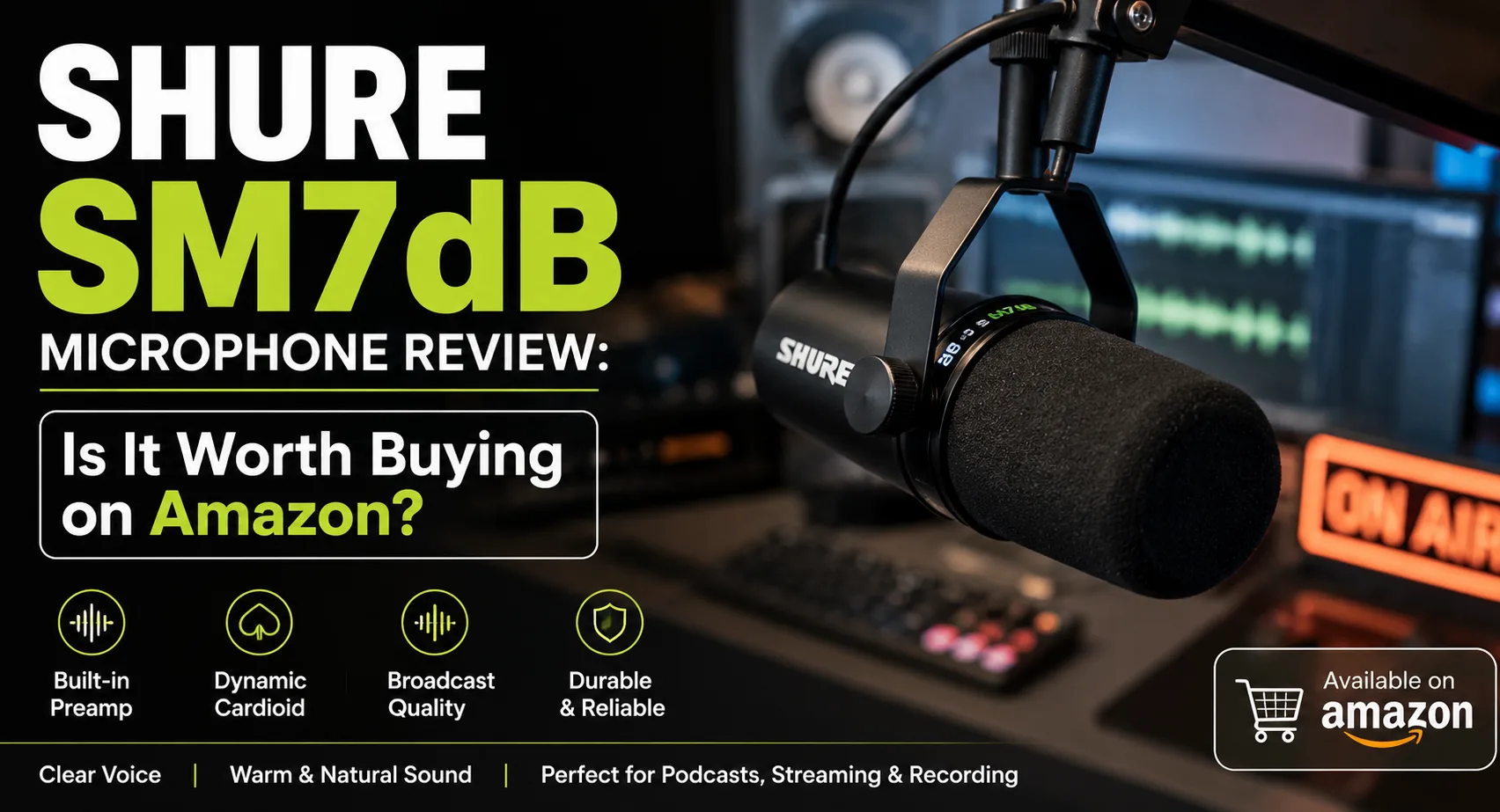
Shure SM7dB microphone review for Amazon buyers. Learn about its built-in preamp, sound, XLR setup, pros, cons, alternatives, and who should buy it.
If you’re looking for a serious microphone for podcasting, YouTube, streaming, voice-over work, or spoken-word recording, the Shure SM7dB deserves a close look. It’s based on the well-known SM7B design, but adds one feature that can make setup much easier: a built-in active preamp. Shure says the preamp can provide up to +28 dB of gain, while the microphone keeps the classic dynamic cardioid design associated with the SM7 family.
But there’s an important question before you buy: is the SM7dB actually the right Shure microphone for you? That depends on your interface, room, voice, recording style, and budget. The SM7dB is not a simple USB microphone — it uses XLR, and its built-in preamp still needs 48V phantom power when engaged.
This review breaks down the design, specifications, setup, strengths, weaknesses, alternatives, and buying considerations, based on manufacturer documentation, the current Amazon listing, and product research rather than personal hands-on testing.
Check the Shure SM7dB on Amazon →
Table of Contents
Quick Verdict
The Shure SM7dB is a strong choice for creators who want the familiar SM7-style vocal sound but don’t want to depend on a separate inline gain booster. Its built-in preamp gives more flexibility than the original SM7B — you can use +18 dB, +28 dB, or bypass the preamp entirely. Shure also includes bass roll-off and presence boost controls, so you can shape the response without relying entirely on software EQ.
The main catch: this is still an XLR microphone. You need an audio interface or mixer with an XLR input, and if you activate the built-in preamp, you also need 48V phantom power.
| Best for | Podcasting, streaming, voice-over, YouTube, broadcast-style speech, serious home recording |
| Main advantage | Built-in low-noise preamp |
| Main weakness | Still a relatively large, heavy XLR microphone requiring a proper recording setup |
| Overall | A premium microphone for people who want the SM7 sound plus more convenient gain management |
What Is the Shure SM7dB?

- ICONIC SOUND, SIMPLIFIED: Built on the same dynamic cartridge and frequency response as the SM7B, the SM7dB delivers the…
- FOCUSED VOCAL ISOLATION: A precision cardioid pickup pattern pairs with air suspension shock isolation to reject backgro…
- BUILT-IN PREAMP CONTROL: Selectable +18 dB or +28 dB of clean onboard gain lets you drive virtually any XLR interface wi…
The SM7dB is a dynamic vocal microphone with a built-in active preamp, belonging to the same famous microphone family as the SM7B and designed for content creation, speech, music, podcasting, and other vocal work.
The most important difference is inside the microphone. The original SM7B has relatively low output and often benefits from a strong microphone preamp. The SM7dB builds that preamp into the microphone itself — meaning you don’t necessarily need a separate inline preamp just to get a healthy recording level.
Shure specifies two selectable gain levels plus a bypass mode:
- +18 dB
- +28 dB
- Preamp bypass — operates in the original SM7B-style mode
This makes the SM7dB more than just “an SM7B with more gain” — it gives you several ways to build your signal chain.
Specifications
| Spec | Detail |
|---|---|
| Microphone type | Dynamic, moving coil |
| Polar pattern | Cardioid |
| Frequency response | 50 Hz–20 kHz |
| Output impedance (preamp on) | 27 ohms |
| Output impedance (bypass) | 150 ohms |
| Preamp gain | +18 dB or +28 dB |
| Phantom power | 48V DC (when preamp engaged) |
| Weight | 837 g |
| Housing | Black enamel aluminum and steel |
| Mounting | Yoke mount |
| Connector | XLR |
| Windscreen | Included |
| Stand adapter | 3/8″ included |
The 837-gram weight is worth noting — this is a substantial broadcast-style microphone, not a tiny desktop mic, so your boom arm or stand needs to support it safely.
How Does the SM7dB Sound?
The microphone uses a dynamic moving-coil capsule and a cardioid polar pattern, with a frequency response Shure describes as smooth, flat, and wide-ranging. That design suits speech well — the microphone focuses more strongly on the person speaking into it while reducing sound from other directions, useful in a home office or bedroom recording space without needing a perfect studio.
Microphone technique still matters, though. Shure recommends positioning the microphone 1 to 6 inches from the speaker — moving closer produces a warmer bass response, moving farther away reduces that bass effect. It works best when you speak toward the front of the microphone and keep your distance reasonably consistent.
Why the Built-In Preamp Matters
The built-in preamp is the biggest reason to consider the SM7dB over a plain SM7B. A traditional setup might look like:
Microphone → XLR cable → inline preamp → audio interface → computer
The SM7dB simplifies that to:
SM7dB → XLR cable → audio interface → computer
The built-in preamp provides up to +28 dB of additional gain, which Shure describes as low-noise, flat, and transparent. That doesn’t mean you can plug it into a computer with a normal USB cable — it’s still an XLR microphone requiring an appropriate interface or mixer. The advantage is that your interface doesn’t need to supply as much gain from its own microphone preamp.
Does the SM7dB Need Phantom Power?
Yes, with a nuance: the SM7dB requires 48V phantom power only when its built-in preamp is active. Shure states the microphone can operate in bypass mode without phantom power.
- Preamp enabled: Use +18 dB or +28 dB of built-in gain — your interface or mixer needs to provide 48V phantom power.
- Preamp bypassed: The internal preamp is turned off, and the microphone operates like the original SM7B configuration.
This flexibility is useful if you already own a powerful microphone preamp.
Controls Explained
Four controls on the rear give the SM7dB more flexibility than a basic dynamic microphone:
Bass Rolloff — Reduces low-frequency response, helpful against unwanted low-frequency noise (HVAC, traffic, room vibration) or if your voice sounds too heavy up close.
Presence Boost — Increases midrange emphasis, which can make some voices sound more forward and clear. Whether you need it depends on your voice, distance, room, and recording chain — don’t use it just because the switch exists.
Preamp Bypass — Disables the internal preamp, useful if you want the original SM7B-style signal path or already have enough clean gain from your interface or external preamp.
Preamp Gain (+18 dB / +28 dB) — Shure notes quieter speech applications may benefit from the higher setting, while louder speakers or some instrumental applications may need less gain.
Is the SM7dB Good for Podcasting?
Yes — one of the clearest use cases. A podcast microphone needs to handle speech well in environments that aren’t always acoustically perfect, and the SM7dB’s cardioid pattern and dynamic design suit close-range spoken-word recording. The built-in preamp means less worry about whether an interface has enough microphone gain, and the microphone mounts easily on a boom arm — usually more practical for podcasting than a desk stand (Shure documents both boom-arm and stand mounting configurations).
A simple setup: SM7dB → XLR cable → USB audio interface → computer, plus a boom arm, headphones, recording software, and reasonable room treatment. You don’t need an expensive studio to start.
Is the SM7dB Good for YouTube?
It can be excellent for tutorials, commentary, reviews, educational videos, voice-over, podcast-style videos, desk-based content, and live streaming. A dynamic microphone helps when your recording room isn’t perfectly quiet — but it doesn’t magically remove every background sound. A loud fan is still a loud fan; a noisy air conditioner can still affect a recording. Good microphone placement remains important.
Is the SM7dB Good for Streaming?
It makes sense for streamers using an XLR audio setup, giving your voice a professional broadcast-style presentation while letting you adjust gain and response from the microphone itself. The biggest hurdle for new streamers is the equipment around it — coming from a USB gaming microphone, you’ll need an XLR cable, an audio interface or mixer, a boom arm or stand, and headphones for monitoring. More complicated than plugging in a USB mic, but it gives you a more expandable audio system.
SM7dB for Voice-Over Work
Another strong use case — the close-working style produces a focused vocal recording when positioned correctly, and the built-in bass roll-off and presence boost give useful starting points for adjusting the sound. Don’t assume one EQ setting works for every voice; a deeper voice may need a different approach than a higher one, and an extremely reflective room limits what the microphone alone can fix.
SM7dB for Music
Shure lists music among the SM7dB’s applications, useful for vocals and other sources where a dynamic microphone makes sense, with the built-in preamp helping when connected to an interface with limited microphone gain. Still, the best microphone for music depends heavily on the instrument, vocalist, room, and desired sound — buy it because its characteristics match your recording needs, not just because it’s popular among podcasters.
Pros and Cons
Pros
- Built-in active preamp, up to +28 dB of selectable gain
- Preamp bypass mode
- Cardioid dynamic design, wide 50 Hz–20 kHz frequency response
- Bass roll-off and presence boost controls
- Strong background rejection compared with more open microphone designs
- Includes standard and close-talk windscreen options
- Suitable for podcasting, streaming, speech, vocals, and content creation
- Works with standard XLR interfaces
- Can simplify a high-gain microphone setup
Cons
- More expensive than basic dynamic microphones
- Requires an XLR audio interface or mixer
- Built-in preamp requires 48V phantom power
- Heavy compared with compact desktop microphones
- Requires proper microphone positioning
- A boom arm may be needed for comfortable desk use
- Not a plug-and-play USB microphone
- Premium features may be unnecessary for casual users
What I Like About the SM7dB
The biggest strength is flexibility — use the built-in preamp today, bypass it later if your setup changes. The microphone also combines the classic SM7-style form with modern gain management; Shure says the SM7dB’s preamp was designed to preserve the microphone’s frequency response rather than dramatically change its character. It’s built with practical recording controls rather than relying entirely on software.

What I Would Watch Before Buying
Check your audio interface first. Don’t buy the SM7dB and figure out the interface later — confirm it has an XLR microphone input, 48V phantom power (if using the internal preamp), proper microphone-level input, and suitable monitoring options.
Check your boom arm. At 837 grams, a cheap arm that struggles with heavier microphones will become frustrating fast.
Shure SM7dB vs. Shure SM7B
The SM7B is the microphone that built this product family’s reputation. The SM7dB keeps the same design philosophy but adds a built-in active preamp.
SM7B best for: experienced audio users, existing high-gain interfaces, users who already own an inline preamp, and people who want the traditional SM7B signal path.
SM7dB best for: newer professional users, podcasters, streamers, creators, users who want simpler gain management, and people who want selectable internal gain.
The SM7dB also lets you bypass its preamp, so it can adapt to a more traditional setup later if needed.
Alternatives to Consider
Shure SM7B — If you don’t need the built-in preamp and already have an interface or preamp with enough clean gain, the original remains an important alternative. Check the Shure SM7B on Amazon →
Shure MV7 — Particularly interesting for creators who want a microphone that works with both computer-based recording and traditional XLR setups. For a beginner without an audio interface, this flexibility can be very useful — the SM7dB is more focused on an XLR-only workflow. Check the Shure MV7 on Amazon →
Shure MV7X — An XLR-only microphone for someone who wants a Shure dynamic mic without the SM7dB’s built-in preamp. A better fit for a conventional interface-based setup, and a sensible option for multi-microphone podcast setups where buying several premium SM7dBs would be unnecessary. Check the Shure MV7X on Amazon →
Which Shure Microphone Should You Buy?
| Microphone | Best For | Main Reason |
|---|---|---|
| SM7dB | Serious creators | Built-in preamp and SM7-style design |
| SM7B | Experienced audio users | Classic SM7B signal path |
| MV7 | Flexible home creators | USB/XLR-style workflow |
| MV7X | XLR podcast setups | Simpler XLR-focused design |
If your goal is a premium broadcast-style microphone without buying an external gain booster, the SM7dB is the most interesting option. If you already have a powerful interface, the SM7B deserves consideration. For easier computer connectivity, look at the MV7. For a multi-person podcast setup, the MV7X can be more practical.
Do You Need a Cloudlifter With the SM7dB?
Usually not. People typically add an inline preamp to an SM7B for extra clean gain — but the SM7dB already has an active preamp inside, providing up to +28 dB. Buying another gain booster just because “every SM7-style microphone needs one” doesn’t make sense here. Check your complete signal chain first: if the SM7dB’s internal preamp plus your interface already produces the level you need, there’s no reason to add another gain stage.
Do You Need a Boom Arm?
Not strictly, but for podcasting and streaming it makes the microphone much easier to position — moving it closer to your mouth when you speak while keeping the desk clearer. The SM7dB is designed for boom-arm mounting (Shure documents both boom and stand configurations); just make sure the arm can safely support the microphone’s weight.
Do You Need a Pop Filter?
Not necessarily right away. The SM7dB includes a standard windscreen and a larger close-talk windscreen — Shure says the larger A7WS windscreen provides additional protection from plosives and wind noise during close vocal use. This is one area where the SM7dB can save you from an immediate extra accessory purchase.
How to Position the SM7dB
Good placement can matter more than buying another piece of gear. Shure recommends a working distance of roughly 1 to 6 inches:
- Position the microphone in front of you.
- Keep it close enough for a strong direct voice signal.
- Speak toward the front of the microphone.
- Keep your distance reasonably consistent.
- Experiment with angle and distance.
- Adjust gain after positioning the microphone.
- Use the bass roll-off or presence boost only when needed.
Don’t point the microphone at your mouth from an awkward angle just because it looks better on camera — audio quality should come first.
Can the SM7dB Reduce Background Noise?
It can help with unwanted sound because it’s a cardioid dynamic microphone, but that’s not the same as active noise cancellation. Its polar pattern favors sound from the front and rejects more from the sides and rear — Shure describes strong rear rejection with minimal off-axis coloration — but room noise can still reach the microphone. The best approach combines good placement, close working distance, reasonable room treatment, lower background noise, proper gain, and good recording technique. Don’t expect the microphone alone to fix a noisy room.
SM7dB for a Home Office
Makes a lot of sense here — you may be recording beside a computer, air conditioning, desk fans, hard surfaces, monitors, and other electronics, and the SM7dB’s design focuses on the speaker rather than capturing the entire room equally. Shure also highlights shielding against broadband interference from computer monitors, useful for desk-based recording. Room acoustics still matter, though — a dynamic microphone reduces some problems but can’t fully eliminate reflections from bare walls, glass, or hard floors.
Is the SM7dB Worth It for Beginners?
Depends what kind of beginner. If you’re a complete beginner who wants to record directly into a laptop, this wouldn’t be the first choice — it requires more equipment. If you’re a beginner serious about podcasting, streaming, or content creation and willing to learn an XLR setup, it becomes much more attractive.
The important distinction: beginner doesn’t always mean cheap. A beginner planning a long-term recording setup may prefer buying one serious microphone over upgrading several times — but the rest of the audio chain still matters. A premium microphone connected to a poor setup won’t automatically produce premium recordings.
SM7dB vs. USB Microphone
USB microphone advantages: easy setup, direct computer connection, usually cheaper system cost, no audio interface required. USB microphone disadvantages: less flexible signal chain, fewer upgrade paths, may not fit professional studio workflows.
SM7dB advantages: XLR connection, built-in preamp, professional audio workflow, flexible gain options, works with mixers and interfaces, stays useful as your setup grows. SM7dB disadvantages: requires an interface, more equipment, higher total setup cost, more setup knowledge required.
For a casual user, USB wins on simplicity. For someone building a serious recording system, the SM7dB becomes much more attractive.
What About the SM7dB for iPhone, Mac, or Windows?
The SM7dB is not a direct plug-in iPhone microphone — it uses XLR. To record with an iPhone, you’d need a compatible audio interface or adapter system that can accept the microphone signal, which is one reason a USB or wireless microphone may be easier for mobile creators.
For Mac and Windows, the microphone doesn’t connect directly through USB — the normal setup is SM7dB → XLR → audio interface → USB → computer, with the computer recognizing the audio interface rather than the mic itself. This works well with podcast software, streaming software, voice recording software, and video editing software on either platform — the important part is choosing a compatible interface with suitable gain and phantom power.
Related TechRigReview Guide
If you’re weighing the SM7dB against a more portable option, see 10 Best Amazon Wireless Microphones Under $90 in 2026. The right microphone depends heavily on how you record — a wireless microphone makes more sense for mobile video, while an XLR microphone like the SM7dB suits a desk-based recording environment.
Who Should Buy the Shure SM7dB?
Makes the most sense if you’re a serious podcaster, YouTube creator, professional streamer, voice-over creator, broadcaster, a musician who needs a dynamic vocal microphone, a content creator upgrading from an entry-level mic, someone who already owns an XLR audio interface, or someone who wants built-in microphone gain. Particularly attractive if you want the SM7 family sound without your microphone gain depending entirely on the interface.
Who Should Skip the SM7dB?
You probably don’t need it if you only make occasional Zoom calls, want a simple USB microphone, record mainly on your phone, need a small travel microphone, don’t own an audio interface, have a very limited equipment budget, or don’t want to learn XLR audio. There’s nothing wrong with choosing a simpler microphone — the best microphone is the one that fits your workflow. A $100 microphone you use correctly can be far more useful than an expensive one that stays in a box because the setup feels complicated.
Frequently Asked Questions
Is the Shure SM7dB better than the SM7B?
Not automatically. The SM7dB adds a built-in preamp and selectable gain, making it easier to use with many interfaces. The SM7B remains attractive if you already have a strong preamp or want the traditional SM7B signal path — the better choice depends on your equipment.
Does the Shure SM7dB need an audio interface?
Yes — it uses an XLR connection and needs an appropriate XLR microphone input on an interface, mixer, or other compatible device.
Does the SM7dB need phantom power?
The built-in preamp requires 48V phantom power. Shure says the microphone can operate in bypass mode without it.
Does the SM7dB connect directly to a computer?
No — it’s not a USB microphone. The typical setup is microphone → XLR cable → audio interface → USB → computer.
Is the SM7dB good for podcasting?
Yes — its dynamic cardioid design, close-working style, built-in gain, and vocal-focused controls suit podcasting well.
Is the SM7dB good for streaming?
Yes, especially for desk-based streamers using an XLR audio interface. Less attractive if you want a simple USB microphone with no external equipment.
Does the SM7dB block background noise?
It helps reject sound from unwanted directions, but doesn’t actively cancel all background noise — room control and microphone placement remain important.
Is the SM7dB good for a home studio?
Yes — particularly useful for spoken-word recording, vocals, streaming, podcasting, and voice-over work.
Do I need a Cloudlifter with the SM7dB?
Usually not, if you’re using the built-in preamp correctly — it already provides up to +28 dB of internal gain. Your exact requirement depends on the interface and setup.
Is the Shure SM7dB worth buying?
For serious creators who need a premium dynamic XLR microphone with built-in gain, yes. For casual computer users, it’s probably more microphone than necessary.
Final Verdict
The Shure SM7dB is an impressive evolution of the classic SM7 microphone concept. Its biggest advantage isn’t simply the Shure name — it’s the combination of a familiar dynamic cardioid design with a built-in active preamp. Choose +18 dB, +28 dB, or bypass the preamp completely; you also get bass roll-off and presence controls, substantial metal construction, a yoke mount, and windscreens designed for close vocal recording.
The trade-off is that this remains a serious XLR microphone — you need an interface, the right cable, a stable stand or boom arm, and some time to learn microphone placement. For a casual Zoom user, that’s unnecessary. For a podcaster, streamer, YouTuber, voice-over artist, or serious home creator, the equation is very different.
Research-based pick: If you want the SM7 family sound and prefer the convenience of an integrated preamp, the SM7dB is the Shure microphone worth investigating first. If you already own a strong interface and want the traditional setup, consider the SM7B. For a more flexible computer-friendly workflow, look at the MV7. For a simpler XLR podcast microphone, the MV7X is another option.
Before buying, check the current Amazon listing and make sure the model, seller, and included accessories match what you need.
Check the Shure SM7dB on Amazon →
Official Shure Resources
- Shure SM7dB official product page — product features, accessories, and official specifications
- Shure SM7dB User Guide — detailed setup, microphone placement, preamp operation, and specifications
- Shure’s SM7dB Preamp Guide — Shure’s explanation of the built-in preamp and how it differs from the traditional SM7B setup
Amazon Associates Disclosure: As an Amazon Associate I earn from qualifying purchases.

MD.HASAN is an experienced SEO expert and amazon products review writer passionate about helping people find right products on amzon for buy without confusion. With 4 years of hands-on experience in content strategy and search engine optimization, he specializes in writing SEO-friendly blog posts that rank, engage, and convert.