🔗 Affiliate Disclosure: As an Amazon Associate, Tech Rig Review earns from qualifying purchases. Links on this page may be affiliate links — at no extra cost to you.
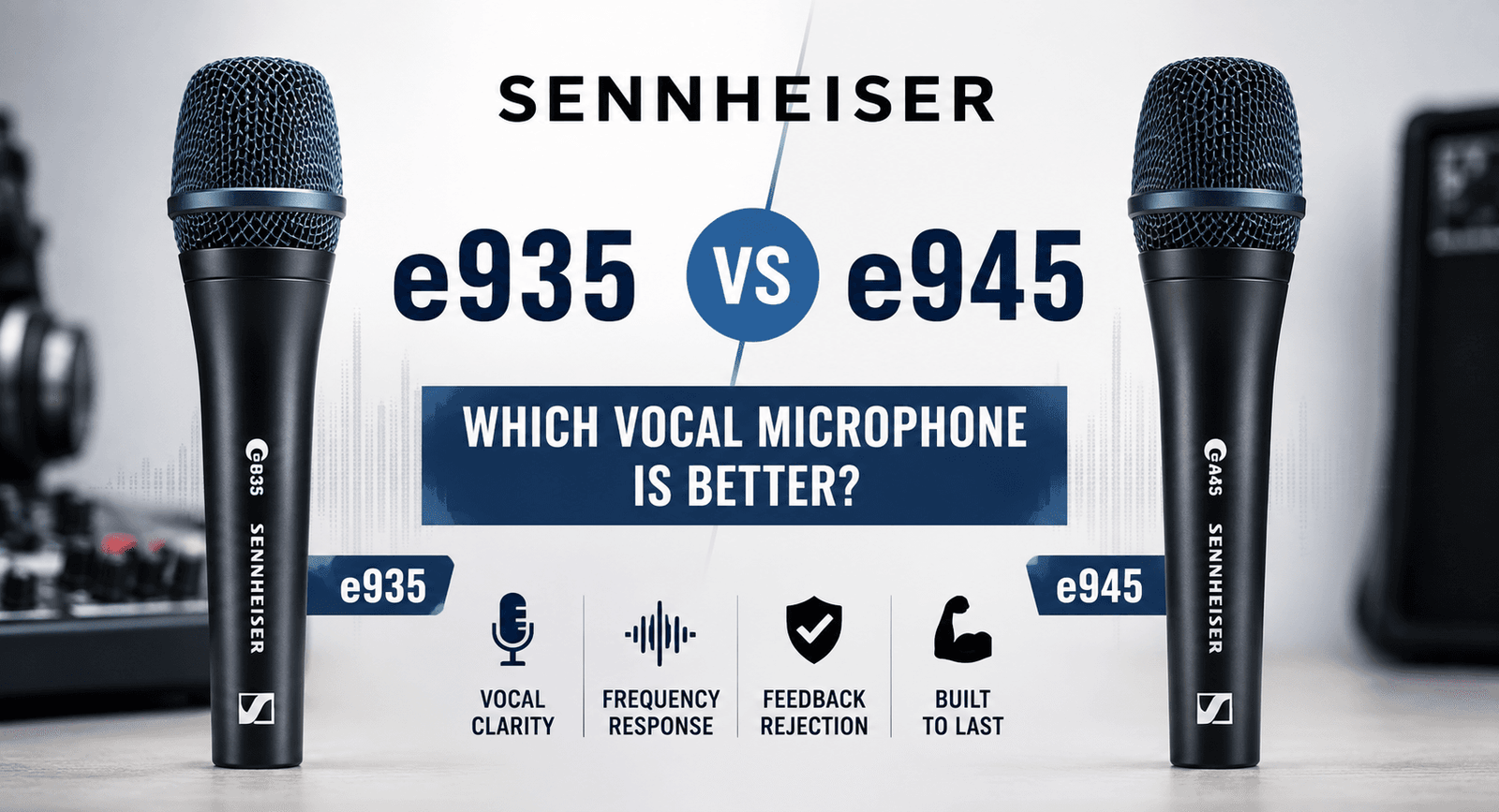
Sennheiser e935 vs e945: Compare sound, pickup pattern, feedback rejection, build quality, vocals, and value to choose the right Sennheiser mic.
Quick Answer
Choosing between the Sennheiser e935 vs e945 can be difficult because both are professional dynamic vocal microphones from Sennheiser’s evolution series, built for live vocals, stage work, speech, worship, and other situations where a microphone needs to stay clear when the room gets loud.
The biggest difference is the pickup pattern: the e935 uses a cardioid pickup pattern, while the e945 uses a supercardioid pattern. That difference affects how each microphone handles sound coming from the sides and rear, as well as how it behaves around loud stage monitors.
If you want a more forgiving microphone that’s easier to use with normal vocal technique, the e935 is the safer choice. If you perform on a loud stage and need stronger isolation and feedback rejection, the e945 is the more focused choice. Neither is automatically better for everyone — your stage, voice, monitor setup, microphone technique, and preferred vocal character all matter.
Research note: This comparison is based on manufacturer specifications, product documentation, current marketplace availability signals, and published buyer-feedback patterns. I did not purchase or personally test these microphones, so this article does not claim hands-on testing.
Table of Contents


Comparison Table
| Feature | Sennheiser e935 | Sennheiser e945 |
|---|---|---|
| Microphone type | Dynamic vocal microphone | Dynamic vocal microphone |
| Pickup pattern | Cardioid | Supercardioid |
| Connection | 3-pin XLR | 3-pin XLR |
| Frequency response | 40–18,000 Hz | 40–18,000 Hz |
| Main strength | Natural, clear vocal sound | Strong isolation and stage focus |
| Best for | Lead vocals, worship, general live use | Loud stages and demanding live vocals |
| Feedback control | Very good | Stronger focus from supercardioid design |
| Construction | Rugged metal | Rugged metal |
| Wireless? | No | No |
| Best choice for most users | e935 | Best for demanding stages |
1. Sennheiser e935
Best For: Natural, Clear Live Vocals
The Sennheiser e935 is a dynamic cardioid vocal microphone designed for singers and performers who want a clear, focused vocal sound without moving into an overly specialized pickup pattern. Sennheiser lists it with a stated frequency response of 40–18,000 Hz, a nominal impedance of 350 ohms, and a sensitivity of 2.8 mV/Pa at 1 kHz.
👉 Check the Sennheiser e935 on Amazon
Why It Stands Out
The e935 is built around a useful idea: give the singer a strong vocal presence while keeping the microphone relatively natural and forgiving. Sennheiser describes its sound as having transparent highs and warm, defined lower mids, with a presence boost in the 2.5–3 kHz range to help vocals remain intelligible in a busy mix.
That matters because a vocal microphone doesn’t work alone — there may be guitars, bass, drums, keyboards, monitors, amplifiers, and other performers competing for space. A vocal microphone needs enough presence to help the singer remain understandable, and the e935 is built for exactly that.
Key Specs
- Transducer: Dynamic
- Pickup pattern: Cardioid
- Frequency response: 40–18,000 Hz
- Sensitivity: 2.8 mV/Pa
- Nominal impedance: 350 ohms
- Minimum terminating impedance: 1,000 ohms
- Connector: 3-pin XLR
- Dimensions: 47 × 151 mm
- Weight: 355 g
- Construction: Rugged metal, shock-mounted capsule
- Connection: Wired
Cardioid Pickup Pattern
The cardioid design is one of the most important reasons to consider the e935. A cardioid microphone primarily focuses on sound from the front and is less sensitive toward the rear. For many singers, this is a practical pattern — it offers a good balance between vocal focus and ease of use. You still need proper microphone technique, but you don’t have to treat the microphone like an extremely narrow target, which can help singers who move slightly while performing.
Vocal Sound
The e935 is aimed at a natural but present vocal character. Sennheiser describes it as offering transparent high frequencies and warm lower mids, with a design that can help vocals gain intensity and size in a mix. That makes it interesting for lead singers, backup singers, worship vocalists, singer-songwriters, live bands, acoustic performers, public speakers, and event presenters — it isn’t limited to one musical style.
Feedback Performance
The e935 is designed with high feedback rejection. Sennheiser states that the microphone’s design can provide additional gain before feedback compared with leading microphones. Still, feedback depends on much more than the microphone itself — speaker placement, monitor angle, room acoustics, microphone distance, and gain settings all matter, so no microphone should be expected to completely eliminate feedback.
Build Quality
Stage microphones are handled often — placed on stands, transported, and used night after night — so rugged construction matters. The e935 uses a rugged metal body, a shock-mounted capsule, and a sealed internal air chamber designed to reduce sensitivity to handling noise, along with a hum-compensating coil.
Pros
- Clear and present vocal character
- Cardioid pattern is relatively easy to work with
- Rugged metal construction with a shock-mounted capsule
- Hum-compensating coil
- Designed for live vocal use with a standard XLR connection
- Strong feedback performance
Cons
- Not wireless — requires an XLR cable and suitable audio equipment
- Cardioid isolation isn’t as focused as the e945’s supercardioid pattern
- May not be the best choice for extremely loud stages
Buyer Sentiment: Consistently well regarded among buyers and musicians looking for a professional dynamic vocal microphone.
What Buyers Tend to Like: The strongest recurring appeal of the e935 is its combination of clarity, vocal presence, and professional construction. Buyers looking for a serious stage microphone often want something noticeably more controlled than an inexpensive general-purpose dynamic mic — and the e935 fits that need without requiring phantom power or a complicated setup.
Who Should Buy It: Anyone wanting a strong all-around vocal microphone with a natural but present vocal tone, a cardioid pickup pattern, and the ability to handle regular stage use without wireless complexity. For many singers, this is the easiest Sennheiser to recommend.
👉 Check Price on Amazon — Sennheiser e935
2. Sennheiser e945
Best For: Loud Stages and Strong Isolation
The Sennheiser e945 takes a slightly different approach. It’s also a dynamic vocal microphone with a 3-pin XLR connector and a 40–18,000 Hz frequency response, but it uses a supercardioid pickup pattern instead of cardioid — making it particularly interesting for performers who need greater separation between the vocal microphone and other sounds on stage.
👉 Check the Sennheiser e945 on Amazon
Why It Stands Out
Sennheiser describes the e945 as a professional lead vocal microphone designed for demanding live environments. Its supercardioid pickup pattern is designed to help isolate the singer from other stage signals, and the company also highlights feedback rejection, a rugged metal housing, a hum-compensating coil, and a shock-mounted capsule. In simple terms, the e945 is the more focused microphone — which can be a major advantage on a loud stage.
Key Specs
- Transducer: Dynamic
- Pickup pattern: Supercardioid
- Frequency response: 40–18,000 Hz
- Sensitivity: 2.0 mV/Pa at 1 kHz
- Nominal impedance: 350 ohms
- Minimum terminating impedance: 1,000 ohms
- Connector: 3-pin XLR
- Dimensions: 47 × 186 mm
- Weight: Approximately 365 g
- Construction: Rugged metal, shock-mounted capsule
- Connection: Wired
Supercardioid Pickup Pattern
This is the biggest difference between the two microphones. A supercardioid pattern is more focused than cardioid, which can help in an environment where unwanted sound is a serious problem — a singer standing in front of loud monitors, a band playing at high volume, or a stage with several instruments producing a lot of energy. In these cases, extra isolation can be valuable.
There’s a trade-off, though: a more focused microphone requires better technique. You need to keep the microphone pointed toward your mouth and understand where your monitors and speakers are located.
Vocal Character
Sennheiser describes the e945 as offering rich tonal warmth, lively fullness, and strong presence, with a sound designed to cut through guitars, drums, bass, and other loud stage sources. It isn’t simply an e935 with a different label — it’s aimed at performers who need more control in demanding environments.
Feedback Control
Feedback rejection is one of the main reasons to choose the e945. The supercardioid design helps reduce unwanted stage sound reaching the microphone, and Sennheiser specifically highlights the e945’s feedback resistance for demanding live environments. Good stage setup still matters, though — position monitors carefully, avoid pointing the rear of the microphone toward problem speakers, and avoid excessive gain. The microphone can help, but it can’t replace good sound engineering.
Handling Noise & Build Quality
The e945 uses a shock-mounted capsule, which is useful since singers often hold handheld microphones and movement can introduce mechanical noise. Sennheiser also lists a hum-compensating coil as part of the design. The e945 is built for professional stage use, with metal construction designed to withstand the demands of live performance; Sennheiser states the microphone is assembled in Germany and backed by a warranty.
Pros
- Excellent stage isolation via the supercardioid pattern
- Strong feedback rejection
- Rich and present vocal character
- Rugged metal construction with a shock-mounted capsule
- Hum-compensating coil
- Designed for demanding live vocals
Cons
- Requires more careful microphone technique
- Not wireless — XLR cable required
- More specialized than the e935
- Can be less forgiving if microphone position changes frequently
Buyer Sentiment: Highly regarded among performers who specifically need focused pickup and strong stage control.
What Buyers Tend to Like: The most common reason to choose the e945 is its ability to keep attention on the vocalist. Performers on loud stages often value its focused pattern and strong vocal presence, especially when feedback and stage bleed are bigger concerns than having the most forgiving pickup pattern.
Who Should Buy It: Performers on loud stages who use loud monitors, need strong feedback rejection, sing lead vocals in a full band, prefer a supercardioid pattern, and already understand good microphone technique.
👉 Check Price on Amazon — Sennheiser e945
What’s the Real Difference?
The difference is easier to understand once you set the marketing language aside. Both microphones are professional dynamic vocal microphones, both use XLR, both are designed for live performance, both are rugged, and both share a 40–18,000 Hz frequency response. The major design difference is the pickup pattern.
e935 = Cardioid. A strong all-purpose choice, easier to use for many singers, offering good isolation while remaining relatively forgiving.
e945 = Supercardioid. More focused, especially useful when stage volume and feedback are major concerns — but it demands more attention to microphone position.
Choose the e935 for versatility. Choose the e945 for maximum stage focus.
Which One for Your Situation?
Solo singers: The e935 is usually the easier recommendation. A solo singer often doesn’t need extreme stage isolation, and a cardioid pattern gives a good balance while allowing some movement without making technique unnecessarily difficult.
Full bands: If the stage is moderately loud, the e935 may be enough. If the stage is very loud, the e945 becomes more attractive — a supercardioid microphone can help the vocal mic focus more strongly on the singer.
Worship: Both can work well. For smaller worship spaces with moderate stage volume, the e935 is a strong option. For larger stages with louder monitors and multiple instruments, the e945 may have an advantage.
Rock vocals: The e945 deserves serious consideration. Rock stages, drums, and guitar amplifiers can all get loud, and the singer needs to remain present without turning the entire sound system into a feedback machine — exactly where the e945’s focused design becomes useful.
Beginners: Choose the e935. The cardioid pattern is more forgiving, and while you still need proper technique, you don’t need to be as precise. The e945 isn’t difficult to use, but its supercardioid design rewards singers who already understand microphone placement.
Different venues: The e935 is the safer general-purpose choice, since different venues have different acoustics and stage layouts. If you already know feedback and stage volume are recurring problems, the e945 becomes more attractive.
Professional singers: There’s no universal winner. Professionals often choose based on the stage rather than the price — some stages need isolation, some don’t. The better question isn’t “which microphone is more expensive,” but “which microphone matches my stage?”
Feedback: A Closer Look
If feedback is your biggest concern, lean toward the e945. That doesn’t mean the e935 is poor at feedback rejection — it isn’t, and Sennheiser specifically designs it for strong feedback rejection. But the e945’s supercardioid design is more focused, making it particularly useful for loud stage environments.
Don’t make the mistake of thinking the microphone alone controls feedback — your entire signal chain matters. Things that affect feedback include monitor position, main speaker position, microphone direction, vocalist distance from monitors, mixer gain, EQ, room reflections, stage volume, and microphone technique. A good microphone helps; a good stage setup helps even more.
Build Quality: Essentially a Tie
Both microphones are designed for professional live use, with metal construction, shock-mounted capsules, and features intended to reduce unwanted mechanical and electrical noise. Sennheiser’s e935 documentation describes rugged metal construction, a shock-mounted capsule, a sealed air chamber, and a hum-compensating coil; the e945 specification likewise lists rugged metal construction, shock-mounted capsule technology, and a hum-compensating coil. Don’t choose between these microphones based on durability alone — choose based on the sound and pickup pattern you need.
Ease of Use: The e935 Wins
The cardioid pattern gives the e935 a more forgiving operating style. That doesn’t mean the e945 is difficult — it simply rewards more precise technique. If you move the microphone around a lot while performing, the e935 may feel more natural; if you keep the microphone correctly positioned and want maximum isolation, the e945 is a strong choice.
Are the e935 and e945 Wireless?
No — and this is an important point, because search results can make it confusing. Both the e935 and e945 are wired microphones using 3-pin XLR connections. Sennheiser also produces wireless systems and microphone capsules based on the acoustic designs of these wired microphones — for example, the MMD 935 is a wireless dynamic cardioid microphone capsule designed for compatible wireless transmitters, and the MMD 945 uses the supercardioid characteristics associated with the e945 design, also intended for compatible wireless transmitters.
If you specifically want a wireless Sennheiser setup, don’t accidentally purchase the wired e935 or e945 expecting a wireless transmitter built in.
Before buying on Amazon, check:
- Does the listing say wired?
- Does it include an XLR connector?
- Is a wireless receiver included?
- Is the product a microphone capsule rather than a complete microphone?
- Is it a complete wireless microphone system?
This can prevent an expensive shopping mistake — a product title containing words like “wireless,” “vocal,” “handheld,” “Sennheiser,” “935,” or “945” doesn’t automatically mean the product is a complete wireless system.
Home Recording
Neither microphone is a typical USB desktop microphone — both use XLR, which means you need suitable audio equipment such as an audio interface, mixer, microphone preamp, professional PA system, or XLR-equipped recorder. For simple computer recording, a USB microphone may be easier, but if you already own an audio interface, these Sennheiser microphones can fit nicely into a serious recording setup.
For vocals recorded at home, room acoustics become important. A dynamic microphone can be useful because it doesn’t capture the room the way many sensitive condenser microphones do — but microphone placement and room treatment still matter.
How to Connect and Set Up the e935 or e945
- Connect the XLR cable. Plug one end into the microphone and the other into your mixer, audio interface, PA system, or microphone input.
- Set the input gain. Start conservative, have the singer perform at normal volume, and increase gain until the signal is strong without unwanted clipping.
- Position the microphone. Keep it near the mouth rather than pointed randomly around the stage. With the e945 especially, correct position matters because the supercardioid pattern is more directional.
- Check monitors. Have the performer sing while monitor level is raised, and listen for feedback. If it starts, adjust monitor placement, microphone position, EQ, or gain rather than simply turning everything down.
- Test the full mix. A microphone that sounds excellent alone may need different EQ once guitars, drums, bass, and keyboards enter the mix.
How to hold it correctly: A common mistake is holding the microphone by the grille — don’t do this. Covering the grille can change the microphone’s acoustic behavior and may reduce the benefits of its directional pickup pattern. Hold the microphone by the body, keep the grille open, and aim it toward your mouth. This is especially important with the e945, since its supercardioid design depends on directional positioning.
What to Check Before Buying on Amazon
Amazon listings can change — different sellers offer different bundles, and a microphone may appear in several packages. Check the actual listing before ordering.
For the e935, verify the listing identifies the product as the Sennheiser e935 and that the ASIN matches — the researched identifier is B000N94RP2. For the e945, the researched identifier is B000NAXCC0. Current marketplace data identifies both as Amazon-available products, but because inventory, sellers, bundles, and availability can change, always confirm the live Amazon page immediately before buying.
My Research-Based Verdict
After comparing the specifications and intended designs, I’d give the e935 the overall recommendation for most buyers. It’s the more versatile option — its cardioid pattern is easier for many singers to work with, its vocal design focuses on clarity, presence, and natural tone, and it’s built to handle professional live use.
That doesn’t make the e945 worse. It’s the better specialist microphone — if you perform on a loud stage and regularly fight feedback or unwanted stage sound, the supercardioid pattern can be a major advantage. Sennheiser specifically positions the e945 for demanding live environments where isolation and feedback resistance matter.
| Category | Winner |
|---|---|
| Best overall | Sennheiser e935 |
| Best for loud stages | Sennheiser e945 |
| Easiest microphone technique | e935 |
| Maximum stage focus | e945 |
| Best for professional lead vocals | Either, depending on stage conditions |
| Best if you’re unsure | e935 |
| Best if feedback is your main problem | e945 |
FAQ
Is the Sennheiser e935 better than the e945?
Not for everyone. The e935 is more versatile because it uses a cardioid pickup pattern. The e945 uses a supercardioid pattern and is better suited to demanding stages where isolation and feedback rejection are major concerns.
What is the main difference between the e935 and e945?
The biggest difference is the pickup pattern — the e935 is cardioid, the e945 is supercardioid. Both are dynamic XLR vocal microphones designed for live performance.
Is the Sennheiser e945 good for live vocals?
Yes. The e945 is specifically designed for lead vocals in demanding live environments, with a supercardioid pickup pattern, feedback rejection, rugged construction, and vocal presence.
Is the Sennheiser e935 good for singing?
Yes. It’s a professional dynamic vocal microphone with a cardioid pattern and presence-focused sound suitable for lead vocals, backing vocals, worship, singer-songwriters, and live bands.
Are the e935 and e945 wireless microphones?
No. The standard e935 and e945 are wired microphones with 3-pin XLR connections. Sennheiser does offer wireless systems and compatible microphone capsules based on these vocal microphone designs.
Does the e945 reject feedback better than the e935?
The e945’s supercardioid pickup pattern is specifically positioned by Sennheiser for strong isolation and feedback rejection, making it a strong option for loud stages. But feedback depends on the entire sound system, including monitor placement, gain, EQ, room acoustics, and microphone position.
Which is better for beginners, e935 or e945?
The e935 is generally the easier starting point — its cardioid pattern is more forgiving and works well for a broad range of live vocal situations. The e945 can be excellent for beginners too, but its more focused pattern rewards better technique.
Can I use the e935 or e945 with a computer?
Yes, but not directly through a standard USB port. Because these microphones use XLR connections, you generally need an audio interface, mixer, or another compatible XLR input device.
Do the e935 and e945 need phantom power?
No — they’re dynamic microphones and don’t require phantom power to operate. If you connect them to an audio interface that provides phantom power, follow the interface’s instructions.
Which one is better for rock singers?
The e945 can be especially attractive for rock singers on loud stages, thanks to its supercardioid pattern and strong stage focus. But the e935 can also be an excellent rock vocal microphone, especially when a more forgiving cardioid pattern is preferred.
Which one should I buy if I perform in different venues?
The e935 is the safer general-purpose choice, since its cardioid pattern gives a useful balance between focus and ease of use across different acoustics and stage layouts.
Final Verdict
The Sennheiser e935 vs e945 debate isn’t really about which microphone is universally better — it’s about choosing the right pickup pattern for your performance.
The e935 is the overall pick because it offers a strong combination of vocal clarity, presence, durability, and a forgiving cardioid pattern. The e945 is the pick for demanding stages — its supercardioid pattern gives it a more focused job: helping the lead vocal remain controlled when the stage gets loud.
Both are serious professional microphones. Both use XLR. Both are designed for live vocal work, and both come from Sennheiser’s established evolution microphone family.
If you’re buying your first professional Sennheiser vocal microphone, start with the e935. If you already know that stage isolation and feedback control are your biggest problems, choose the e945. The most important thing is to match the microphone to your actual environment instead of choosing based only on the model number.
👉 Check the Sennheiser e935 on Amazon 👉 Check the Sennheiser e945 on Amazon
Related Reading
If you’re building a complete audio setup, these related Tech Rig Review guides may also help:
- 10 Best Amazon Wireless Microphones Under $90 in 2026
- 10 Best Amazon Microphones for Computer – Honest Reviews (2026)
- Tech Rig Review Home Page
Sources and Further Reading
For the most accurate technical information, Sennheiser’s official product documentation should be treated as the primary source for specifications.
- Sennheiser e935 official product page
- Sennheiser e945 official product page
- Sennheiser Evolution microphone family
As an Amazon Associate I earn from qualifying purchases.

MD.HASAN is an experienced SEO expert and amazon products review writer passionate about helping people find right products on amzon for buy without confusion. With 4 years of hands-on experience in content strategy and search engine optimization, he specializes in writing SEO-friendly blog posts that rank, engage, and convert.