
🔗 Affiliate Disclosure: As an Amazon Associate, Tech Rig Review earns from qualifying purchases. Links on this page may be affiliate links — at no extra cost to you.
Shure MV7 vs SM7B compared for podcasting & streaming in 2026. Real specs, total cost, sound differences, and which mic fits your setup—with current Amazon links.
If you record podcasts, streams, or voiceovers from a home office, you have almost certainly seen both the Shure MV7 and the legendary Shure SM7B. One looks like a modern, creator-friendly version of the other. The price gap is real. The workflow difference is even bigger.
This guide compares the two microphones the way a buyer actually decides: sound character, connectivity, total cost to get usable audio, and how each behaves in a normal untreated room. All recommendations use products currently available on Amazon. Affiliate links use the tracking ID techrigreview-20 so every purchase supports the research that goes into these articles.
Three visual summaries sit throughout the article so you can scan the key differences quickly.


Quick Verdict (Read This First)
- Choose the Shure MV7 or MV7+ if you want USB plug-and-play today, a lighter desk footprint, built-in headphone monitoring, and a lower total cost. It is the smarter starting point for most home creators in 2026.
- Choose the Shure SM7B if you already own (or will buy) an audio interface with solid gain, you want the classic warm broadcast tone, and you may also record sung vocals or instruments.
- True cost matters more than list price. An MV7 can be ready to record for under $320. An SM7B often lands between $550 and $750 once you add the interface and, in many cases, a Cloudlifter.
Both microphones are currently available on Amazon. The original MV7 (USB/XLR) remains listed, while the newer MV7+ adds USB-C, a color LED touch panel, and stronger onboard DSP.
What Each Microphone Actually Is
Shure SM7B — The Broadcast Standard
- NATURAL VOCALS: Engineered with a dynamic cartridge and wide-range frequency response, the Shure SM7B captures warm, bal…
- FOCUSED AUDIO: A precise cardioid pickup pattern works with air suspension shock isolation to minimize background noise,…
- BROADCAST-READY CLARITY: Built-in pop filtering and a detachable windscreen reduce plosives, breath, and wind noise, del…
The SM7B is a passive dynamic cardioid microphone that has been a studio and radio staple for decades. It delivers a smooth, relatively flat frequency response (50 Hz–20 kHz), excellent electromagnetic shielding, and a built-in air-suspension shock mount plus pop filter. It outputs only via XLR and needs roughly 60 dB of clean gain to sound its best. That is why so many owners pair it with a strong interface or an inline activator such as the Cloudlifter CL-1.
Current Amazon listing: Shure SM7B
Shure MV7 / MV7+ — The Creator Hybrid
Shure designed the MV7 as a more approachable, speech-focused sibling of the SM7B. It keeps the dynamic cardioid capsule and adds both USB and XLR outputs, a headphone jack, touch controls, and software DSP via the MOTIV app. The newer MV7+ upgrades to USB-C, a full-color LED touch panel, Auto Level Mode, real-time denoiser, and a digital pop filter.

- USB Dynamic Microphone with Onboard DSP
- XLR Output – Black
- Headphone Output
Current Amazon listings:
The MV7 series is intentionally tuned for close-miked speech. It is lighter, smaller, and far easier to get running the day it arrives.
Side-by-Side Specs That Matter
| Feature | Shure MV7 / MV7+ | Shure SM7B |
|---|---|---|
| Output | USB + XLR | XLR only |
| Frequency response | 50 Hz – 16 kHz | 50 Hz – 20 kHz |
| Sensitivity | –55 dBV/Pa | –59 dBV/Pa |
| Output impedance | 314 Ω | 150 Ω |
| Max SPL | 132 dB | 180 dB |
| Weight | ~1.2 lb | ~1.7 lb |
| Headphone monitoring | Yes (on mic) | No |
| Onboard DSP / app | Yes (MOTIV) | None |
| Typical mic price | $249–$299 | $399–$439 |
| Ready-to-record cost | $249–$320 (USB) | $550–$750 (mic + interface) |
The wider frequency range and lower impedance of the SM7B give it a small edge for sung vocals and instruments. The MV7’s higher sensitivity and built-in preamp make it far less gain-hungry when used over USB.
Sound Character: What Buyers Actually Notice
Independent comparisons and patterns in verified buyer feedback show consistent differences:
- SM7B tends to sound warmer and fuller in the low-mids. Many describe it as “radio-ready” with less need for heavy EQ on spoken word. The extra high-end extension also helps on acoustic guitar or sung vocals.
- MV7 is more mid-forward and speech-optimized. Clarity and intelligibility are excellent for podcasts and streaming. Some listeners hear a touch more sibilance on the USB path compared with a well-gained SM7B, though the difference shrinks when the MV7 is used over XLR into a good interface.
Neither microphone is “bad.” The SM7B simply sits closer to a neutral broadcast reference. The MV7 is voiced to sound finished and present with minimal processing—exactly what most solo creators want.
Both reject room noise well because they are dynamics with tight cardioid patterns. In an untreated home office they both outperform most condenser mics of similar price.
Connectivity and Daily Workflow
This is where the practical gap becomes obvious.
MV7 / MV7+
Plug the USB cable into a laptop or phone (with adapter if needed), open the free MOTIV app if you want EQ or Auto Level, put on headphones plugged into the mic, and record. Mute, gain, and monitoring live on the body. The XLR output remains available when you later add an interface.
SM7B
You need an XLR cable, an audio interface with enough clean gain (or a Cloudlifter + interface), and usually a separate headphone mix. Once set up it is rock-solid, but the first-day friction is higher.
For remote-work creators who switch between Zoom, OBS, and a DAW, the MV7’s dual-output design removes several failure points.
Total Cost to Get Usable Audio
List prices alone mislead. Here is the realistic 2026 picture based on current Amazon availability:
MV7 path (USB-first)
- Mic: ~$249–$299
- Optional boom arm: $30–$80
- Total ready-to-record: often under $350
SM7B path
- Mic: ~$399–$439
- Audio interface with ≥60 dB clean gain (e.g., Focusrite Scarlett 2i2 4th Gen): ~$200–$230
- Often a Cloudlifter CL-1 for quieter interfaces: ~$129
- XLR cables + boom: $40–$80
- Total ready-to-record: $550–$750 for many users
Recommended supporting products currently available:

- FOR HOME STUDIOS & PROFESSIONAL RECORDING: In the studio, boost the signal of quiet audio sources like vocals, percussio…
- REDUCE NOISE WHILE ADDING MICROPHONE CLARITY & SIGNAL STRENGTH: The Cloudlifter CL-1 mic activator uses Phantom power to…
- DESIGNED FOR PROFESSIONAL RESULTS: Our home studio equipment is perfect for podcasts, live streaming, radio broadcasts, …
- Cloud Microphones Cloudlifter CL-1 — the classic +25 dB clean-gain solution for the SM7B
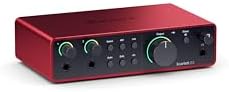
- The new generation of the artist’s interface: Connect your mic to Scarlett’s 4th Gen mic pres. Plug in your guitar. Fire…
- Studio-quality sound: With a huge 120dB dynamic range, the newest generation of Scarlett uses the same converters as Foc…
- Never lose a great take: Scarlett 4th Gen’s Auto Gain sets the perfect level for your mic or guitar, and Clip Safe preve…
- Focusrite Scarlett 2i2 4th Gen — popular interface that pairs well with the SM7B and still leaves headroom
If your budget for the entire signal chain is under $400, the MV7 (or MV7+) is the clearer choice.
Build, Durability, and Accessories
Both mics feel solid. The SM7B is heavier and has a more industrial presence; its yoke mount and dual windscreens (standard + close-talk A7WS) are excellent. The MV7 is lighter and easier to position on a desk boom for long sessions.
Neither requires phantom power. Both handle close-miked speech without excessive plosives when the included foam is used (or a proper pop filter is added). The SM7B’s internal shock isolation is slightly more effective against desk bumps.
Who Should Buy Which in 2026
Buy the MV7 or MV7+ if:
- You are starting or upgrading a home podcast/stream setup
- You want results the same day the box arrives
- You value USB simplicity with an XLR upgrade path later
- Your room is a normal home office, not a treated booth
- Total budget for mic + cabling is under $350
Buy the SM7B if:
- You already own a capable interface or plan to buy one
- You want the classic warm, flat broadcast tone
- You also record music (sung vocals, guitar amps, etc.)
- You care about long-term industry recognition and resale
- You are willing to spend the extra $150–$300 on supporting gear
Consider skipping both if:
- You need a true large-diaphragm condenser for distant sources or ensemble work
- Your absolute ceiling is under $150
- You only record on a phone with no USB or Lightning adapter options
Real-World Buyer Patterns
Across thousands of Amazon reviews and independent tests, a few themes repeat:
- MV7 owners praise the “set it and forget it” nature and the jump in quality from headset or USB condenser mics.
- SM7B owners who already had good gain almost never regret the purchase; those who did not budget for an interface or Cloudlifter often feel frustrated at first.
- Many creators start with the MV7, grow their setup, and later add an SM7B for “hero” tracks or guest interviews. The two microphones complement each other more than they compete.
Setup Tips That Actually Improve Sound
- Distance — Both mics prefer 2–6 inches from the mouth. Closer gives more proximity bass; farther reduces plosives but can pick up more room.
- Angle — Slightly off-axis (speaking across the capsule rather than directly into it) softens sibilance on both models.
- Gain staging — On the MV7, use Auto Level or set gain so peaks sit around –12 to –6 dBFS. On the SM7B, aim for the same after the interface/Cloudlifter.
- Room — Soft furnishings, a simple acoustic panel behind the mic, and closing the door matter more than the last 5 % of mic quality.
- Monitoring — Use the MV7’s headphone jack or your interface’s zero-latency mix so you never record with software monitoring delay.
FAQ — Shure MV7 vs SM7B
Is the Shure MV7 as good as the SM7B?
For pure spoken-word podcasting and streaming in a home environment, the MV7 is close enough that most listeners will not notice a difference. The SM7B still edges it on warmth, high-end extension, and instrument recording.
Does the SM7B need a Cloudlifter?
Not always. Modern interfaces such as the Focusrite Scarlett 2i2 4th Gen supply enough clean gain for many users. A Cloudlifter becomes useful if your interface is older, noisier at high gain, or you want maximum headroom with lower preamp settings.
Can I use the MV7 with an audio interface?
Yes. Both the original MV7 and the MV7+ have a full XLR output. You can start on USB and later move to a professional interface without buying a new microphone.
Is the MV7+ worth the extra money over the original MV7?
If you want USB-C, the color LED panel, stronger onboard DSP (denoiser, digital pop filter, reverb), and future-proof connectivity, the MV7+ is the better buy. The original MV7 remains a strong value if you find it at a discount and do not need the newer features.
Which mic is better for untreated rooms?
Both reject room noise well. The SM7B’s slightly tighter rejection and lower sensitivity can be marginally more forgiving of noisy environments, but the difference is small compared with proper mic technique and basic room treatment.
Can either mic record music?
Yes. The SM7B is the stronger all-rounder for sung vocals, guitar cabinets, and other instruments. The MV7 is usable but is optimized for speech.
Do I need a boom arm?
Highly recommended for both. A solid boom keeps the mic at a consistent distance and frees desk space. Choose one rated for at least 1.7 lb if you plan to use the SM7B.
Are these microphones still available on Amazon in 2026?
Yes. The SM7B (ASIN B0002E4Z8M), original MV7 (B08G7RG9ML), and MV7+ (B0CTJ7PVN1) are all currently listed and selling.
Conclusion
The Shure MV7 (and especially the MV7+) solves the real problem most home creators face: getting professional-sounding speech audio without a complicated signal chain. It is lighter, simpler, cheaper to get running, and still delivers the Shure dynamic character that made the SM7B famous.
The SM7B remains the reference for a reason. When you already have (or are ready to invest in) the supporting gear, its wider frequency response, lower impedance, and classic tone still justify the higher total cost—especially if you also record music.
For the majority of remote-work podcasters, streamers, and voiceover artists in 2026, start with the Shure MV7+ or the original Shure MV7. Upgrade to the Shure SM7B later if you outgrow the hybrid workflow or want the extra polish. Pair the SM7B with a solid interface such as the Focusrite Scarlett 2i2 4th Gen and, if needed, a Cloudlifter CL-1.
Choose the microphone that matches the gear you already own and the way you actually work. That decision will improve your recordings more than any single feature on the spec sheet.
As an Amazon Associate I earn from qualifying purchases.

MD.HASAN is an experienced SEO expert and amazon products review writer passionate about helping people find right products on amzon for buy without confusion. With 4 years of hands-on experience in content strategy and search engine optimization, he specializes in writing SEO-friendly blog posts that rank, engage, and convert.