🔗 Affiliate Disclosure: As an Amazon Associate, Tech Rig Review earns from qualifying purchases. Links on this page may be affiliate links — at no extra cost to you.
Sennheiser e835 wireless microphone review for Amazon buyers. Learn about sound, wireless performance, setup, pros, cons, and who should buy it.
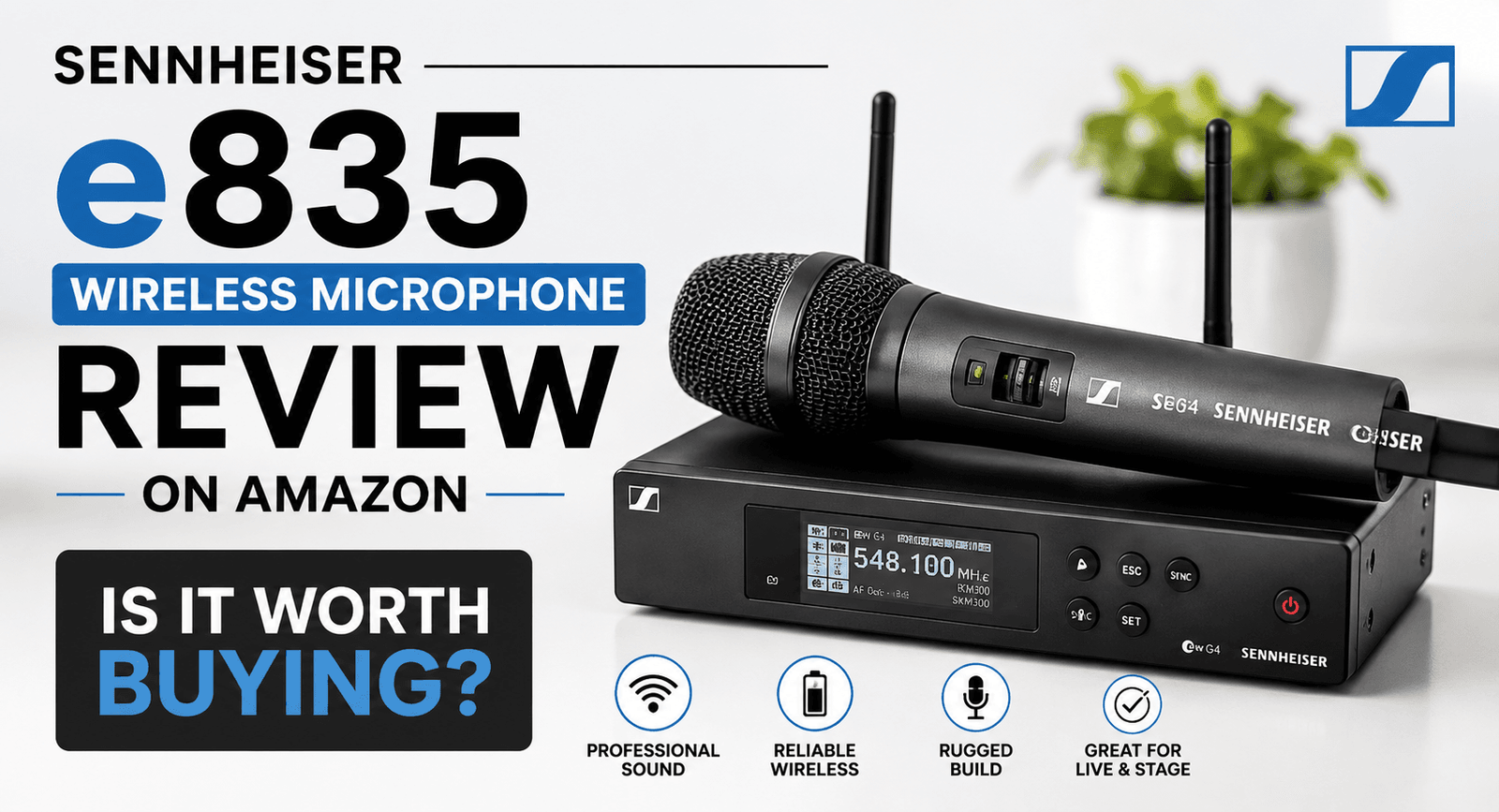
If you’re searching for a Sennheiser e835 wireless microphone review on Amazon, there’s one detail you should know before buying: the e835 microphone itself is a wired XLR microphone. The wireless version uses the same well-known e835 microphone capsule inside a Sennheiser wireless system.
That system is the Sennheiser XSW 1-835-A Vocal Wireless Microphone.
For this review, I researched the current Amazon listing, Sennheiser’s official product information, technical specifications, and related microphone information. I also compared the product with other wireless microphone solutions and looked at buyer feedback patterns rather than pretending to have personally tested the microphone.
The result is a simple answer: the XSW 1-835-A makes sense for singers, presenters, speakers, churches, small stages, and other users who want a traditional handheld microphone without being connected to the mixer by a cable.
However, it’s not the best choice for everyone. If you mainly create YouTube videos, podcasts, interviews, or smartphone videos, a compact 2.4GHz wireless microphone may be a better fit. If you perform on stage and want the familiar feel of a professional handheld vocal microphone, the Sennheiser system becomes much more interesting.


Table of Contents
Quick Verdict
| Best for | Singers, presenters, public speakers, churches, small events, and live performers |
| Microphone type | Dynamic cardioid handheld |
| Wireless system | Sennheiser XSW 1 series |
| Wireless technology | UHF |
| Microphone capsule | Sennheiser e835 |
| Amazon ASIN | B01N5ODFZ6 |
| Connection | Wireless microphone to receiver; receiver provides an audio output to your sound system |
| Research status | Amazon product page currently exists, but shows no featured offer and directs shoppers toward other sellers |
| Best reason to buy | You want the familiar vocal character and stage-focused design of the e835 in a wireless setup |
| Main reason to skip it | You need a small wireless microphone for phones, cameras, vlogging, or portable content creation |
→ Check the current Sennheiser XSW 1-835-A listing on Amazon
Sennheiser e835 vs. Sennheiser XSW 1-835-A: What Is the Difference?
This is the first thing that needs to be clear.
The Sennheiser e835 is a standalone wired vocal microphone. Sennheiser lists it as a dynamic cardioid microphone with a 3-pin XLR connector, a 40 Hz to 16 kHz frequency response, a nominal impedance of 350 ohms, and a rugged metal housing.
The XSW 1-835-A is the wireless system built around the e835 capsule. That means you’re not really buying a completely different microphone design — you’re getting the e835-style vocal capsule combined with a wireless transmitter and receiver.
This is important because many shoppers search for “e835 wireless microphone” and may assume that the e835 itself is wireless. It is not — the wireless system is the XSW 1-835 family.
Sennheiser describes the XSW 1-835-A as an all-in-one wireless system for singers and presenters. It uses a dynamic cardioid microphone capsule and includes a stationary receiver, handheld microphone, microphone clamp, power supply, and batteries.
So, when you see an e835 wireless microphone, think:
e835 microphone capsule + Sennheiser XSW wireless system.
That distinction will help you avoid buying the wrong product.
What Is the Sennheiser XSW 1-835-A?
The Sennheiser XSW 1-835-A is a handheld UHF wireless vocal system designed for live sound. It’s not aimed at the same buyer as tiny wireless lavalier systems — instead, it’s designed around the classic handheld microphone format.
That makes it a natural fit for singers, public speakers, presenters, worship services, small stages, theater, conferences, events, DJs, karaoke, and educational presentations.
The microphone uses the Sennheiser e835 dynamic cardioid capsule. Sennheiser describes the capsule as suitable for vocals and speech, with a focus on clear vocal reproduction and feedback rejection.
The wireless system adds the freedom of movement. Instead of running an XLR cable from the microphone to the mixer, the handheld transmitter sends the audio to the receiver, which then connects to your sound system. This is a traditional wireless stage setup — different from modern smartphone wireless microphones that often connect directly to a phone or camera. That difference matters.
The e835 Capsule Is the Main Attraction
The most interesting part of the system is the e835 capsule. Sennheiser has positioned the e835 as a workhorse vocal microphone, describing it as a dynamic cardioid microphone with consistent sound when the performer moves on and off axis.
That’s useful on a real stage. A singer doesn’t always keep the microphone in exactly the same position — a speaker may move, a presenter may turn their head, a performer may hold the microphone lower for a moment. A good stage microphone needs to remain usable when this happens, and the e835 is designed around that type of use.
It also uses a cardioid pickup pattern, focusing primarily on sound coming from the front while reducing sound arriving from other directions. For live vocals, this can be helpful because it gives the sound engineer more control over the microphone’s relationship with stage monitors and speakers.
Sennheiser also lists excellent feedback rejection as one of the e835’s features. That doesn’t mean feedback becomes impossible — room design, speaker placement, monitor position, microphone technique, gain, and equalization still matter. But the microphone’s design is clearly aimed at live performance rather than casual desk recording.
Sound Quality
Sound quality is the biggest reason someone would choose this system. The e835 isn’t designed to produce an artificially huge or overly processed voice — instead, the design focuses on clarity and vocal presence.
Sennheiser describes the e835 as having a gentle presence boost designed to provide vocal clarity and projection, along with a relatively controlled proximity effect. In simple terms, the microphone is designed to help vocals remain understandable — important for both singers and speakers. A microphone can have technically impressive specifications and still be poor for speech if the voice gets lost inside a mix. The e835’s design is aimed at keeping the voice forward.
What type of voice might work well with it? There’s no microphone that’s perfect for every singer — some voices are naturally bright, others dark, some have strong low frequencies, others need more presence. The e835’s vocal-focused tuning makes it a sensible choice when you want clear speech and vocals without relying heavily on studio processing. It’s especially attractive if you want a microphone that can move between speech and singing.
Dynamic Microphone Design
The e835 uses a dynamic transducer — a useful choice for live performance. Dynamic microphones are generally less sensitive than condenser microphones, which can be an advantage in environments with stage monitors, room noise, audience noise, amplifiers, other performers, speakers, air conditioning, and general live-event sound.
The microphone doesn’t try to capture every tiny sound in the room — instead, it’s built to focus on the performer. This is one reason dynamic handheld microphones remain common on stages. A condenser microphone can provide excellent detail, but detail isn’t always the goal — for a live singer, unwanted room sound can become a problem. The e835’s dynamic cardioid design makes more sense for that environment.
Cardioid Pickup Pattern
The cardioid pattern is another strong point. A cardioid microphone is most sensitive toward the front, with sound from the rear reduced. This can help isolate the performer and can also help with feedback control when the microphone and speakers are positioned correctly. Sennheiser specifically lists excellent feedback rejection for the e835.
Still, don’t confuse a cardioid microphone with a magic noise filter. If you point a loud speaker directly toward the microphone, you can still create feedback. If the microphone is held far away from the mouth, you’ll need more gain. If the stage is extremely loud, any microphone can struggle. Technique matters, placement matters, the room matters, the sound system matters — the e835 simply gives you a sensible foundation.
Wireless Performance
The XSW 1 system uses UHF wireless transmission. Sennheiser describes the system as supporting up to 10 compatible channels and using antenna-switching diversity reception, with automatic frequency management and synchronization features intended to make setup easier.
That’s very different from many tiny creator microphones. A compact phone microphone may use a small 2.4GHz wireless link, while the XSW 1 is built more like a traditional live wireless microphone system. This makes sense for stages and events — you have a receiver at the sound system, and the performer carries the transmitter. The microphone doesn’t need a cable running across the stage, giving the performer much more freedom.
Diversity Reception
The receiver uses antenna-switching diversity reception — an important feature in wireless microphone systems. Wireless signals can be affected by reflections and obstacles, and a diversity receiver can use multiple reception paths to improve reliability.
For a live performer, reliability matters. A microphone that sounds amazing but drops out during a presentation isn’t useful. That’s why wireless systems shouldn’t be judged only by audio quality — you also need to consider signal stability, frequency management, receiver design, antenna setup, operating environment, compatibility, and local frequency rules. The XSW 1 system is designed with these live-use concerns in mind.
Up to 10 Compatible Channels
Sennheiser lists up to 10 compatible channels for the XSW 1 system — useful when building a larger setup. Imagine a small event using several wireless microphones; you don’t want every microphone fighting for the same frequency. Having multiple compatible channels gives the system more flexibility.
However, the exact frequency range matters. The XSW 1-835-A version uses the A frequency range, which Sennheiser lists at 548–572 MHz. This is something buyers should check carefully before ordering — don’t assume that every XSW 1-835 listing uses the same frequency band, since different regional versions can exist. If you’re replacing an existing wireless microphone, match the frequency range and system requirements before buying.
Setup
One of the biggest selling points of the XSW 1 is its relatively simple setup:
- Connect the receiver near your mixer, powered speaker, amplifier, or other audio equipment.
- Connect the receiver to your sound system using the appropriate audio connection from the receiver to the mixer or sound system.
- Install the batteries in the handheld transmitter.
- Turn on the microphone — power up the handheld transmitter.
- Turn on the receiver.
- Match the channel using the system’s frequency management and synchronization features to establish the wireless connection.
Sennheiser specifically designed the XSW 1 series to simplify setup for singers and presenters — a useful benefit for beginners.
Is It Good for Singing?
Yes — this is probably one of the strongest use cases. The e835 was designed as a vocal stage microphone. Sennheiser describes it as a lead and backup vocal microphone capable of handling high sound pressure levels while providing clear reproduction and feedback rejection.
That makes it a logical option for live singers, bands, worship teams, karaoke, small venues, school performances, and community events. The handheld format is also familiar — you don’t need to change your performance style. You hold it like a normal vocal microphone; the wireless system simply removes the cable.
Is It Good for Public Speaking?
It can be an excellent fit. The e835 isn’t limited to singing — Sennheiser specifically lists speech as an application for the microphone. For public speaking, a microphone needs to make speech easy to understand, and the e835’s cardioid design and presence-focused tuning can help keep the speaker’s voice clear.
This makes the system suitable for conferences, lectures, presentations, churches, weddings, events, school programs, and community meetings. The wireless design also lets the speaker move, which can make presentations more natural.
Is It Good for Churches?
The XSW 1-835 is worth considering for church environments. Churches often need microphones that can handle both speech and singing — one microphone may be used for announcements, another for vocals, another by a presenter. A handheld wireless system gives users freedom to move without cables across the stage, and the e835 capsule is also designed for vocal work. That combination makes sense.
However, churches should pay particular attention to frequency coordination if several wireless systems are already in use. Don’t simply buy several wireless systems and assume they’ll all work together automatically — proper frequency planning is important.
Is It Good for YouTube?
This is where the answer changes.
If you mean YouTube videos recorded in a studio or home office, I would not automatically choose the XSW 1-835. It can work, but it’s not designed specifically for this job. For a YouTube creator, a USB microphone or compact camera wireless microphone can be easier — you may not need a separate UHF receiver or a handheld stage microphone. You may instead want a microphone that connects directly to a camera, smartphone, computer, or tablet.
Your needs determine the better choice. TechRigReview already covers computer-focused microphones in its guide to 10 Best Amazon Microphones for Computer, which compares USB and other computer-friendly microphone choices for creators and remote workers.
Is It Good for Vlogging?
Usually, no. A handheld UHF microphone isn’t the most convenient tool for typical vlogging. If you’re walking around with a camera, you probably want something small — a lavalier transmitter that clips onto your shirt, or a compact wireless system that connects to a camera and stays out of the shot.
The XSW 1-835 is different — it’s a traditional handheld microphone, great for a presenter holding the microphone, but less convenient for someone filming themselves while walking around. If your main goal is vlogging, it’s worth looking at compact wireless microphone systems instead. See TechRigReview’s broader Amazon vlogging equipment guide for other creator-focused options.
What About Podcasts?
The answer depends on the podcast format.
If you record a podcast at a desk, the e835 can work very well with the right audio interface or mixer. The dynamic cardioid design is useful for voice and can help reduce room sound compared with a sensitive condenser microphone. But the wireless system may be unnecessary — if everyone is sitting at a table, wired XLR microphones can be simpler.
The wireless system becomes more useful when the presenter needs to move — for example, interviewing people around a room, recording a live podcast, hosting a stage show, moving between speakers, or combining podcasting with live events. For a normal desk podcast, you can probably spend your money more efficiently elsewhere.
What Buyers Should Know About the Amazon Listing
The Amazon product page for ASIN B01N5ODFZ6 currently identifies the product as:
Sennheiser XSW 1-835-A Vocal Wireless Microphone, A Range 548-572 MHz, Black.
Amazon’s current product page shows the product information and customer feedback, but it currently reports no featured offer and points shoppers to other sellers.
This is important — a product page existing on Amazon doesn’t always mean Amazon itself is the current seller. Wireless microphone prices and seller availability can change. So before publishing an affiliate article or making a purchase, readers should click through and check the current buying options.
That’s why the article uses wording such as: “Check the current Amazon listing before buying” — rather than promising that a specific seller or price will remain available.
→ Check current buying options on Amazon
Key Specifications
Based on Sennheiser’s official information, the XSW 1-835-A has the following notable specifications:
- Microphone capsule: e835
- Transducer: Dynamic
- Pickup pattern: Cardioid
- Wireless technology: UHF
- Frequency range: 548–572 MHz for the A version
- Compatible channels: Up to 10
- Receiver type: Stationary receiver
- Reception: Antenna-switching diversity
- Frequency management: Automatic frequency management and synchronization
- Use cases: Singing, presenting, live sound, stage and related applications
- Microphone format: Handheld
- Audio output: Receiver-based connection to a sound system
Sennheiser’s official page confirms the system’s dynamic cardioid design, UHF operation, diversity reception, automatic frequency management, and up-to-10-channel capability.
Pros and Cons
Pros
- Uses the respected e835 vocal capsule
- Dynamic cardioid design suits live vocals
- Wireless freedom for singers and presenters
- UHF wireless transmission
- Antenna-switching diversity
- Automatic frequency management
- Up to 10 compatible channels
- Designed specifically for live sound
- Traditional handheld microphone format
- Useful for both speech and singing
- Strong brand support from Sennheiser
- More stage-focused than many consumer wireless systems
Cons
- The e835 itself is wired; the wireless product is the XSW 1-835 system
- The system needs a separate receiver
- Not the most convenient option for smartphone creators
- Not as compact as modern creator wireless microphones
- Frequency band must be checked before purchase
- Can be unnecessary for a simple home podcast
- Current Amazon page does not show a featured offer
- Wireless setup requires more planning than a basic wired microphone
These drawbacks don’t make the product bad — they simply show that it has a specific purpose.
Who Should Buy the Sennheiser e835 Wireless System?
The strongest buyers are people who need a handheld wireless microphone for live use:
- A singer
- A presenter
- A public speaker
- A church
- A small event organizer
- A stage performer
- A theater group
- A karaoke host
- A conference presenter
- A school or community event organizer
The system makes the most sense when mobility matters. If you need to stand in front of an audience and move without dragging an XLR cable behind you, wireless makes sense.
Who Should Not Buy It?
You may want something else if your main goal is:
| Use Case | Better Option |
|---|---|
| Smartphone recording | A wireless microphone designed for USB-C or Lightning devices |
| Vlogging | A compact lavalier-style system will usually be easier |
| Desktop podcasting | A wired USB or XLR microphone may be simpler |
| Computer calls | A USB microphone is generally easier |
| Remote work | You probably don’t need a stage wireless receiver |
For computer microphone options, see the related TechRigReview comparison: 10 Best Amazon Microphones for Computer – Honest Reviews.
e835 Wireless vs. e835 Wired
The choice is simple.
Choose the wired e835 if: you don’t need to move around, you already have an XLR cable, you have a mixer or audio interface, you want a simple stage setup, or you want to reduce wireless complexity. Sennheiser’s current e835 product page confirms that the standard e835 is a wired microphone using a 3-pin XLR connector.
Choose the XSW 1-835 if: you need wireless movement, you perform on stage, you give presentations, you host events, you want a handheld wireless microphone, or you want the e835 capsule in a wireless system.
That’s the core difference.
Why the Frequency Band Matters
Wireless microphone buyers sometimes ignore the frequency band — that’s a mistake.
The XSW 1-835-A is an A-band model. Sennheiser lists its operating range as 548–572 MHz. Other XSW versions may use different frequency ranges, so if you see a listing with a different letter or frequency specification, don’t assume it’s identical.
Before buying, check:
- The exact model.
- The frequency range.
- Your local wireless regulations.
- Whether you’re adding it to an existing wireless microphone system.
- Whether multiple wireless channels need to operate together.
This is particularly important for professional venues. A product that works well in one region may not be the correct frequency configuration for another region.
How to Get Better Sound From the e835
Buying a good microphone is only the first step — your microphone technique matters.
Keep a consistent distance. Try to keep the microphone at a reasonably consistent distance from your mouth. Moving very close can increase bass; moving far away can make the voice quieter and allow more room sound into the system.
Don’t point the microphone at speakers. This is a basic rule — keep the microphone away from loudspeaker output whenever possible.
Speak toward the capsule. The e835 is a directional microphone; your voice should reach the front of the microphone.
Don’t cover the grille. Avoid wrapping your hand around the microphone grille — this can change the microphone’s acoustic behavior and may make feedback control harder.
Set gain carefully. More gain is not always better — set the system so normal speech or singing has enough level without clipping.
How It Compares With Modern 2.4GHz Wireless Mics
This is one of the most important buying decisions.
Modern 2.4GHz wireless microphones are often tiny, and may include small transmitters, charging cases, USB-C receivers, smartphone compatibility, noise cancellation, internal recording, and camera connectivity. They’re excellent for creators.
The XSW 1-835 is different — it’s a traditional UHF wireless vocal system. It uses a handheld microphone, has a stationary receiver, and is designed for live sound. Neither approach is automatically better; they solve different problems.
| Scenario | Better Choice |
|---|---|
| YouTube | A modern compact system may win |
| Smartphone videos | A compact system may win |
| Stage singing | The XSW 1-835 becomes much more attractive |
| Public speaking | The XSW 1-835 is a natural fit |
| Church services | It can be a strong option |
| Professional event | A traditional UHF system can make more sense than a tiny creator microphone |
External Research Sources
For this article, the best external source is Sennheiser itself.
- Sennheiser e835 official product information — confirms the microphone’s dynamic cardioid design, frequency response, XLR connection, dimensions, and other specifications.
- Sennheiser e835 official tutorial — covers the e835 vocal and speech dynamic microphone.
- Sennheiser XSW 1-835-A official product page — confirms the wireless system’s UHF operation, diversity reception, automatic frequency management, and channel capabilities.
These are much stronger sources for this article than linking to another “best microphone” article.
FAQ
Is the Sennheiser e835 wireless?
The standard Sennheiser e835 is a wired XLR microphone. The wireless version is used inside Sennheiser wireless systems such as the XSW 1-835-A. Sennheiser’s official e835 page lists the standard microphone as wired with a 3-pin XLR connector.
What is the Sennheiser XSW 1-835-A?
It’s an all-in-one UHF wireless vocal system that combines a wireless handheld transmitter using the e835 dynamic cardioid capsule with a stationary receiver.
Is the Sennheiser e835 good for singing?
Yes. The e835 was designed as a vocal stage microphone. Its dynamic cardioid design, vocal presence, feedback rejection, and ability to handle high sound pressure levels make it well suited to live singing.
Is the e835 good for speaking?
Yes. Sennheiser lists both speech and vocals among the microphone’s applications. Its cardioid pickup pattern helps focus on the speaker’s voice.
Is the XSW 1-835 good for YouTube?
It can be used for YouTube, but it’s primarily a live vocal wireless system. If your main goal is smartphone or camera-based content creation, a compact wireless lavalier system may be more convenient.
Does the XSW 1-835 work with a mixer?
The wireless receiver is designed to connect to a sound system, making the system suitable for live audio setups using mixers and related equipment.
What frequency does the XSW 1-835-A use?
The A version is listed by Sennheiser in the 548–572 MHz frequency range.
How many channels can the XSW 1 system support?
Sennheiser states that the XS Wireless 1 system can support up to 10 compatible channels, depending on the configuration and frequency environment.
Is the Sennheiser e835 a condenser microphone?
No. The e835 is a dynamic microphone.
Does the e835 need phantom power?
The standard e835 is a passive dynamic microphone and doesn’t require phantom power for normal operation.
Is the e835 better than a USB microphone?
That depends on your use. For live singing and stage speech, the e835 is designed for the job. For computer calls, USB microphones are usually easier because they connect directly to the computer.
Is the wireless version worth it?
If you need freedom to move on stage, yes, the wireless version can make sense. If you’re sitting at a desk, the wired e835 or a USB microphone may be the better value.
Final Verdict: Should You Buy the Sennheiser e835 Wireless Microphone?
The Sennheiser e835 wireless microphone is best understood as the Sennheiser XSW 1-835 wireless system built around the e835 dynamic cardioid capsule. That distinction is important — the standard e835 is wired, while the XSW 1-835-A gives you wireless freedom while keeping the e835-style vocal microphone at the center of the system.
Based on the specifications and intended use, this is a strong choice for singers, presenters, churches, public speakers, small stages, and live events. It’s less compelling for a YouTuber sitting at a desk or a creator recording smartphone videos — for those users, smaller USB or 2.4GHz wireless microphones may offer a simpler workflow.
The e835’s biggest strength is that it was designed around a real live-performance problem: getting a clear voice from a performer while allowing that performer to move. The XSW 1 system adds the wireless freedom needed to make that possible.
→ Check the Sennheiser XSW 1-835-A on Amazon
Bottom Line
| Best for | Live singers and presenters |
| Best feature | e835 dynamic cardioid vocal capsule |
| Best use | Stage, church, events, presentations |
| Main advantage | Wireless freedom with a traditional handheld microphone |
| Main drawback | More specialized and less portable than modern creator wireless systems |
| Research verdict | Worth considering if you specifically need a handheld wireless stage microphone |

MD.HASAN is an experienced SEO expert and amazon products review writer passionate about helping people find right products on amzon for buy without confusion. With 4 years of hands-on experience in content strategy and search engine optimization, he specializes in writing SEO-friendly blog posts that rank, engage, and convert.