🔗 Affiliate Disclosure: As an Amazon Associate, Tech Rig Review earns from qualifying purchases. Links on this page may be affiliate links — at no extra cost to you.
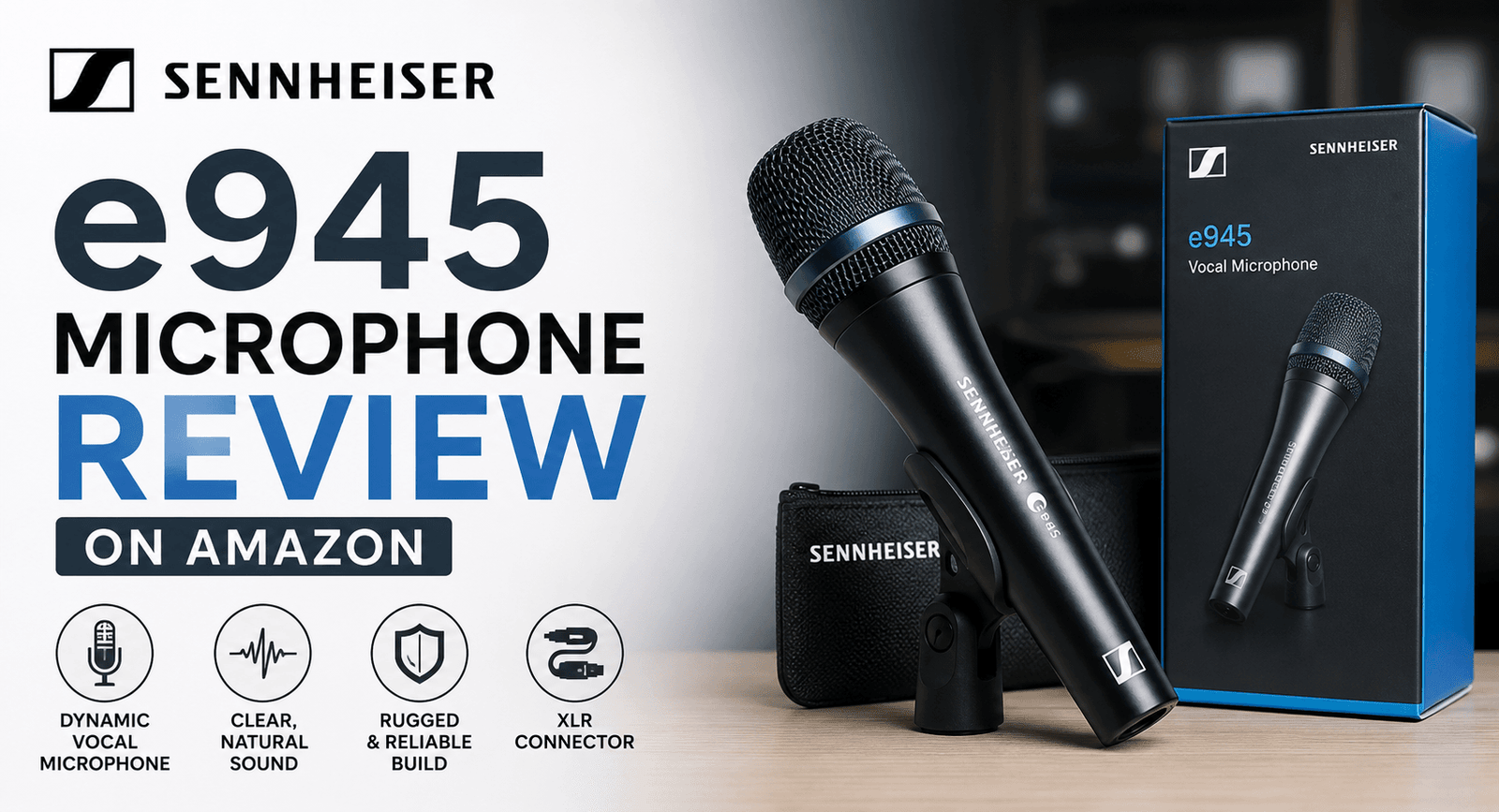
Sennheiser e945 microphone review: learn about its sound, supercardioid pickup, build quality, Amazon availability, pros, cons, and who should buy it.
Quick answer: The Sennheiser e945 is a professional dynamic vocal microphone built for live performance. It has a tight supercardioid pickup pattern, rugged metal housing, an internal shock-mounted capsule, and a 3-pin XLR connection. However, there’s one important detail: the standard e945 is wired, not wireless. Sennheiser also sells wireless systems that use an e945 microphone head, but those are different products.
If you’re searching Amazon for a Sennheiser e945 wireless microphone, this difference matters before you buy.
The standard Sennheiser e945 is designed for singers, stage performers, presenters, churches, event hosts, and other live vocal users who want strong vocal focus without relying on a condenser microphone.
For this review, I researched the current Amazon listing, the manufacturer’s specifications, product details, and available buyer-feedback patterns. I did not treat this as a hands-on test. The goal is to give you a clear research-based view of what the e945 does well, where it has limitations, and whether it makes sense for your setup.
Table of Contents

Sennheiser e945 at a Glance
| Feature | Sennheiser e945 |
|---|---|
| Microphone type | Dynamic |
| Pickup pattern | Supercardioid |
| Connection | 3-pin XLR |
| Frequency response | 40 Hz–18 kHz |
| Nominal impedance | 350 ohms |
| Weight | About 365 g |
| Main use | Live vocals and stage performance |
| Build | Rugged metal housing |
| Internal shock protection | Yes |
| Wireless? | No — standard e945 is wired |
| Amazon ASIN | B000NAXCC0 |
| Best for | Live singers and demanding stage use |
Sennheiser lists the e945 as a dynamic supercardioid vocal microphone. Its official specifications include a 40 Hz–18 kHz frequency response, 350-ohm nominal impedance, and 3-pin XLR connector.
What Is the Sennheiser e945?
The Sennheiser e945 is a handheld dynamic vocal microphone designed primarily for live sound. It sits in Sennheiser’s evolution wired microphone family. The design focuses on a few things that matter on stage: clear vocal presence, strong rejection of unwanted sound, resistance to feedback, low handling noise, rugged construction, consistent performance, and easy integration with professional PA systems.
This is not a USB microphone. It’s not a plug-and-play microphone for a laptop. It does not contain Bluetooth. And the standard e945 is not a wireless microphone.
Instead, it uses a traditional 3-pin XLR connection. You connect it to a mixer, audio interface, microphone preamp, powered speaker, or other suitable audio equipment. That may sound less convenient than a USB or wireless microphone, but for live vocals, an XLR connection remains a very practical choice.
The e945 is built around a dynamic transducer. Dynamic microphones are popular on stages because they can handle loud sources and don’t require phantom power like many condenser microphones. Sennheiser specifically positions the e945 for demanding live environments, saying the microphone combines a supercardioid pattern with a smooth response, strong presence, and feedback rejection.
Important: Is the Sennheiser e945 Wireless?
No. This is probably the most important point in this entire review.
The standard Sennheiser e945 is a wired microphone. It has a 3-pin XLR connector and does not have a built-in wireless transmitter. Sennheiser’s own product specifications identify the connection as wired and the connector as 3-pin XLR.
So why do people sometimes search for a “Sennheiser e945 wireless microphone”? There’s a good reason — Sennheiser offers wireless microphone systems that use a 945 microphone head. For example, the company’s EW 100 G4 945 S system uses a dynamic supercardioid microphone and wireless transmission. That’s a complete wireless system. The standard e945 is the microphone itself.
Think of it this way:
| Product | What It Includes |
|---|---|
| Sennheiser e945 | Microphone + XLR cable + mixer/PA |
| Sennheiser wireless 945 system | Wireless handheld transmitter + 945 microphone head + wireless receiver + PA/mixer |
These are not the same product. If you want a microphone that plugs directly into your mixer with an XLR cable, the e945 is the product to consider. If you need to walk around a stage without a cable, you need a compatible Sennheiser wireless system instead.
Sennheiser e945 Review

- Supercardioid pickup pattern: Provides insulation from other on-stage signals
- Shock-mounted capsule: Low sensitivity to impact and handling noise
- Hum compensating coil: Reduces electrical interference
Sound Quality
Sound quality is the main reason to consider the e945. Sennheiser designed this microphone specifically for lead vocals, describing it as offering presence, warmth, fullness, and clarity.
That makes sense for a stage microphone. A singer needs the voice to remain understandable when guitars, drums, bass, keyboards, monitors, and other instruments are all producing sound at the same time — a microphone that sounds excellent in a quiet room can behave very differently on a loud stage. The e945’s design is intended to keep the vocal focused.
Sennheiser lists a frequency response of 40 Hz to 18,000 Hz — a broad range for a dynamic vocal microphone. But numbers alone don’t tell the whole story; the pickup pattern is just as important.
The e945 uses a supercardioid pattern, meaning it focuses strongly on sound coming from the front while reducing sound from much of the surrounding area. Sennheiser explains that supercardioid microphones provide more focused pickup than normal cardioid microphones and can reduce unwanted stage bleed — very useful for live singers.
Supercardioid Pickup Pattern
The supercardioid pattern is one of the e945’s biggest selling points. A microphone doesn’t simply hear everything equally — different microphones are designed to hear sound from different directions, and the e945 is designed to focus on the performer.
This can help when a stage contains loud guitar amplifiers, drum kits, monitor speakers, other vocalists, keyboard speakers, or audience noise. Sennheiser explains that the e945’s supercardioid pattern is designed to isolate the vocalist and reduce unwanted stage signals — particularly interesting for singers who perform in loud environments.
However, there’s a small learning curve. Supercardioid microphones reward good microphone technique — you generally want to speak or sing toward the front of the microphone, and you also need to pay attention to monitor placement. Sennheiser notes that the maximum rear rejection area for a supercardioid pattern is around the rear-left and rear-right areas rather than directly behind the microphone. That means placement matters — a good microphone cannot completely fix poor stage setup.
Feedback Rejection
Feedback is one of the biggest problems in live vocal performance. It happens when sound from the speaker system enters the microphone, gets amplified, comes back through the speaker, and repeats — the result can be a loud squeal.
A tightly focused microphone can help reduce this problem. Sennheiser specifically markets the e945 as a microphone with high feedback rejection, and the supercardioid pickup pattern is part of that design.
This doesn’t mean the e945 is immune to feedback — no microphone is. Your mixer settings, monitor position, room acoustics, speaker placement, microphone technique, and gain structure still matter. But the e945 is designed for exactly the kind of environment where feedback control matters, which is one reason it makes more sense as a stage microphone than as a casual desktop microphone.
Handling Noise
Another useful feature is the microphone’s internal shock-mounted capsule. When you hold a handheld microphone, your hands naturally move — you may adjust your grip, move the microphone closer to your mouth, touch the body, or accidentally bump it. Those small movements can create unwanted noise.
Sennheiser says the e945 uses a shock-mounted capsule designed to reduce sensitivity to impact and handling noise. This is a practical feature — a live vocal microphone needs to survive real use. You’re not placing it carefully on a desk and leaving it there; you’re holding it, moving, possibly performing for several hours. That’s where rugged construction and internal shock protection become more important.
Build Quality
The e945 uses a metal housing. Sennheiser describes the construction as rugged and designed for professional use — exactly what you’d expect from a microphone aimed at working musicians.
A stage microphone needs to survive repeated setup, repeated teardown, transport, microphone stands, handheld use, occasional bumps, long performances, and regular cable connection and disconnection. The metal body gives the microphone a professional feel, though it’s not designed to be an ultra-light travel microphone — Sennheiser lists the weight at approximately 365 grams. That’s worth considering if you’re used to very lightweight microphones, though for a singer, the weight is unlikely to be a major issue for normal performances.
Hum-Compensating Coil
The e945 also includes a hum-compensating coil. This is a useful feature in professional audio environments because electrical interference can create unwanted noise. Sennheiser specifically lists the hum-compensating coil as one of the microphone’s design features — another example of how the e945 is built around live performance rather than casual computer use. It’s not trying to be everything to everyone; it’s trying to be a reliable vocal microphone, and that focused design is one of its strengths.
XLR Connection
The e945 uses a 3-pin XLR connector. That’s good news if you already own a mixer, a PA system, an audio interface, a microphone preamp, or a professional recording setup. XLR also makes the microphone easy to integrate into many live audio systems.
But it’s not ideal if your goal is simple computer recording — you cannot simply plug the e945 into a normal USB port; you’ll need suitable audio hardware.
For a computer setup: If you want to use the e945 with a computer, you’ll typically need an audio interface or another device that accepts XLR input and converts the microphone signal to a format your computer can use. That adds cost and complexity. For a singer with a PA system, this isn’t a problem — for someone who simply wants to record YouTube videos at a desk, it may be unnecessary.
Frequency Response
Sennheiser lists the e945’s frequency response as 40 Hz–18,000 Hz. This range covers the important frequencies used for vocals. The microphone is designed to produce a lively vocal sound with presence and fullness, and Sennheiser also describes the e945 as having rich lower mids and enhanced presence. That combination can help vocals maintain body without becoming difficult to understand.
Of course, every singer’s voice is different — a microphone that sounds excellent on one vocalist may not be the perfect match for another. Your voice, microphone distance, room, PA system, EQ settings, and performance style all matter. That’s why the e945 shouldn’t be described as a universal “best microphone for every singer” — it’s better described as a professional dynamic microphone designed for demanding vocal performance.
Sennheiser e945 Key Specifications
According to Sennheiser’s current product documentation, the main specifications include:
- Transducer: Dynamic
- Pickup pattern: Supercardioid
- Frequency response: 40 Hz–18 kHz
- Sensitivity: 2.0 mV/Pa
- Nominal impedance: 350 ohms
- Minimum terminating impedance: 1 kΩ
- Connector: 3-pin XLR
- Dimensions: Approximately 47 × 186 mm
- Weight: Approximately 365 g
- Construction: Metal housing
- Internal feature: Shock-mounted capsule
- Noise-control feature: Hum-compensating coil
- Primary use: Live vocals
These are manufacturer specifications rather than hands-on test measurements.
Pros and Cons
Pros
- Excellent focus for live vocals
- Supercardioid pickup pattern
- Designed to reject unwanted stage sound
- Strong feedback-rejection characteristics
- Rugged metal construction
- Internal shock-mounted capsule
- Hum-compensating coil
- Professional XLR connection
- Dynamic design does not require phantom power
- Designed specifically for demanding stage environments
- Long-running Sennheiser professional microphone design
Cons
- It is not wireless
- Requires an XLR cable
- Requires compatible audio equipment
- More expensive than basic entry-level vocal microphones
- May be more microphone than casual users need
- Supercardioid pickup requires sensible monitor placement
- Not a simple USB plug-and-play microphone
- Handheld dynamic design is less convenient for some desktop recording setups
What Buyers Like About the e945
The available buyer-feedback patterns around the e945 are generally positive. Users commonly highlight the microphone’s vocal clarity, strong sound, and ability to work well for live vocals. Some long-term users also compare it favorably with other handheld dynamic microphones.
That said, not every buyer experience is identical. One important theme is that microphone choice depends heavily on the rest of the sound system. A microphone can be excellent and still sound wrong if the gain is too high, EQ is poorly adjusted, the monitor is positioned incorrectly, the singer holds the microphone incorrectly, the room is highly reflective, or the PA system is poorly configured.
So it would be misleading to say the e945 automatically eliminates every live-sound problem — it doesn’t. What it does is provide a professional microphone platform designed specifically for the problems that stage vocalists face.
Who Should Buy the Sennheiser e945?
The e945 makes the most sense for people who already have, or plan to build, a proper live audio setup.
1. Live Singers — If you sing in clubs, concerts, churches, events, wedding venues, theaters, bands, or rehearsal spaces, the e945 is worth considering. Its supercardioid pattern is especially useful when stage isolation matters.
2. Church Vocalists — Church environments can be challenging, with multiple singers, instruments, floor monitors, PA speakers, large rooms, and reflective surfaces. A focused dynamic microphone can be useful in this kind of setup, especially if your church audio system already uses professional XLR microphones.
3. Professional Presenters — The e945 isn’t only for singers; it can also work for spoken vocals in environments where a handheld microphone is appropriate, such as live events, stage presentations, public speaking, conferences, theater, or announcements. However, there may be better microphone styles for a presenter who needs both hands free.
4. Touring Musicians — Durability matters when a microphone travels often. The e945’s metal construction and shock-mounted capsule are designed around professional use, making it a logical option for musicians who regularly move equipment between venues.
Who Should Not Buy the Sennheiser e945?
The e945 isn’t automatically the right microphone for everyone. You probably don’t need it if you only want Zoom calls, Google Meet, basic gaming chat, casual Discord use, simple podcast recording, basic computer voice recording, or smartphone videos. For these uses, a USB microphone or wireless lavalier may be much easier.
Sennheiser e945 vs. a Wireless Microphone
This is where buyers need to be careful — a wireless microphone and a wired microphone solve different problems.
Wired e945 gives you: XLR connectivity, no wireless battery in the microphone, no wireless receiver required, a simple professional signal path, strong stage-focused pickup, and reliable cable-based connection.
Wireless system gives you: freedom to move, no microphone cable across the stage, transmitter and receiver, batteries, wireless frequency management, and more components to manage.
Sennheiser’s EW 100 G4 945 S is an example of a wireless system using a dynamic supercardioid 945 microphone configuration, with a true-diversity receiver and typical operating time of about eight hours.
So if you specifically need wireless operation, don’t accidentally order the standard e945 expecting it to work wirelessly.
Is the Sennheiser e945 Good for Recording?
Yes, it can be — but its main purpose is live vocal performance. The e945 can be connected to a suitable audio interface and used for recording. Its dynamic design can be useful in less-than-perfect rooms because it’s focused and doesn’t behave like a highly sensitive condenser microphone.
That said, if you’re building a quiet home recording studio, you may want to compare it against studio-oriented microphones. For a singer recording vocals in a treated room, the best choice depends on the desired sound. For a noisy room or live environment, the e945’s focused pickup can become more attractive.
Is the e945 Good for Podcasting?
It can work for podcasting, but I wouldn’t recommend buying it simply because you want a podcast microphone. Why? Because there are microphones designed specifically for desktop podcasting.
The e945 requires XLR equipment — if you already own an audio interface, that’s easy; if you don’t, you have to buy additional hardware. For podcast creators who want an XLR microphone and already understand gain, EQ, and audio interfaces, the e945 can be useful. For beginners who want to plug a microphone directly into a laptop, a USB microphone is easier.
Common Questions About Setup
Does the e945 need phantom power? No. The e945 is a dynamic microphone and does not require phantom power to operate. If your audio interface has phantom power available, you should still follow the interface manufacturer’s instructions and use the appropriate connection — the key point is that the e945 doesn’t need phantom power in the way a typical condenser microphone does.
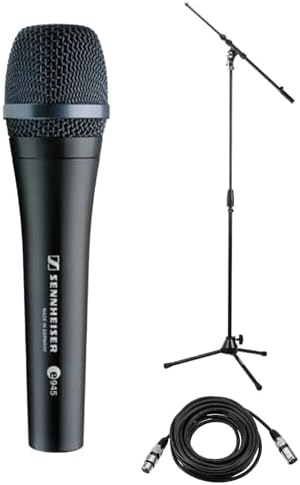
Does the Sennheiser e945 come with a cable? Sennheiser’s product documentation lists the e945, microphone clamp, pouch, and guides among the included items. A microphone cable is not something to assume is included unless the exact Amazon package you’re buying specifically says so — Amazon sellers sometimes offer bundles, so always check the “What’s Included” section of the current listing before ordering. If you need an XLR cable, add one separately.
Does the e945 come with a microphone stand? No — the manufacturer’s listed delivery contents include the microphone, pouch, microphone clamp, and documentation, but not a stand. If you’re building your first setup, remember that the microphone is only one part of the system. You may also need an XLR cable, microphone stand, mixer or audio interface, PA speaker, monitor, and appropriate power cables. This is another reason the e945 makes more sense for someone building a real audio system than for someone looking for a simple USB microphone.
How to Get the Best Sound From the e945
Buying a good microphone is only half the job — your technique matters.
- Keep the microphone close enough. Dynamic vocal microphones generally work best when used at an appropriate distance. Don’t hold the microphone far away from your mouth and expect the same vocal presence.
- Aim the front toward your mouth. The e945’s supercardioid pattern is directional — you need to sing into the correct side of the microphone.
- Avoid covering the grille. Don’t wrap your hand around the microphone head — doing so can change the microphone’s directional behavior.
- Position monitors carefully. Because the microphone uses a supercardioid pattern, monitor placement matters. Sennheiser explains that supercardioid microphones have their strongest rejection areas toward the rear sides.
- Set gain carefully. Don’t assume more gain means better sound — set the input level so your strongest vocal passages have enough headroom.
- Use EQ carefully. Start with a clean signal, then make small adjustments. A good microphone shouldn’t need extreme EQ to become usable.
Comparisons With Other Microphones
Sennheiser e945 vs. Sennheiser e935
The e935 is one of the most natural comparisons — both are professional Sennheiser handheld dynamic vocal microphones. The major difference is the pickup pattern: the e945 uses supercardioid, while the e935 uses cardioid. Sennheiser explains that the e945’s narrower pattern provides greater focus and can further reject unwanted side-stage bleed.
Choose the e945 if: your stage is loud, isolation matters, feedback control is important, you want focused vocal pickup, and you’re comfortable with directional microphone technique.
Consider the e935 if: you want a more forgiving pickup pattern, your stage is relatively controlled, and you want more freedom with microphone positioning.
Neither is automatically better — the right choice depends on the singer and stage.
Sennheiser e945 vs. Shure SM58
The Shure SM58 is one of the most recognizable live vocal microphones in the world and is also a dynamic vocal microphone. So why would someone choose the e945? The answer isn’t simply “better sound” — it’s about the pickup pattern and the way the microphone interacts with the stage.
The e945’s supercardioid pattern is tighter than a typical cardioid pattern, which can make it appealing to singers dealing with stage bleed and feedback. The SM58, meanwhile, has an enormous track record and is known for its durability and broad stage use.
If you already use an SM58 and like it, you don’t automatically need to replace it. The e945 is more interesting when you specifically want the characteristics of a supercardioid vocal microphone.
What Makes the e945 Different From Cheap Amazon Microphones?
Amazon has thousands of microphones — many are inexpensive USB microphones, others are low-cost wireless microphones or generic handheld microphones. The e945 is different because it’s not trying to compete in the same category. It’s a professional wired stage microphone from an established audio company, with a design focused on vocal performance, stage isolation, feedback resistance, durability, handling noise, and XLR connectivity.
That explains why the e945 isn’t the obvious choice for a beginner looking for a microphone for Zoom — it’s designed for a different job.
- Supercardioid pickup pattern: Provides insulation from other on-stage signals
- Shock-mounted capsule: Low sensitivity to impact and handling noise
- Hum compensating coil: Reduces electrical interference
Is the Sennheiser e945 Worth Buying on Amazon?
For the right buyer, yes. The important part is the phrase “right buyer.”
If you’re a singer who needs a professional handheld microphone for live performance, the e945 deserves serious consideration. It has a strong feature set: dynamic capsule, supercardioid pickup, rugged metal construction, internal shock mounting, hum compensation, XLR connection, professional vocal tuning, and strong stage isolation. Sennheiser’s current documentation continues to position the e945 as a demanding live-vocal microphone.
But if you’re looking for a wireless microphone, stop before buying — the normal e945 is wired. If wireless is essential, look for a complete Sennheiser wireless system designed around the 945 microphone configuration.
→ Check Current Price on Amazon
Amazon prices, sellers, stock, delivery dates, and product bundles can change. Check the live Amazon page before purchasing.
Related Microphone Guides
If you’re comparing the e945 with other microphones, these related guides are useful next steps:
- 10 Best Amazon Wireless Microphones Under $90 in 2026 — if you specifically want wireless audio, this covers compact wireless systems for creators as well as professional options.
- 10 Best Amazon Microphones for Computer – Honest Reviews (2026) — if your goal is recording into a computer rather than singing on stage, compare the e945 with USB and computer-focused microphone options.
- 10 Best Amazon Vlogging Equipment for Beginners (2026 Buying Guide) — for YouTube and video creators, the microphone is only one part of the setup; this guide covers the broader creator workflow.
FAQ
Is the Sennheiser e945 wireless?
No. The standard Sennheiser e945 is a wired dynamic microphone with a 3-pin XLR connector. Sennheiser also makes wireless systems using a 945 microphone configuration — those include a wireless transmitter and receiver and should not be confused with the standard e945.
Is the Sennheiser e945 good for live singing?
Yes. Live vocals are one of its main intended uses. Sennheiser designed the e945 as a dynamic supercardioid vocal microphone for demanding stage environments.
Does the Sennheiser e945 need phantom power?
No. It’s a dynamic microphone and doesn’t require phantom power for normal operation.
Does the e945 use XLR?
Yes. The e945 uses a 3-pin XLR connector.
Is the e945 good for a loud stage?
That’s one of the situations where the e945 makes the most sense. Its supercardioid pickup pattern is designed to focus on the vocalist and reduce unwanted stage sound.
Is the e945 good for podcasts?
It can be, especially if you already have an XLR audio interface. However, a USB microphone may be easier for someone who wants a simple computer setup.
Is the e945 better than the e935?
Not universally. The e945 has a tighter supercardioid pickup pattern, while the e935 uses cardioid pickup. The e945 may be preferable when stage isolation is important.
Is the e945 good for beginners?
It can be, but it’s not necessarily the easiest first microphone. Beginners who want to plug directly into a laptop may find a USB microphone simpler. Singers who already use an XLR PA system can use the e945 without needing to learn a complicated microphone setup.
Does the e945 reduce feedback?
Its supercardioid design and stage-focused construction are intended to provide strong feedback rejection, but no microphone can guarantee that feedback will never occur. Speaker placement, monitor position, gain, EQ, room acoustics, and microphone technique still matter.
What is the e945 best for?
The e945 is best suited to live vocal performance, especially when the singer needs focused pickup, stage isolation, and a durable handheld microphone.
Final Verdict: Should You Buy the Sennheiser e945?
The Sennheiser e945 is a serious vocal microphone for serious live use. Its strongest qualities are not flashy wireless features or smartphone connectivity — instead, it focuses on the basics that matter on stage: clear vocals, directional pickup, feedback resistance, handling-noise control, and rugged construction.
The supercardioid pattern is particularly important — it gives the microphone a focused pickup area that can help reduce unwanted stage sound. Sennheiser specifically designed the e945 around this kind of demanding environment.
The biggest buying mistake would be ordering the e945 because you think it’s a wireless microphone. It isn’t. The standard e945 is a wired XLR microphone. If you need a cable-free stage microphone, look at a complete Sennheiser wireless system that uses a compatible 945 microphone configuration.
If you already have an XLR PA or mixer and want a high-quality handheld vocal microphone, the e945 is much easier to recommend.
Research-Based Verdict
| Category | Verdict |
|---|---|
| Best for | Live singers, bands, churches, stage performers, event professionals, and users who need strong vocal isolation |
| Not ideal for | People who simply want a USB microphone for a laptop, casual gaming, Zoom calls, or basic home recording |
| Wireless? | ❌ Standard e945 is not wireless |
| Wired vocal use | ✅ Excellent fit for demanding live vocal use |
| Build quality | ✅ Strong professional construction |
| Stage isolation | ✅ Supercardioid design is a major advantage |
Overall buying advice: If your setup already supports XLR and your priority is live vocal performance, the Sennheiser e945 is a microphone worth considering.
→ Check the Sennheiser e945 on Amazon
Research Note
This article is based on product research rather than hands-on testing. Product specifications were checked against Sennheiser’s current documentation, while Amazon listing availability and the product identity were checked against Amazon’s current search/listing pages. Buyer-feedback observations are summarized as general patterns rather than presented as fabricated personal testing or invented customer quotations.

MD.HASAN is an experienced SEO expert and amazon products review writer passionate about helping people find right products on amzon for buy without confusion. With 4 years of hands-on experience in content strategy and search engine optimization, he specializes in writing SEO-friendly blog posts that rank, engage, and convert.